










Glass Wall Systems targets Rs 500 crore H2 orders for visibility
Key highlights
- Glass Wall Systems reported a Rs 957 crore order book on September 30, 2026, with 18 to 24 months of expected execution.
- Glass Wall Systems is targeting Rs 500 crore of order inflow in Q3 and Q4 FY27 while expecting to execute more than Rs 350 crore.
- H1 FY27 revenue from operations was Rs 239 crore, up 16%, including domestic revenue of Rs 140 crore, up 33%.
- Glass Wall Systems is bidding on a domestic pipeline above Rs 3,000 crore and will assess margins, customer terms and execution timelines before converting orders.
powered by IRIS
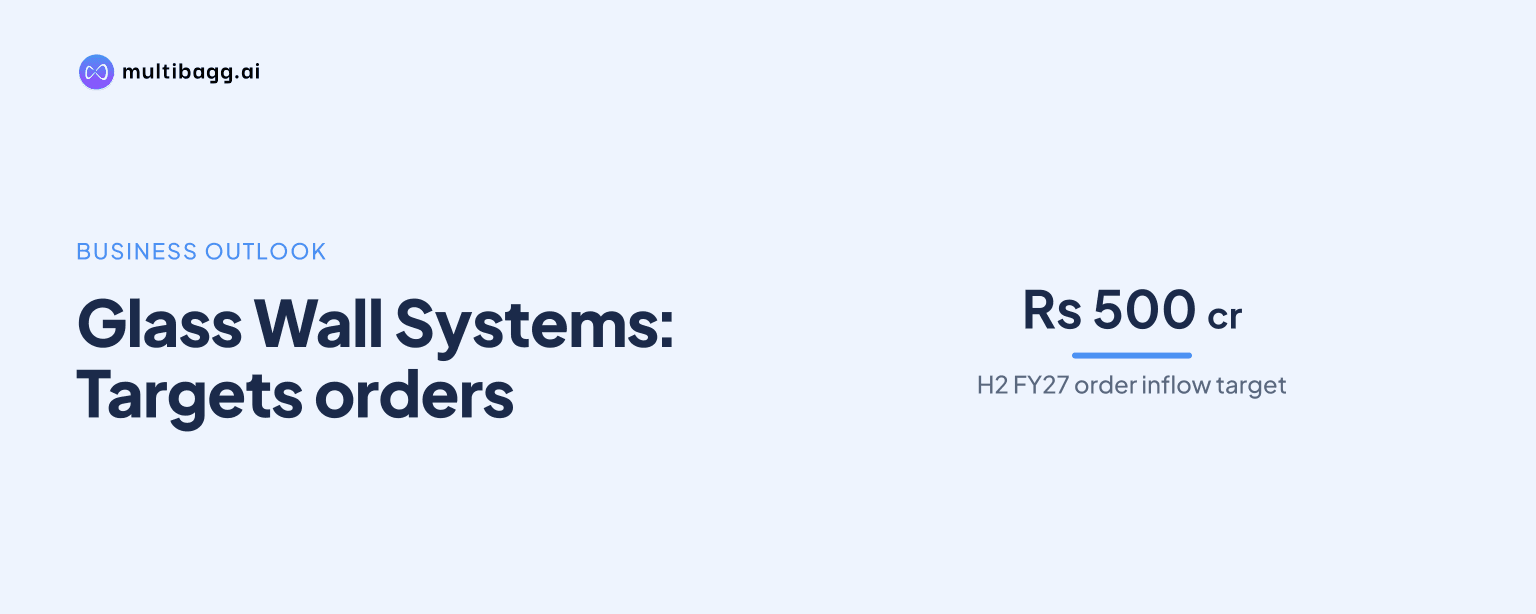
Glass Wall Systems is targeting Rs 500 crore of order inflow in Q3 and Q4 FY27 to maintain 18 to 24 months of execution visibility after reporting a Rs 957 crore order book on September 30, 2026. Management expects to execute more than Rs 350 crore during the second half and says it will prioritise workable timelines, client quality and margins over the largest possible backlog.
Know Glass Wall Systems (India) inside out
Results, valuation, peers and who's buying, in one view.
Why is Glass Wall Systems seeking Rs 500 crore of H2 orders?
Glass Wall Systems is seeking Rs 500 crore of bookings in Q3 and Q4 FY27 because management expects more than Rs 350 crore of its existing order book to be executed in those two quarters. The stated aim is to replenish work as it is delivered and retain about 18 months of order visibility at the end of FY27, rather than pursue orders simply to increase the reported backlog.
The order book has expanded across the periods management disclosed. It was Rs 383 crore in April 2025, Rs 846 crore in April 2026 and Rs 957 crore on September 30, 2026. Management said the FY27 closing order book could be above Rs 1,000 crore, although that is a projection rather than a reported figure.
The 18-to-24-month execution horizon is central to the strategy. Management said an order book is useful only when projects are executable within a reasonable timeframe, allowing for a few months of normal variation. Orders delayed by customer-side construction schedules may increase the nominal backlog without generating planned revenue or factory activity.
How will Glass Wall Systems select projects from its pipeline?
Glass Wall Systems will select orders based on the client, commercial terms, margin profile and execution period from a domestic bidding pipeline of more than Rs 3,000 crore. Management said it does not want to build an order book that cannot be executed, so each proposed project must be sufficiently ready to proceed as well as meet the company’s commercial criteria.
The pipeline includes projects of varied sizes and segments. Management cited a Rs 400 crore Mumbai bid, a Rs 225 crore bid in Raidurg, an Rs 85 crore-plus fenestration opportunity in Mumbai and a Rs 450 crore fenestration quote in Delhi. It also cited an Amravati job with a Rs 4,000 crore standalone bid, while noting that such a project would likely be divided among several contractors.
Management did not provide a domestic, international and fenestration split for the Rs 500 crore target. It said it expects bookings from all three segments, but conversion will depend on the deal available in each case. That means the target does not imply a predetermined revenue mix or a disclosed commitment to win any individual bid.
Glass Wall Systems also said its contracts are re-measurable item-rate agreements, not cost-plus contracts. Aluminium and glass have contractual base prices, and documented changes are claimed from customers when procurement prices move. Management said certification of those claims generally takes 45 to 60 days, which can shift the recognition of reimbursement between quarters.
Got a follow-up? Ask IRIS
What supports Glass Wall Systems' H2 FY27 execution?
Glass Wall Systems said existing export orders are funded, on the shop floor and being dispatched daily, supporting its expectation of higher Q3 and Q4 FY27 activity. Management distinguished these current orders from potential US work, where developers may postpone project starts despite having funding in place.
H1 FY27 revenue from operations was Rs 239 crore, up 16% year on year. Domestic revenue increased 33% to Rs 140 crore, while international revenue declined 14% to Rs 76 crore because of the timing of execution. Fenestration revenue rose 82% to Rs 22 crore, with management attributing the increase to luxury residential demand and describing the segment as a higher-margin business.
An analyst suggested that the H2 FY27 revenue run rate could imply more than 30% growth, and management called that estimate ballpark accurate. Separately, management retained its FY27 revenue-growth guidance of 20% to 22%, citing projects advancing at factories and customer sites. The difference reflects the project-based timing of revenue recognition rather than a revised full-year target.
H1 FY27 earnings before interest, tax, depreciation and amortisation, or EBITDA, were Rs 60 crore, up 22% year on year, and the reported EBITDA margin was 25.3%, up 138 basis points. Freight of Rs 14 crore was recorded as both income and expense for export customers; excluding that pass-through, management said the H1 EBITDA margin would have been 26.9%. It retained FY27 EBITDA-margin guidance of 23% to 25% and profit-after-tax-margin guidance of 18% to 20%.
What could affect order conversion and project delivery?
Glass Wall Systems said one or two domestic projects are behind schedule because of client-side factors, though management described the delays as immaterial. In a milestone-driven business, the timing of work at a customer’s site can affect execution even when the company is ready to supply or install facade products.
For prospective US work, management said developers have projects lined up but may wait for prices to normalise before commencing them. Management said pent-up demand could emerge after US midterm elections or if the war ends, but presented this as a view of possible market conditions rather than an order forecast. Existing US orders, in contrast, were described as funded and progressing as planned.
Management said an initial Israel order could be below Rs 50 crore, with potentially larger jobs over a 1.5-to-2-year period if the relationship develops. It also said it may be able to secure a couple of US jobs in the next quarter, without quantifying revenue or order value. Neither prospective market was identified as a defined component of the Rs 500 crore H2 target.
Glass Wall Systems is building a glass-processing unit with a project cost of about Rs 70 crore. Civil construction was at an advanced stage, orders for machinery had been placed and management expected full commissioning around July or August of the following year. Management estimated that greater control over glass supply could improve EBITDA margin by 1% to 1.5%, with an effect potentially visible in Q3 and Q4 of the following year.
Conclusion
Glass Wall Systems is using its Rs 500 crore H2 FY27 order target to preserve execution visibility while converting more than Rs 350 crore of current work. The approach combines a Rs 957 crore order book, a domestic bid pipeline above Rs 3,000 crore and management’s stated preference for projects with acceptable commercial terms and executable schedules rather than maximum order-book volume.
The next measures to watch are whether Glass Wall Systems closes FY27 with an order book above Rs 1,000 crore, whether H2 execution supports its 20% to 22% full-year revenue-growth guidance, and progress toward the glass-processing unit’s planned July or August commissioning. Management has not disclosed a segment split for the Rs 500 crore target, leaving domestic, international and fenestration conversion as the main unresolved variables.