










Glottis cash flow stays negative as receivables reach Rs 226.63 crore
Key highlights
- Glottis trade receivables rose to Rs 226.63 crore at September 30, 2026 from Rs 171.74 crore at March 31, 2026.
- Glottis used Rs 23.59 crore in operating cash during the half year ended September 30, 2026.
- Glottis reported Rs 15.16 crore of profit before tax, exceptional and extraordinary items in the first half.
- Glottis received Rs 28.40 crore in net long-term borrowing proceeds and closed Rs 51.36 crore of fixed deposits.
powered by IRIS
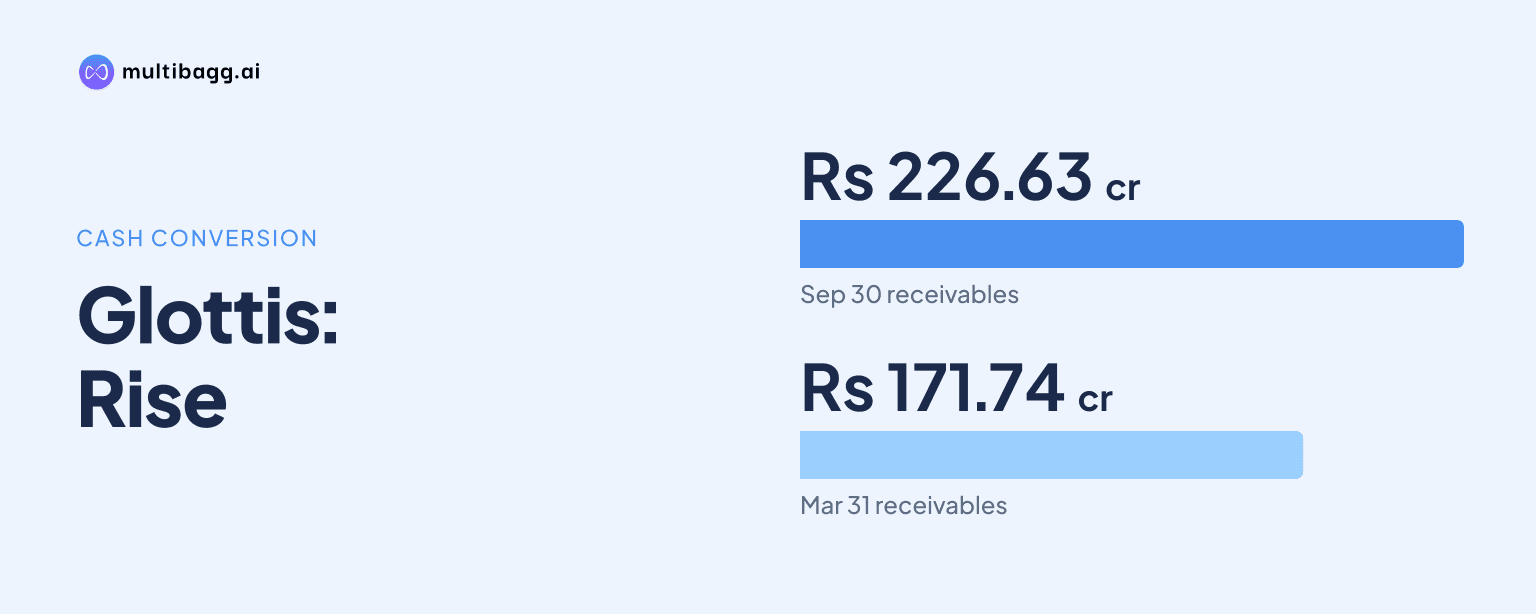
Glottis Limited reported trade receivables of Rs 226.63 crore at September 30, 2026 and used Rs 23.59 crore in operating cash during the first half, despite reporting Rs 15.16 crore of profit before tax, exceptional and extraordinary items. Receivables increased Rs 54.89 crore from March 31, 2026, absorbing cash generated from operations.
Know Glottis inside out
Results, valuation, peers and who's buying, in one view.
Why did Glottis operating cash flow remain negative?
Glottis’s operating cash flow remained negative because working-capital movements exceeded operating profit during the period ended September 30, 2026. Profit before tax, exceptional and extraordinary items was Rs 15.16 crore, while operating profit before working-capital changes was Rs 20.53 crore after adjustments including Rs 5.04 crore of depreciation and amortisation, Rs 2.86 crore of interest income and Rs 59.29 lakh of expected-credit-loss allowance.
The largest stated cash outflow was the Rs 54.58 crore increase in trade receivables. Other non-financial assets increased by Rs 33.90 crore and financial assets increased by Rs 22.78 crore. These uses were partly offset by a Rs 22.67 crore increase in trade payables, a Rs 52.53 crore increase in other liabilities and a Rs 17.47 crore increase in financial liabilities.
After Rs 4.15 crore of net income-tax payments, Glottis reported net cash used in operating activities of Rs 23.59 crore. Operating activities used Rs 25.26 crore in the corresponding period ended September 30, 2025, making the latest outflow Rs 1.67 crore lower year on year. The first-half result nevertheless did not translate the reported accounting profit into positive operating cash flow.
How much did Glottis trade receivables increase?
Glottis’s trade receivables rose to Rs 226.63 crore at September 30, 2026 from Rs 171.74 crore at March 31, 2026, an increase of Rs 54.89 crore over six months. The balance was also above Rs 164.72 crore at September 30, 2025. The cash-flow statement recorded a Rs 54.58 crore increase in trade receivables for the half year.
Receivables turnover declined to 2.57 times for the half year ended September 30, 2026 from 2.83 times in the corresponding half year of 2025. For the September 2026 quarter, the ratio was 1.30 times, compared with 1.53 times a year earlier and 1.27 times in the June 2026 quarter. Glottis defines the ratio as net credit sales divided by average trade receivables.
Trade receivables accounted for about 54% of Rs 419.48 crore in current assets at September 30, 2026. Cash and cash equivalents stood at Rs 49.74 crore, while bank balances other than cash equivalents were Rs 29.80 crore. Other current assets rose to Rs 94.92 crore from Rs 23.83 crore at March 31, 2026, showing that the rise in current assets extended beyond customer dues.
Got a follow-up? Ask IRIS
What funded Glottis’s higher cash balance?
Glottis increased cash and cash equivalents by Rs 40.23 crore during the half year to Rs 49.74 crore at September 30, 2026, from Rs 9.51 crore at March 31, 2026. Net financing inflows of Rs 25.83 crore and net investing inflows of Rs 58.00 crore more than offset the Rs 23.59 crore operating cash outflow.
Financing cash inflows included Rs 28.40 crore of net proceeds from long-term loans and borrowings and Rs 3.19 crore from short-term loans and borrowings. These were partly reduced by Rs 3.09 crore of lease-related payments and Rs 2.67 crore of interest paid. The cash-flow statement showed no proceeds from an issue of share capital in the half year, compared with Rs 148.40 crore for the year ended March 31, 2026.
The investing inflow principally reflected Rs 51.36 crore from closure of fixed deposits, alongside Rs 2.81 crore of interest received. Glottis spent Rs 6.41 crore on property, plant and equipment and intangible assets, and received Rs 23.54 lakh from asset sales. The company’s notes state that unutilised initial public offering proceeds were held in temporary fixed deposits pending utilisation.
How did Glottis borrowing and liabilities change?
Glottis’s long-term borrowings increased to Rs 30.30 crore at September 30, 2026 from Rs 1.99 crore at March 31, 2026. The balance-sheet movement corresponds with the Rs 28.40 crore of net long-term borrowing proceeds in the first-half cash-flow statement. Glottis also stated that it made no default on debt securities, borrowings or subordinated liabilities during the quarter and half year.
Total non-current liabilities rose to Rs 44.52 crore at September 30, 2026 from Rs 4.95 crore at March 31, 2026. Lease liabilities represented Rs 13.52 crore of the September total, compared with Rs 2.86 crore in March. The notes attribute higher amortisation partly to new warehouse lease agreements entered during the quarter, while the cash-flow statement records Rs 3.09 crore of net lease repayments in the half year.
Trade payables due to micro and small enterprises fell to Rs 1.76 crore from Rs 2.41 crore at March 31, 2026, even as aggregate trade payables increased by Rs 22.67 crore in the cash-flow statement. Other current liabilities rose to Rs 6.63 crore from Rs 3.76 crore, while other financial liabilities declined to Rs 1.76 crore from Rs 2.26 crore. Working-capital funding therefore moved across multiple liability categories.
Conclusion
Glottis generated Rs 20.53 crore of operating profit before working-capital changes in the half year ended September 30, 2026, but the Rs 54.58 crore receivables increase and rises in other assets produced Rs 23.59 crore of operating cash use. Cash rose to Rs 49.74 crore because investing and financing inflows, including fixed-deposit closures and long-term borrowing proceeds, outweighed the operating outflow.
The disclosed item to watch next is the use of initial public offering proceeds. Glottis said Rs 59.90 crore remained unutilised at September 30, 2026 and was held in temporary fixed deposits pending utilisation. The company also said there was no deviation from the objects of the issue, which include capital expenditure and general corporate purpose.