










Glottis September profit falls 98% as freight margins shrink
Key highlights
- Glottis reported Rs 24.78 lakh profit after tax for the quarter ended 30 September 2026, compared with Rs 12.36 crore a year earlier.
- Glottis revenue from operations rose 28.7% year on year to Rs 276.48 crore in the September 2026 quarter.
- Glottis reported a 1.31% operating margin ratio for the September 2026 quarter, down from 8.42% a year earlier.
- Glottis had utilised Rs 90.10 crore of IPO proceeds and held Rs 69.90 crore in temporary fixed deposits at 30 September 2026.
powered by IRIS
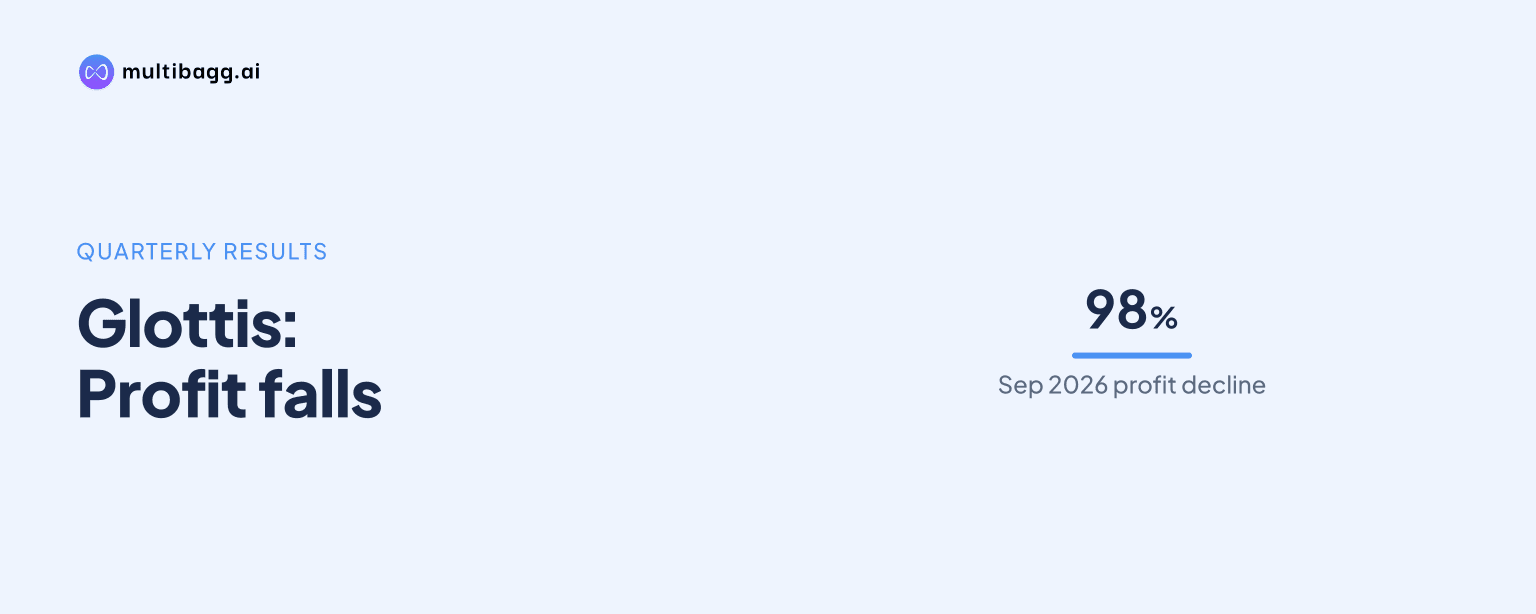
Glottis Limited reported profit after tax of Rs 24.78 lakh for the quarter ended 30 September 2026, down 98.0% from Rs 12.36 crore a year earlier, even as revenue from operations increased 28.7% to Rs 276.48 crore. Glottis attributed the earnings decline to freight and bunker-charge volatility, fixed customer pricing and lower volumes in selected cargo categories.
Know Glottis inside out
Results, valuation, peers and who's buying, in one view.
Why did Glottis profit fall in the September 2026 quarter?
Glottis’s profit after tax fell to Rs 24.78 lakh in the quarter ended 30 September 2026 from Rs 12.36 crore in the corresponding quarter ended 30 September 2025. Profit before tax declined to Rs 57.46 lakh from Rs 17.08 crore, while tax expense was Rs 32.72 lakh. The net profit ratio consequently fell to 0.09% from 5.76% a year earlier.
The earnings movement came despite higher sales. Revenue from operations rose to Rs 276.48 crore from Rs 214.71 crore, an increase of Rs 61.77 crore, while total income increased to Rs 278.34 crore from Rs 215.09 crore. Other income was Rs 1.86 crore, compared with Rs 37.69 lakh a year earlier, and Glottis said the increase principally reflected interest from temporary fixed deposits created from initial public offering, or IPO, proceeds awaiting use.
What caused Glottis’s margin pressure?
Glottis said global logistics-sector conditions led to volatility in bunker charges and freight rates during the September 2026 quarter. It said these movements could not be fully incorporated into customer pricing because contractual rates had been agreed in advance, creating pressure on shipment-level margins.
Lower project-cargo, bulk-shipment and sea-import-shipment volumes also reduced gross-profit contribution, according to Glottis. The filing identifies these categories rather than giving their individual volumes, but the company linked their weaker activity to challenging global logistics conditions and its lower overall profitability.
Cost of services rendered increased to Rs 259.57 crore in the September quarter from Rs 185.49 crore a year earlier, rising faster than revenue. Employee-benefit expense was Rs 7.99 crore, finance costs were Rs 2.12 crore and other expenses were Rs 5.34 crore. These costs contributed to the operating margin ratio falling to 1.31% from 8.42% in the comparable quarter.
How did Glottis perform in the first half?
Glottis reported profit after tax of Rs 10.84 crore for the half year ended 30 September 2026, compared with Rs 24.21 crore in the corresponding prior-year half. Revenue from operations nevertheless grew to Rs 510.09 crore from Rs 382.87 crore, indicating that the September-quarter decline materially affected the six-month earnings outcome.
Profit before tax for the half year was Rs 15.16 crore, down from Rs 33.19 crore, while total tax expense fell to Rs 4.22 crore from Rs 8.89 crore. The half-year net profit ratio was 2.18%, against 6.35% a year earlier, and the operating margin ratio was 3.50%, compared with 5.15%.
Depreciation and amortisation expense increased to Rs 5.04 crore in the half year from Rs 1.15 crore a year earlier. Glottis attributed this to deployment of fixed assets funded through IPO proceeds and new warehouse lease agreements, which increased amortisation of right-of-use assets. The company reports a single operating segment, freight forwarding, under Indian Accounting Standard 108.
Got a follow-up? Ask IRIS
What does Glottis’s balance sheet show after the IPO?
Glottis had total assets of Rs 510.84 crore at 30 September 2026, up from Rs 367.08 crore at 31 March 2026, while total equity increased to Rs 291.66 crore from Rs 280.07 crore. Trade receivables rose to Rs 226.63 crore from Rs 171.74 crore, and cash and cash equivalents increased to Rs 49.74 crore from Rs 9.51 crore.
The IPO’s net proceeds were Rs 160.00 crore, with Rs 90.10 crore utilised by 30 September 2026. Glottis said Rs 69.90 crore was held in temporary fixed deposits pending utilisation, with Rs 2.33 lakh in the monitoring bank account. It also said there had been no deviation from the objects of the issue.
The disclosed IPO objects included Rs 132.54 crore for capital expenditure, Rs 145.33 crore for general corporate purposes and Rs 12.77 crore for issue expenses. Property, plant and equipment stood at Rs 35.01 crore at 30 September 2026, compared with Rs 20.79 crore at 31 March 2026, while right-of-use assets increased to Rs 18.88 crore from Rs 2.93 crore.
Which liquidity and debt indicators changed for Glottis?
Glottis’s current ratio was 2.40 times at 30 September 2026, compared with 3.00 times a year earlier and 3.18 times at 30 June 2026. Its debt-equity ratio was 0.28 times, versus 0.24 times at 30 September 2025, while total debt to total assets was 0.16 times compared with 0.14 times.
Debt-service coverage was 2.69 times in the September 2026 quarter, down from 30.37 times a year earlier and 10.04 times in the preceding quarter. Interest-service coverage was 3.29 times, compared with 17.52 times in the year-earlier quarter. Glottis stated that it had no default in repayment of debt securities, borrowings or subordinated liabilities during the quarter and half year.
Net cash used in operating activities was Rs 23.59 crore for the half year ended 30 September 2026, compared with Rs 25.26 crore used in the corresponding prior-year half. The cash-flow statement recorded a Rs 54.58 crore increase in trade receivables during the current half year, while the receivables-turnover ratio was 1.30 times in the September quarter versus 1.53 times a year earlier.
Conclusion
Glottis’s September-quarter result shows that a Rs 61.77 crore year-on-year increase in operating revenue did not translate into higher earnings. Freight and bunker-cost movements that were not fully recoverable under pre-agreed customer rates, together with lower project, bulk and sea-import cargo volumes, reduced margins and left profit after tax at Rs 24.78 lakh.
The next disclosures will show how Glottis deploys the Rs 69.90 crore of IPO proceeds held in temporary fixed deposits, including against its Rs 132.54 crore capital-expenditure objective. The filing also leaves freight-rate movements, activity in the three cited cargo categories, trade receivables of Rs 226.63 crore and the 1.31% operating margin as key reported measures to watch.