










Glottis sea exports jump 344%, shifting quarterly revenue mix
Key highlights
- Glottis sea-export revenue rose 344% year on year to about Rs 116 crore in Q2 FY27.
- Sea exports accounted for 42% of Q2 FY27 revenue, up from 12% in Q2 FY26.
- Sea-import revenue fell 20.8% year on year, but remained the largest vertical at Rs 137.1 crore.
- Q2 FY27 EBITDA was Rs 3.4 crore, producing a 1.2% margin.
powered by IRIS
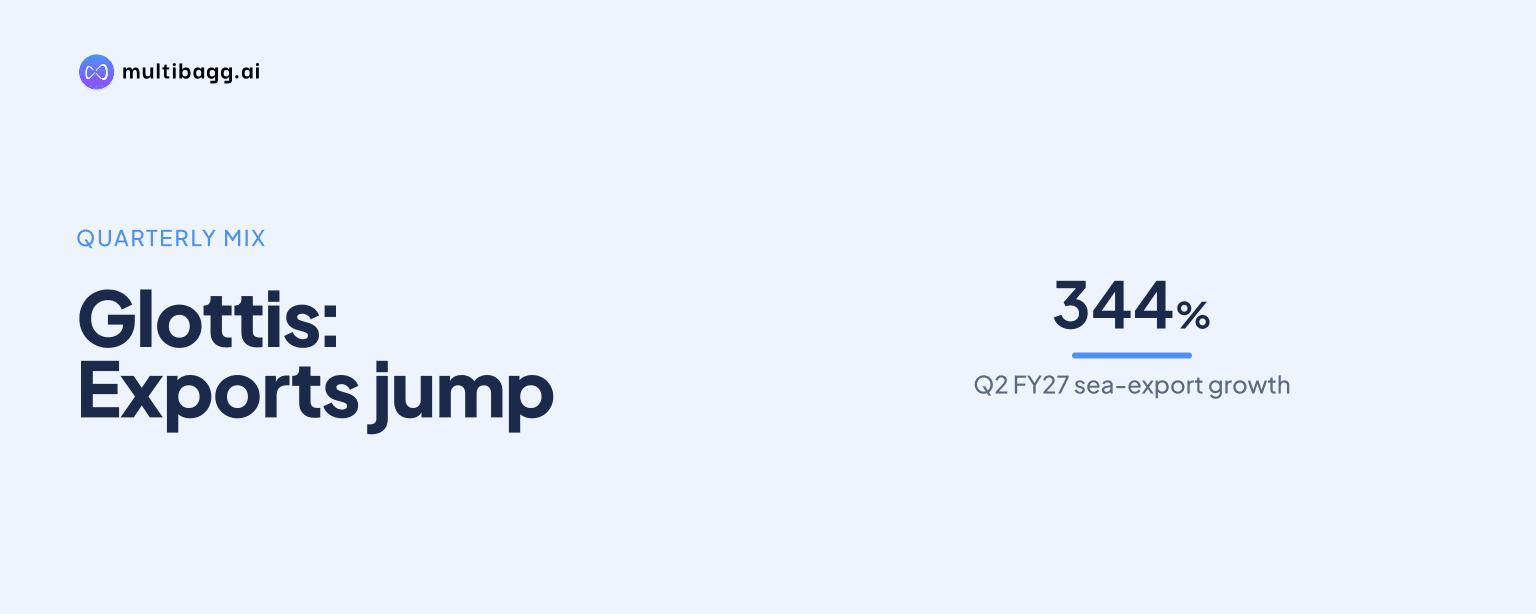
Glottis Limited shifted its Q2 FY27 revenue mix towards exports as sea-export revenue rose 344% year on year to about Rs 116 crore, lifting its share to 42% from 12% in Q2 FY26. Revenue from operations increased 28.8% to Rs 276.5 crore, while sea imports remained the largest vertical at 50% of quarterly revenue.
Know Glottis inside out
Results, valuation, peers and who's buying, in one view.
How did Glottis change its revenue mix in Q2 FY27?
Glottis changed its Q2 FY27 mix through sea-export growth, which brought the segment to about Rs 116 crore and 42% of revenue, versus a 12% share in Q2 FY26. Sea imports accounted for 50%, narrowing the gap with exports after imports represented 81% of revenue a year earlier.
Sea imports remained the largest business at about Rs 137.1 crore, but segment revenue declined 20.8% year on year in Q2 FY27. Management described the change as an expansion of exports alongside its established import operations.
The first-half figures show that sea imports still had a larger role over six months. Sea-import revenue was about Rs 301.9 crore, or 59% of H1 FY27 revenue, while sea exports generated about Rs 162.6 crore, or 32%, after increasing 215% year on year.
Did Glottis grow revenue despite lower sea-import sales?
Glottis grew Q2 FY27 revenue from operations 28.8% year on year to Rs 276.5 crore despite the 20.8% decline in sea-import revenue. Revenue also rose 17.9% quarter on quarter, while total income, including Rs 1.9 crore of other income, reached Rs 278.3 crore against Rs 215.1 crore in Q2 FY26.
For H1 FY27, revenue from operations increased 33.5% to Rs 511 crore from Rs 382.9 crore in H1 FY26, and total income rose to Rs 515 crore from Rs 383.3 crore. Management attributed the first-half revenue growth to higher sea-export contribution and increased participation across industries and geographies.
Container volumes declined even as revenue increased. Twenty-foot equivalent units, or TEUs, handled were 21,375 in Q2 FY27, below 21,972 in Q2 FY26 and 21,841 in Q1 FY27; H1 FY27 TEUs were 43,216, compared with 47,032 a year earlier.
Which industries gained and lost revenue share at Glottis?
Glottis reduced renewable energy's share to around 16% of Q2 FY27 revenue from 46% in Q2 FY26, while logistics rose to 20% from 4% and home appliances increased to 18% from 11%. The changes reduced the proportion of revenue coming from renewable energy while raising the contribution from two other end-user industries.
Chemicals represented around 7% of Q2 FY27 revenue, engineering products about 10%, and automobiles around 5%. Management reported year-on-year revenue growth of 532% in chemicals and 110% in automobiles.
The H1 FY27 mix retained a greater renewable-energy weighting than Q2 alone. Renewable energy accounted for 26% of first-half revenue, against 45% in H1 FY26, while logistics represented 15% and home appliances 14%.
Customer concentration also fell during the quarter. The top five customers accounted for around 33% of Q2 FY27 revenue, down from 41% in Q2 FY26, and management said it was seeking additional business from existing accounts across sea freight, air freight and transportation.
Got a follow-up? Ask IRIS
What happened to Glottis profitability during the mix shift?
Glottis reported earnings before interest, tax, depreciation and amortisation, or EBITDA, of Rs 3.4 crore in Q2 FY27, equal to a 1.2% margin. Management attributed the pressure to the business mix, freight realisations and operating costs, while the chief financial officer also cited fluctuating prices and a higher cost base.
H1 FY27 EBITDA was Rs 19.6 crore, with a 3.8% margin, compared with the 1.2% margin in Q2 alone. This indicates that quarterly profitability moderated while Q2 revenue increased 17.9% from Q1 FY27.
Trade receivable days were around 70 days at the November 12, 2026 call. Management said it was taking measures to reduce receivables and expected them to come down from Q3 FY27, with working-capital requirements returning to normal in Q3 or Q4.
What operating plans could support Glottis' new mix?
Glottis had deployed 85 vehicles by the November 12, 2026 earnings call and installed global positioning system, or GPS, trackers on each vehicle. Management said it had acquired transportation software intended to track vehicle movements and integrate with artificial intelligence for automated real-time updates to customers and internal teams.
Container deployment was expected to begin in Q3 FY27 after trailer additions in Q1 FY27. Management said production was complete but deployment had been delayed by raw-material and geopolitical issues; it intends to complete its planned capital expenditure programme during 2027 using initial public offering proceeds.
Warehousing was another expansion plan, with Glottis signing a long-term arrangement for 200,000 square feet and seeking to scale in southern and western India. The company also incorporated wholly owned Glottis Logistics SDN. BHD. in Malaysia, where management said formalities could conclude in Q3 or Q4 before revenue begins.
Conclusion
Glottis' Q2 FY27 figures show that exports became a near-equal revenue contributor to sea imports within a year, while logistics and home appliances gained share as renewable energy receded. Revenue grew despite lower TEUs and declining sea-import sales, but the 1.2% quarterly EBITDA margin shows the new mix was accompanied by profitability pressure.
The next disclosures to watch are Q3 FY27 container deployment, management's plan to reduce receivables from Q3 and the stated goal of normalising working-capital requirements in Q3 or Q4. Management also expects Malaysia formalities to finish in Q3 or Q4 and plans to complete its capital expenditure programme during 2027.