










GNFC chemicals H1 result more than doubles to Rs 602 crore
Key highlights
- GNFC chemicals segment result increased to Rs 602 crore in H1 FY 26-27 from Rs 294 crore in H1 FY 25-26.
- GNFC chemicals revenue reached Rs 3,200 crore in H1 FY 26-27, up from Rs 2,167 crore a year earlier.
- GNFC chemicals Q2 FY 26-27 result was Rs 177 crore, down from Rs 425 crore in Q1 FY 26-27.
- GNFC reported a Rs 21,000-per-metric-tonne methanol-to-acetic-acid spread in Q2 FY 26-27, versus Rs 12,000 in Q1.
powered by IRIS
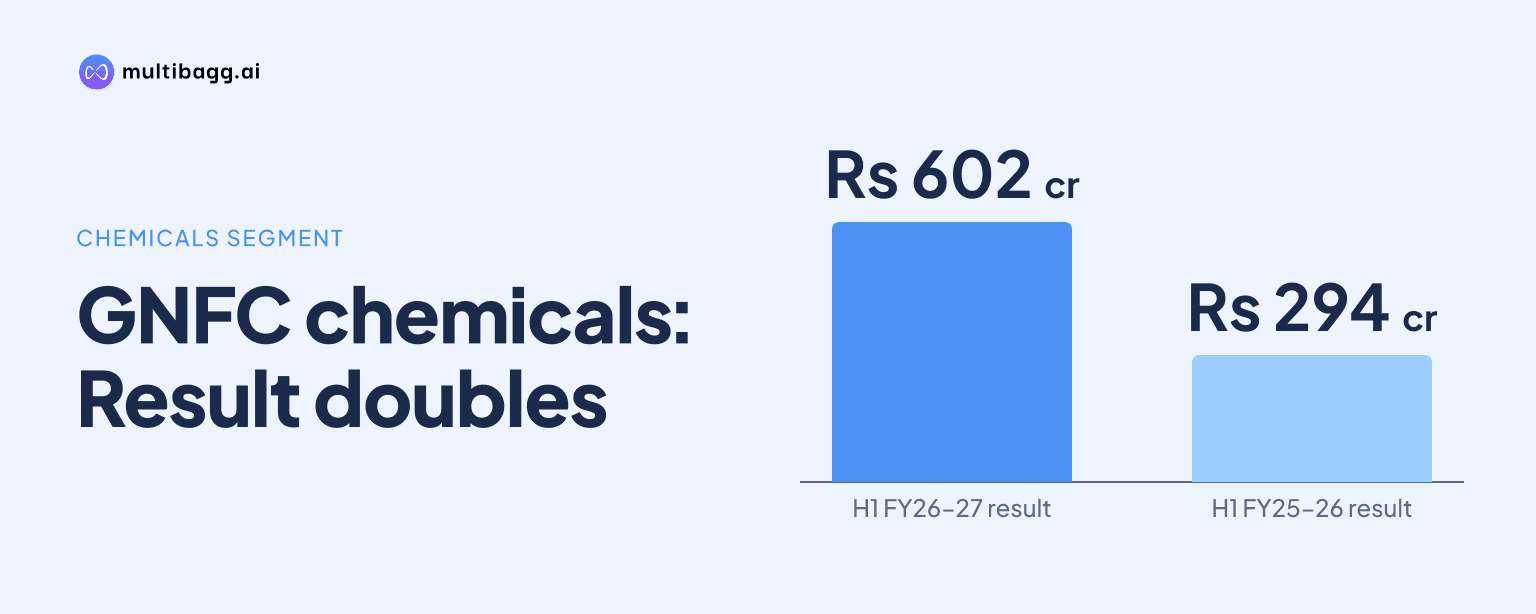
GNFC’s chemicals segment result rose to Rs 602 crore in the first half, or H1, of FY 26-27 from Rs 294 crore a year earlier, more than doubling on higher realisations and volume. The H1 increase came despite a sequential Q2 decline to Rs 177 crore from Rs 425 crore, as lower realisations and higher fixed costs outweighed higher volume.
Know Gujarat Narmada Valley Fertilizers & Chemicals inside out
Results, valuation, peers and who's buying, in one view.
How did GNFC chemicals perform in H1 FY 26-27?
GNFC’s chemicals segment delivered a Rs 602 crore result in H1 FY 26-27, up Rs 308 crore from Rs 294 crore in H1 FY 25-26. Segment revenue increased to Rs 3,200 crore from Rs 2,167 crore, a rise of Rs 1,033 crore. Management attributed the H1 improvement to higher realisation and volume, partly offset by higher input costs and fixed costs.
Chemicals accounted for Rs 3,200 crore of GNFC’s Rs 5,011 crore aggregate segment revenue in H1 FY 26-27, compared with Rs 2,167 crore out of Rs 3,569 crore a year earlier. Fertilizers generated Rs 1,766 crore of H1 revenue but recorded a Rs 123 crore segment loss, while others generated Rs 45 crore of revenue and a Rs 21 crore result. The comparison shows that chemicals supplied the largest segment result in the latest half year.
GNFC said company-level revenue and profit before tax, or PBT, for H1 FY 26-27 and H1 FY 25-26 are not comparable because Bharuch plants underwent an annual turnaround during H1 FY 25-26. The presentation nevertheless reports chemicals revenue of Rs 3,200 crore and result of Rs 602 crore for the latest half. GNFC’s operating revenue was Rs 5,011 crore and PBT was Rs 657 crore in H1 FY 26-27.
Why did GNFC chemicals result decline in Q2 FY 26-27?
GNFC’s chemicals segment result fell to Rs 177 crore in Q2 FY 26-27 from Rs 425 crore in Q1 FY 26-27, a sequential reduction of Rs 248 crore. Management said lower realisations and higher fixed costs caused the decline, while higher volume partly offset those pressures. Chemicals revenue still rose by Rs 62 crore quarter on quarter to Rs 1,631 crore from Rs 1,569 crore.
The Q2 result was higher than the prior-year quarter despite the sequential fall. Chemicals revenue increased to Rs 1,631 crore from Rs 1,162 crore in Q2 FY 25-26, and segment result increased to Rs 177 crore from Rs 158 crore. Management attributed the year-on-year improvement to higher realisation and volume, partly offset by higher input costs and fixed costs.
At company level, total revenue was Rs 2,901 crore in Q2 FY 26-27, compared with Rs 2,339 crore in Q1, while PBT declined from Rs 416 crore to Rs 241 crore. GNFC said Q2 total income increased on higher volume across most products and dividend income, partly offset by lower realisations. The company also reported liquidation of substantial inventory built up at the beginning of the quarter.
Got a follow-up? Ask IRIS
What do GNFC’s feedstock spreads show for chemicals?
GNFC’s reported methanol-to-acetic-acid spread widened to Rs 21,000 per metric tonne in Q2 FY 26-27 from Rs 12,000 per metric tonne in Q1. Acetic acid rose to Rs 73,000 per metric tonne from Rs 63,000, while methanol increased to Rs 52,000 from Rs 51,000. The Q2 spread also exceeded Rs 7,000 per metric tonne in Q2 FY 25-26.
GNFC’s benzene-to-aniline spread was Rs 72,000 per metric tonne in both Q1 and Q2 FY 26-27. Benzene declined to Rs 90,000 per metric tonne from Rs 97,000, while aniline declined to Rs 162,000 from Rs 169,000. This unchanged spread contrasted with the Rs 9,000-per-metric-tonne sequential increase in the methanol-to-acetic-acid spread.
GNFC’s toluene and TDI price chart showed its lower value at Rs 113,000 per metric tonne in Q2 FY 26-27, compared with Rs 88,000 in Q1. The boxed value declined to Rs 156,000 from Rs 167,000, while the upper value rose to Rs 268,000 from Rs 255,000. The presentation does not assign a product-specific financial effect to these price movements, although management cited lower realisations for the Q2 chemicals decline.
How are energy costs and projects relevant to GNFC’s next results?
GNFC reported that imported coal rose 28% quarter on quarter to Rs 15,000 per metric tonne in Q2 FY 26-27 from Rs 12,000 in Q1. Oil declined 7% to Rs 68,000 per metric tonne, while non-urea gas was Rs 72,000 per 1,000 standard cubic metres, compared with Rs 73,000 in Q1; the presentation labels the gas movement as 0%. Management said high energy prices and their effect on downstream products had increased operating costs.
GNFC said its captive coal-based power plant at Dahej has started, reducing operating cost, with remaining parallel activities nearing closure. Net fixed assets stood at Rs 3,314 crore on September 30, 2026, up from Rs 2,881 crore on March 31, 2026, while capital work in progress was Rs 781 crore. The company said this work mainly included the Weak Nitric Acid III plant, Ammonium Nitrate II plant and urea-reactor replacement.
GNFC lists four Bharuch projects under execution: a 50-kilotonne-per-annum ammonia expansion, 200 kilotonnes per annum of Weak Nitric Acid III, 163 kilotonnes per annum of Ammonium Nitrate II, and a 180-to-200-metric-tonnes-per-hour circulating fluidised bed combustion steam boiler. Management expects the Weak Nitric Acid and Ammonium Nitrate projects to strengthen market share and increase revenue and results. It expects the ammonia project and boiler to improve operating reliability and reduce energy costs.
Conclusion
GNFC’s H1 FY 26-27 chemicals result of Rs 602 crore, versus Rs 294 crore a year earlier, was accompanied by Rs 3,200 crore of segment revenue and contrasted with a Rs 123 crore fertilizer loss. The sequential Q2 decline to Rs 177 crore shows that higher chemicals volume did not offset lower realisations and higher fixed costs during the quarter.
The next results will indicate whether chemicals realisations stabilise after Q2 and how energy costs develop after imported coal reached Rs 15,000 per metric tonne. Management’s disclosed execution plan includes 200 kilotonnes per annum of Weak Nitric Acid III and 163 kilotonnes per annum of Ammonium Nitrate II at Bharuch, while a 150-kilotonne-per-annum BisPhenol-A project at Dahej remains under consideration.