










GNFC Q2 revenue rose 24% while PAT fell 40% sequentially
Key highlights
- GNFC reported Q2 FY 26-27 total revenue of Rs 2,901 crore, up 24% from Rs 2,339 crore in Q1.
- GNFC’s Q2 FY 26-27 PAT fell 40% to Rs 185 crore from Rs 310 crore in Q1.
- GNFC’s fertilizer revenue rose to Rs 1,117 crore in Q2 from Rs 649 crore in Q1.
- GNFC’s chemicals segment result declined to Rs 177 crore in Q2 from Rs 425 crore in Q1.
powered by IRIS
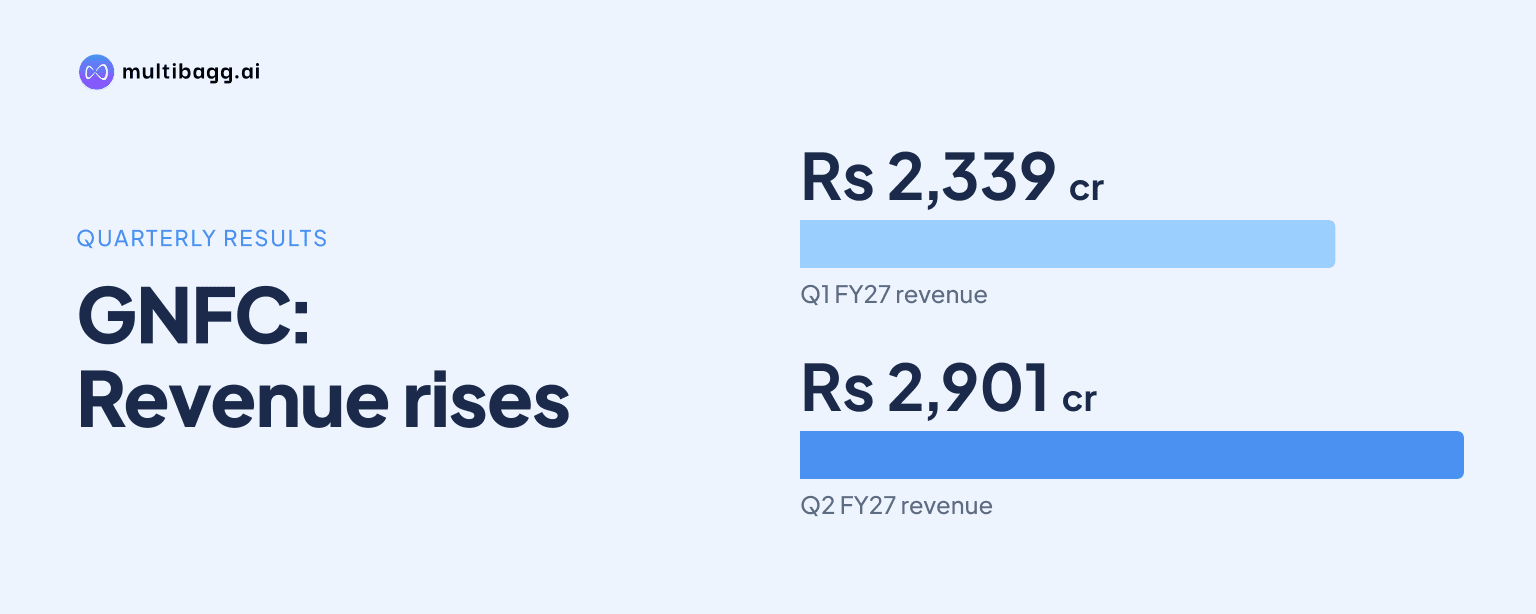
Gujarat Narmada Valley Fertilizers & Chemicals Ltd reported total revenue of Rs 2,901 crore in Q2 FY 26-27, up 24% from Rs 2,339 crore in Q1, but profit after tax fell 40% to Rs 185 crore as lower realisations and higher fixed costs outweighed higher volumes.
Know Gujarat Narmada Valley Fertilizers & Chemicals inside out
Results, valuation, peers and who's buying, in one view.
Why did GNFC’s Q2 profit fall despite higher revenue?
GNFC’s Q2 profit fell because lower product realisations and higher fixed costs more than offset higher volumes, according to management. Total revenue increased by Rs 562 crore from Q1 FY 26-27 to Rs 2,901 crore, while profit before tax, or PBT, declined by Rs 175 crore to Rs 241 crore.
Operating revenue increased by Rs 535 crore to Rs 2,773 crore in Q2 FY 26-27 from Rs 2,238 crore in Q1. Management said higher volume across a majority of products and dividend income lifted total income, partly offset by lower realisations. PAT declined by Rs 125 crore from Rs 310 crore in Q1 to Rs 185 crore in Q2.
The difference between the Rs 562 crore rise in total revenue and the Rs 175 crore decline in PBT indicates that the additional revenue did not translate into higher pre-tax earnings in the quarter. Management attributed the result to lower realisations and higher fixed costs, partly offset by higher volume.
Which GNFC segment drove the Q2 revenue increase?
GNFC’s fertilizer segment supplied most of the sequential revenue increase, with revenue rising by Rs 468 crore to Rs 1,117 crore in Q2 FY 26-27 from Rs 649 crore in Q1. Chemicals revenue increased by Rs 62 crore to Rs 1,631 crore, while the other segment increased by Rs 5 crore to Rs 25 crore.
The chemicals segment recorded the largest decline in segment result. Its result fell by Rs 248 crore to Rs 177 crore in Q2 from Rs 425 crore in Q1, which management attributed to lower realisations and higher fixed costs, partly offset by higher volume. The fertilizer segment loss narrowed to Rs 38 crore from Rs 85 crore, and the other segment result increased to Rs 12 crore from Rs 9 crore.
Management said the fertilizer loss narrowed because of lower input cost in complex fertilizer and higher Neem Urea energy norms, partly offset by lower complex-fertilizer volume and higher fixed costs. The Neem Urea norm was revised to 6.37 gigacalories per metric tonne from 6.20 gigacalories per metric tonne, effective April 1, 2025; the presentation does not quantify its Q2 earnings effect.
Got a follow-up? Ask IRIS
How did GNFC’s Q2 results compare with last year?
GNFC’s Q2 FY 26-27 total revenue was Rs 806 crore higher than the Rs 2,095 crore reported in Q2 FY 25-26, while PAT increased by Rs 8 crore to Rs 185 crore. PBT rose by Rs 11 crore to Rs 241 crore from Rs 230 crore, showing that the year-on-year earnings increase was much smaller than the revenue increase.
Management said the year-on-year total-income increase reflected higher realisations across a majority of products and higher volume in some products. It attributed the marginal PBT improvement to those factors, partly offset by higher input costs and fixed costs. This contrasts with the sequential comparison, where lower realisations were a stated contributor to the decline in Q2 profit.
Fertilizer revenue increased by Rs 336 crore year on year to Rs 1,117 crore, but its segment loss widened by Rs 3 crore to Rs 38 crore. Chemicals revenue increased by Rs 469 crore to Rs 1,631 crore, while its segment result improved by Rs 19 crore to Rs 177 crore from Rs 158 crore. Management linked the chemicals improvement with higher realisations and volume, partly offset by input and fixed costs.
What do GNFC’s half-year figures and operating issues show?
GNFC reported H1 FY 26-27 total revenue of Rs 5,240 crore and PAT of Rs 495 crore, compared with Rs 3,846 crore and Rs 255 crore in H1 FY 25-26. PBT was Rs 657 crore against Rs 335 crore. Management said the half-year revenue and PBT comparison is not comparable because Bharuch plants underwent an annual maintenance shutdown in H1 FY 25-26.
Chemicals generated H1 FY 26-27 revenue of Rs 3,200 crore and a segment result of Rs 602 crore, compared with Rs 2,167 crore and Rs 294 crore a year earlier. Fertilizer revenue rose to Rs 1,766 crore from Rs 1,358 crore, while its loss narrowed to Rs 123 crore from Rs 135 crore. Management attributed the chemicals improvement to higher realisations and volume, partly offset by input and fixed costs.
GNFC said it liquidated substantial inventory built up at the start of Q2 FY 26-27. It also said subsidy receipts were regular, although high feed and fuel prices increased working-capital intensity. Cash and bank balances and deposits stood at Rs 1,805 crore on September 30, 2026, up from Rs 1,111 crore on March 31, 2026, while borrowings were Rs 109 crore compared with nil at the March year-end.
The Dahej captive coal-based power plant has started operations and reduced operating cost, according to management, while remaining project activities are nearing closure. Management said a revision in fixed cost for Neem Coated Urea is being pursued with the government at industry level, with the task assigned to NITI Aayog. It also said nutrient-based subsidy rates for complex fertilizer effective from the Rabi season were awaited.
Conclusion
GNFC’s Q2 FY 26-27 figures show that a Rs 562 crore sequential increase in total revenue did not prevent PAT from falling by Rs 125 crore. Fertilizer revenue provided most of the operating-revenue increase, but the chemicals segment result declined by Rs 248 crore as management cited lower realisations and higher fixed costs.
The next disclosed factors to watch are the announcement of nutrient-based subsidy rates for the Rabi season, progress on the Neem Coated Urea fixed-cost revision, and closure of the remaining Dahej power-project activities. High feed and fuel prices and their effect on working-capital intensity also remain unresolved matters identified by management.