










GNFC's H1 operating cash flow drops to Rs 141 crore on outflow
Key highlights
- GNFC generated Rs 675 crore of operating cash flow before working-capital changes in H1 FY 26-27, versus Rs 322 crore a year earlier.
- GNFC recorded a Rs 387 crore working-capital outflow in H1 FY 26-27, compared with a Rs 98 crore inflow in H1 FY 25-26.
- GNFC's net cash from operating activities declined to Rs 141 crore in H1 FY 26-27 from Rs 314 crore a year earlier.
- GNFC's chemicals segment result increased to Rs 602 crore in H1 FY 26-27 from Rs 294 crore in H1 FY 25-26.
powered by IRIS
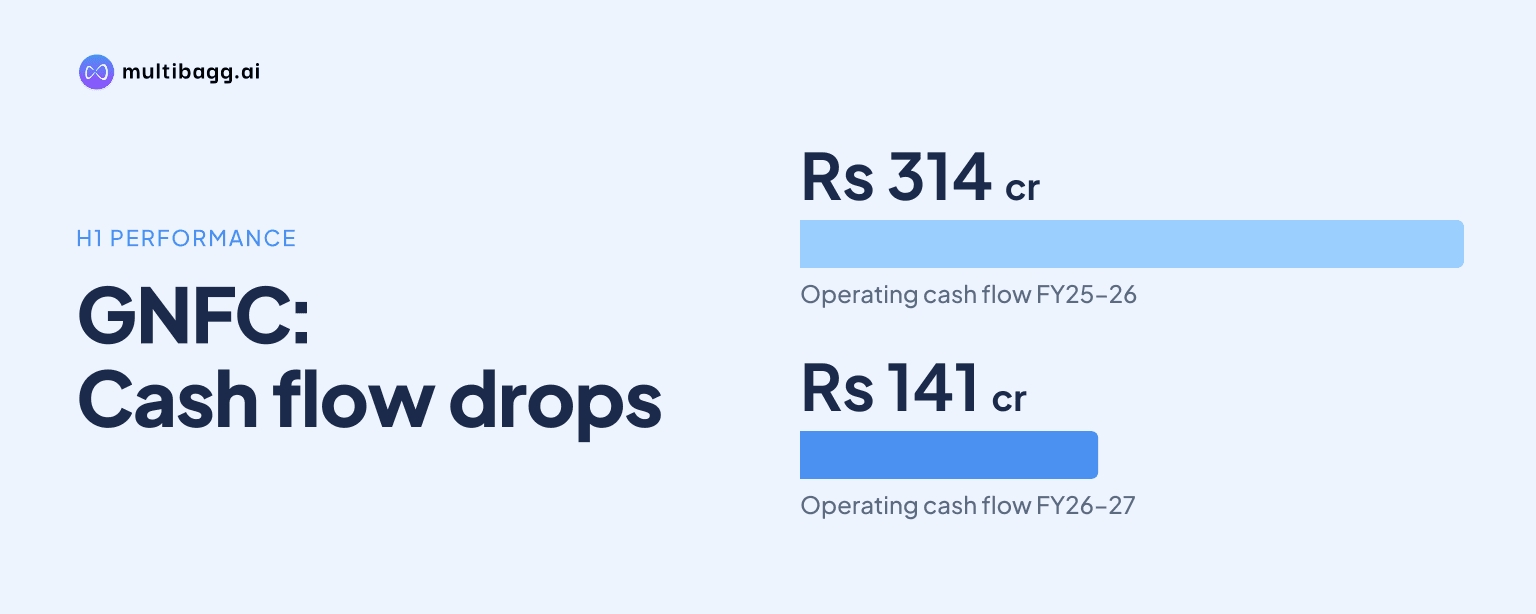
GNFC reported Rs 141 crore of net cash from operating activities in H1 FY 26-27, down from Rs 314 crore a year earlier, because a Rs 387 crore working-capital outflow and Rs 147 crore of taxes paid absorbed much of its Rs 675 crore pre-working-capital operating cash flow.
Know Gujarat Narmada Valley Fertilizers & Chemicals inside out
Results, valuation, peers and who's buying, in one view.
Why did GNFC's operating cash flow decline in H1 FY 26-27?
GNFC's net cash from operating activities declined because the Rs 387 crore working-capital outflow and Rs 147 crore of taxes paid exceeded the conversion of its Rs 675 crore operating cash flow before working-capital changes. In H1 FY 25-26, the corresponding pre-working-capital cash flow was Rs 322 crore, taxes paid were Rs 106 crore, and working capital contributed Rs 98 crore, producing Rs 314 crore of operating cash.
The main change was the working-capital line, which swung by Rs 485 crore from a Rs 98 crore inflow in H1 FY 25-26 to a Rs 387 crore outflow in H1 FY 26-27. Operating cash flow before working-capital changes increased by Rs 353 crore over the same comparison, but that improvement did not flow through to reported operating cash.
Management said subsidy-receipt cash flow remained regular, but high feed and fuel prices amid the geopolitical situation and war increased working-capital intensity. The presentation does not divide the Rs 387 crore movement among inventory, trade receivables, trade payables or other working-capital items.
How did GNFC's cash-flow bridge change from the prior year?
GNFC moved from a Rs 78 crore increase in cash and cash equivalents in H1 FY 25-26 to a Rs 172 crore decrease in H1 FY 26-27. Alongside the lower Rs 141 crore operating cash inflow, the company recorded Rs 310 crore used in financing activities and Rs 3 crore used in investing activities.
GNFC ended H1 FY 26-27 with negative Rs 98 crore of cash and cash equivalents, compared with negative Rs 2 crore at the end of H1 FY 25-26. The H1 FY 26-27 period began with Rs 74 crore, whereas the prior-year period began with negative Rs 80 crore; GNFC said the financing outflow mainly represented dividend payment.
What operating performance accompanied GNFC's higher pre-working-capital cash flow?
GNFC reported Rs 5,240 crore of total revenue and Rs 657 crore of profit before tax, or PBT, in H1 FY 26-27, compared with Rs 3,846 crore and Rs 335 crore in H1 FY 25-26. Profit after tax increased to Rs 495 crore from Rs 255 crore, although management said the H1 comparison was not comparable because Bharuch plants had an annual maintenance shutdown in H1 FY 25-26.
The chemicals segment generated Rs 3,200 crore of revenue and Rs 602 crore of segment result in H1 FY 26-27, against Rs 2,167 crore and Rs 294 crore a year earlier. Management attributed the improvement to higher realisations and volumes, partly offset by higher input and fixed costs.
Fertilizers reported Rs 1,766 crore of H1 revenue, up from Rs 1,358 crore, while its segment loss narrowed to Rs 123 crore from Rs 135 crore. Management attributed the smaller loss mainly to higher complex-fertilizer realisation and lower Neem Urea energy norms, partly offset by higher complex-fertilizer input costs.
Got a follow-up? Ask IRIS
What does GNFC's quarterly performance indicate about inventory and margins?
GNFC said Q2 FY 26-27 saw liquidation of substantial inventory built up at the beginning of the quarter. Operating revenue rose to Rs 2,773 crore in Q2 from Rs 2,238 crore in Q1, while PBT fell to Rs 241 crore from Rs 416 crore.
Management attributed the quarter-on-quarter revenue increase mainly to higher volumes across most products, partly offset by lower realisations. It attributed the PBT decrease mainly to lower realisations and higher fixed costs, partly offset by higher volume.
In segment terms, Q2 fertilizer revenue was Rs 1,117 crore, up from Rs 649 crore in Q1, and its loss narrowed to Rs 38 crore from Rs 85 crore. Chemicals revenue increased to Rs 1,631 crore from Rs 1,569 crore, but chemicals segment result declined to Rs 177 crore from Rs 425 crore as lower realisations and higher fixed costs outweighed the volume benefit.
How do GNFC's balance-sheet measures compare with the cash-flow statement?
GNFC reported Rs 1,805 crore of cash and bank balances or deposits at September 30, 2026, compared with Rs 1,111 crore at March 31, 2026. This differs from the negative Rs 98 crore closing cash-and-cash-equivalents figure in the H1 cash-flow statement, and the presentation provides no reconciliation between the two measures.
Total assets rose to Rs 11,937 crore at September 30, 2026 from Rs 11,225 crore at March 31, 2026, while net worth rose to Rs 9,183 crore from Rs 8,981 crore. Net fixed assets increased by Rs 433 crore to Rs 3,314 crore, and capital work in progress, or CWIP, decreased to Rs 781 crore from Rs 900 crore.
GNFC said CWIP mainly comprised the WNA-III plant, Ammonium Nitrate II plant under construction and a urea-reactor replacement. Borrowings were Rs 109 crore at September 30, 2026, versus no borrowings shown at March 31, while other liabilities and provisions rose to Rs 2,044 crore from Rs 1,581 crore.
What disclosed developments could affect GNFC's cash conversion next?
GNFC did not provide guidance or a forecast, but management identified feed and fuel prices, subsidy rates and fixed-cost revision as matters affecting working-capital intensity and operating costs. The nutrient-based subsidy rate announcement for complex fertilizer was awaited for the Rabi season.
Management said Neem Urea energy norms were revised to 6.37 Gcal per metric tonne from 6.20 Gcal per metric tonne, effective April 1, 2025. It also said the fixed-cost revision for NCU was being pursued with the government at industry level and that NITI Aayog had been assigned the task.
GNFC further said its Dahej captive coal-based power plant had started operations, resulting in lower operating cost, while the balance project activity was nearing completion. The presentation does not quantify the plant's operating-cost reduction or state when the remaining work will finish.
Conclusion
GNFC's H1 FY 26-27 cash flow shows a clear gap between underlying operating cash generation and reported cash conversion. Pre-working-capital operating cash more than doubled to Rs 675 crore, but the Rs 485 crore adverse year-on-year swing in working capital, together with higher tax payments, reduced net operating cash to Rs 141 crore.
The next disclosed items to watch are the Rabi-season complex-fertilizer subsidy announcement, progress on the NCU fixed-cost revision and completion of remaining activity at the Dahej captive coal-based power plant. Management gave no forecast, and the presentation does not identify the specific working-capital components behind the Rs 387 crore H1 outflow.