










GNG expects Rs 427 crore net debt despite higher inventory
Key highlights
- GNG expects net debt to remain near Rs 427 crore for FY27, compared with Rs 406 crore at the previous quarter-end.
- Management expects elevated inventory to remain beneficial for at least the next two quarters.
- GNG expects steady-state inventory of about 90 days of projected sales in roughly two years.
- Strategic inventory contributed an estimated 125 to 150 basis points to Q2 FY27 realisation.
powered by IRIS
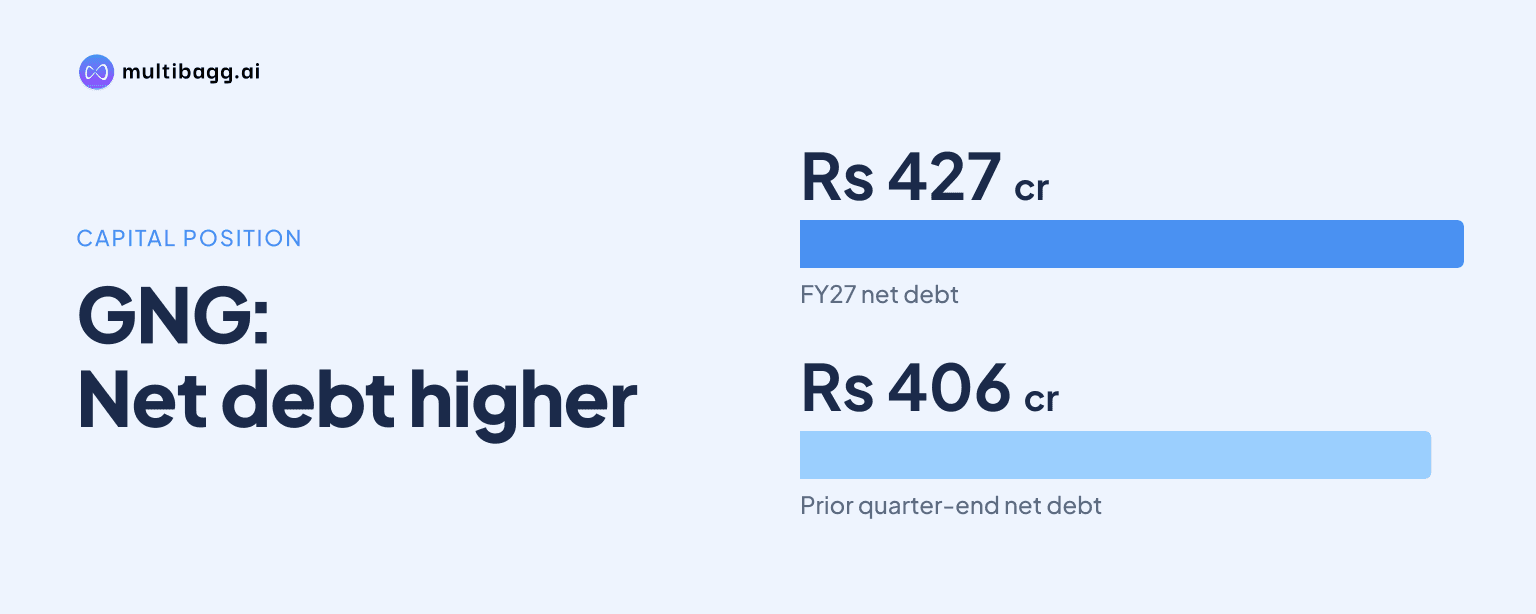
GNG Electronics Limited expects net debt to remain near Rs 427 crore through FY27 despite maintaining elevated inventory for at least the next two quarters, compared with Rs 406 crore at the previous quarter-end. Management said the inventory position supports bulk procurement and customer fulfilment while the supply of used devices remains constrained.
Know GNG Electronics inside out
Results, valuation, peers and who's buying, in one view.
Why is GNG holding higher inventory?
GNG is holding higher inventory because management sees limited availability of used devices and wants stock to meet demand from business customers. Management said enterprises are extending leases and delaying computer purchases as prices of new computers, memory, solid-state drives and processors rise. That means fewer devices are entering disposition channels, from which GNG sources equipment for refurbishment and resale.
The company’s procurement pattern also requires a larger stock position. GNG said sales are broadly linear, whereas devices become available when large corporates dispose of them, often in bulk. Management said it had recently procured significant inventory from global banks and corporates, including one of the world’s top banks, and expects these purchases to support results in the current quarter and the following quarters.
Management said sourcing costs for used devices are rising but are trailing the increase in new-computer prices. It illustrated this with a hypothetical new computer whose price rises from Rs 100 to Rs 180, while a refurbished alternative could rise from Rs 30 to Rs 54. The example increases the absolute price gap from Rs 70 to Rs 126, which management said could allow higher realised prices for refurbished products.
How long will GNG retain elevated inventory?
GNG expects elevated inventory to remain beneficial for at least the next two quarters, rather than three to four quarters. Management based that view on commentary from original equipment manufacturers, or OEMs, and component makers about continued supply pressure. It did not disclose a specific inventory balance or a days-of-inventory target for the next two quarters.
Management also cited IDC data that new-computer sales fell 20% during July, August and September. GNG said lower new-device sales should reduce the number of computers later available for disposition, reinforcing the case for buying when large lots become available. This is management’s assessment of supply conditions, rather than a forecast of the company’s inventory value.
GNG processed about 225,000 units in Q2 FY27 and about 374,000 units in the first half of FY27. Laptops represented 78% to 80% of revenue, according to management. That operating scale helps explain why inventory availability matters, particularly when business customers require larger quantities than can be assembled from regular smaller purchases.
How does higher inventory affect GNG's debt and receivables?
GNG expects to carry net debt at a level similar to the current Rs 427 crore for the full year, despite the costs associated with elevated inventory. The current balance was Rs 21 crore higher than the Rs 406 crore reported at the end of the previous quarter. Management called the current level a fair assumption given the inventory opportunity and did not indicate a further material rise in debt for FY27.
Receivables have increased in proportion to the overall business, but management said they generally remain in a 40- to 45-day range. GNG provides credit support to channel partners, which management said is broadly comparable with credit offered by OEMs. The company presented this as a mechanism to support distribution growth rather than as a change in its collections policy.
The inventory and debt approach sits alongside GNG’s revised FY27 outlook. Management raised its full-year revenue-growth guidance to 40% over FY26. It also said profit after tax, or PAT, is expected to be 1.5 percentage points above the prior year’s level, compared with its earlier guidance of a 1 percentage-point improvement.
Got a follow-up? Ask IRIS
What benefit has GNG reported from strategic inventory?
GNG said strategic inventory decisions accounted for 125 to 150 basis points of improved realisation in Q2 FY27. A basis point is one-hundredth of a percentage point. Management said its overall margin improved by about 400 to 500 basis points in the quarter and by more than 400 basis points in the first half, meaning inventory was only one component of the reported improvement.
Management attributed the larger part of the margin movement to better pricing, product realisation and wider acceptance of the Electronics Bazaar proposition. In Q2 FY27, laptop average selling price, or ASP, was about Rs 31,000, compared with about Rs 28,000 in the corresponding quarter. ASP for other products was about Rs 19,500, compared with about Rs 18,000 a year earlier.
Volume also contributed to growth. GNG said Q2 volume growth was 30%, while first-half growth reflected almost a 25% increase in volume and about 11% better realisation. Management said the laptops-and-other-products mix remained broadly stable, with laptops accounting for 78% to 80% of revenue, although it did not disclose a separate first-half revenue figure.
When does GNG expect inventory to return to normal?
GNG expects inventory to settle at about 90 days of projected sales when market conditions reach what management called a new normal, which it placed around two years away. This is a steady-state expectation rather than a FY27 target. Management said a business reliant on corporate device disposals requires inventory because procurement is irregular and often occurs through bulk transactions.
The 90-day expectation does not mean GNG intends to stop buying larger lots from corporates. Management said bulk procurement can improve product availability and margins when devices are available from banks or other large organisations. The intended change is from the current deliberately elevated inventory position to a more regular stock level tied to projected sales.
Management’s longer-term inventory view is also linked to its investment in capacity and distribution. As of September 2026, Electronics Bazaar supplied 55 countries, up from 49 at the end of Q1 FY27, while customer touchpoints rose to 5,542 from 5,130. Its supply base increased to 820 from 773, showing that the company is expanding both the outlets it serves and the channels through which it sources devices.
Conclusion
GNG’s disclosed working-capital strategy is to retain higher inventory while used-device supply is constrained, without planning a substantial increase from its current Rs 427 crore net-debt level. Compared with Rs 406 crore at the previous quarter-end, debt has risen, but management said this level can support the inventory build, channel credit and its 40% FY27 revenue-growth guidance.
The next issues to watch are whether elevated inventory remains beneficial after the stated two-quarter period, whether receivables stay within the 40- to 45-day range, and whether sourcing conditions move toward management’s two-year normalisation expectation of 90 days of projected sales. GNG has not issued FY28 guidance and said it would assess future guidance as market conditions develop.