










GNG Electronics Limited says FY27 plan uses 40%-50% capacity
Key highlights
- GNG expects only 40% to 50% refurbishment-capacity utilisation while pursuing almost 40% FY27 growth.
- GNG processed about 3.75 lakh units in the first half and expects to remain below 10 lakh units for the full year.
- GNG expanded its United Arab Emirates network from three or four facilities to about eight facilities.
- GNG reported net debt of about Rs 427 crore and expects no significant increase to meet FY27 guidance.
powered by IRIS
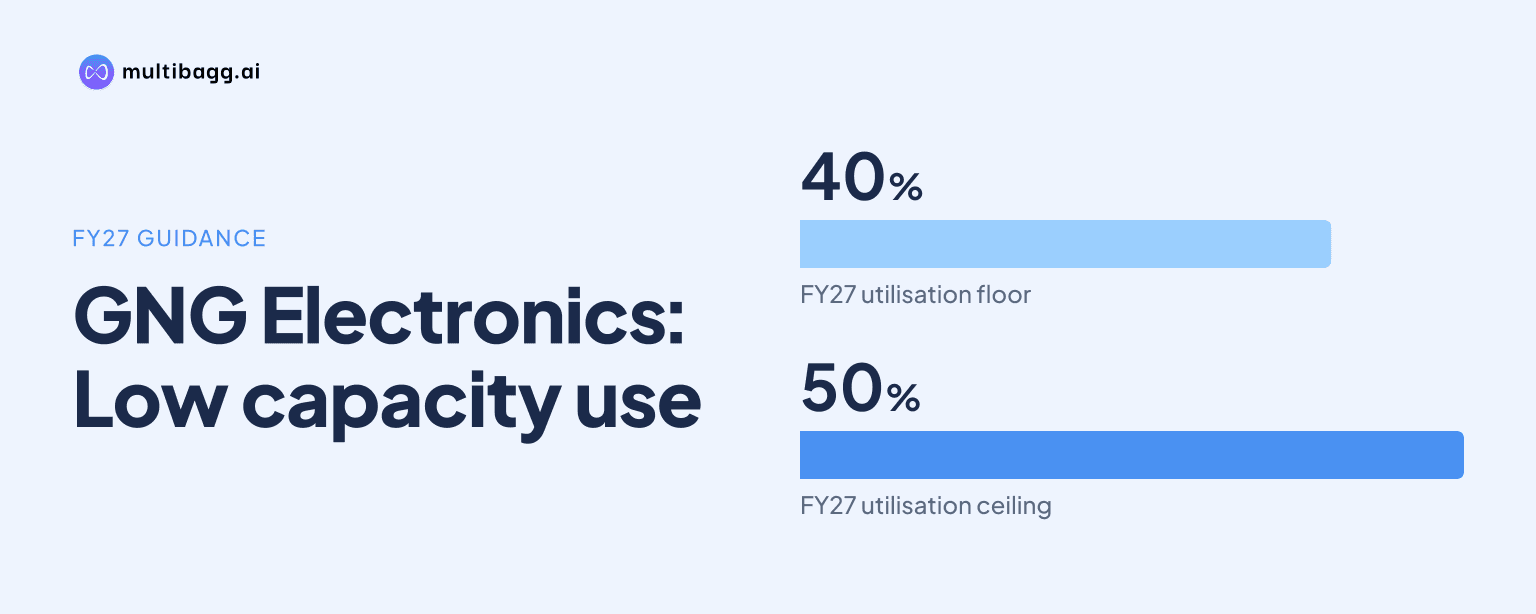
GNG Electronics Limited said its almost 40% FY27 growth guidance can be delivered while its refurbishment network operates at about 40% to 50% utilisation, following recent expansion in India and the United Arab Emirates. Management also expects net debt to remain near Rs 427 crore through the full year, without a significant increase to meet the plan.
Know GNG Electronics inside out
Results, valuation, peers and who's buying, in one view.
How much capacity will GNG use under its FY27 plan?
GNG expects to use only about 40% to 50% of its available refurbishment capacity even after delivering its FY27 guidance. Management based that estimate on first-half processing of about 3.75 lakh units and said full-year volumes would still remain below 10 lakh units at the guided growth rate. The estimate indicates that the capacity currently installed exceeds the operational requirement implied by the company’s full-year target.
The utilisation estimate follows expansion undertaken over the previous three or four quarters. In India, GNG nearly doubled its space two or three quarters earlier, while in the United Arab Emirates it increased its facility count from three or four sites to about eight. Management described the enlarged footprint as sufficient from an execution-capability perspective and did not disclose a further capacity-expansion plan for the second half of FY27.
What has changed in GNG's refurbishment network?
GNG has expanded physical capacity, facilities and staffing ahead of the expected increase in refurbishment volumes. The India space expansion nearly doubled available space, and the United Arab Emirates network rose to about eight facilities from three or four. Since becoming public, management said the company’s employee base has more than doubled, matching the facility build-out with operating personnel.
The preparation also includes commercial and engineering hiring rather than only factory space. Sales and marketing headcount rose from about 196 to 233 in one quarter, an increase of 37 people, while management said it was adding leaders for business verticals, corporate teams and engineering roles globally. GNG said engineering recruitment is necessary because technicians must be hired, trained and brought up to productivity before refurbishment volumes rise.
Management linked the larger sales force to channel activity, including EB Elevate programmes, Chai Pe Charcha and market visits. It also linked engineering capacity to warranty support for refurbished devices, with warranty periods ranging from one to three years in domestic and international markets. These investments mean employee costs are being incurred before GNG uses the remaining capacity, rather than being presented as a direct consequence of current utilisation alone.
Does GNG need more debt to deliver FY27 growth?
GNG does not currently see a significant need to increase debt to achieve its FY27 guidance. Management put net debt for the just-concluded period at about Rs 427 crore and said it would be reasonable to assume a similar full-year figure, with no significant variation. That view applies alongside the target of almost 40% full-year revenue growth and the capacity-use estimate of 40% to 50%.
Management’s position is that its equity, debt and accruals can support the required working capital. It said higher inventory expected by FY27-end would be funded substantially through accruals, while inventory, receivables and payables had been factored into its debt guidance. This is a management expectation, not a commitment to a fixed debt ceiling, because the company also said its ability to churn capital improves as it adds equity and profitability.
The funding plan matters because GNG has been holding elevated inventory after making strategic purchases. Management said 125 to 150 basis points, where one basis point is one-hundredth of a percentage point, of its recent margin improvement came from those inventory decisions. It said the rest of the improvement reflected better pricing and realisation, and that the inventory-related realisation outlook was incorporated in the full-year guidance rather than treated as a separate financing requirement.
Got a follow-up? Ask IRIS
What working-capital factors could affect GNG's debt outlook?
GNG expects inventory to be higher at the end of FY27 while debt remains broadly flat, making accrual generation and customer collections central to the plan. Management said the company sells refurbished computers into business channels, including businesses, small and medium-sized businesses and corporates, rather than directly into the consumer market. It therefore operates with distribution credit norms of 60 to 90 days.
Management said there was no stress in receivables, despite an increase in days sales outstanding, or DSO, which measures the average time taken to collect customer payments. It attributed the longer cycle to selling refurbished computers in the same market and credit environment as new computers. The company said its receivable days remained within acceptable limits, but the 60-to-90-day channel cycle means working capital will remain relevant as distribution partnerships and global stock availability expand.
GNG’s inventory approach is also linked to pricing conditions. Management said purchases were not made at significantly elevated prices and were made selectively when it saw suitable opportunities and pricing. In a scenario where memory or computer prices decline, management said it believes inventory purchased ahead of the curve, its ability to adjust pricing, and real-time intelligence from its field teams would provide cushions, although it did not quantify a potential inventory-value impact.
Conclusion
GNG’s FY27 plan combines almost 40% growth guidance with a stated 40% to 50% utilisation level, suggesting that the India and United Arab Emirates network built over the past three or four quarters has room for further volume growth. The company is simultaneously investing ahead of demand in people, with sales and marketing headcount rising from 196 to 233 in one quarter, while it expects net debt to stay near Rs 427 crore.
The next issues to watch are whether first-half volumes of about 3.75 lakh units progress toward the sub-10-lakh full-year level, whether higher FY27-end inventory is covered substantially by accruals as management plans, and whether receivables remain controlled within the 60-to-90-day distribution credit cycle. Management has also said it is hiring in Singapore and Vietnam and plans deeper sales penetration in Japan, Australia, New Zealand and Association of Southeast Asian Nations markets.