










Gopal Snacks retains FY27 targets despite 5.5% inflation
Key highlights
- Gopal Snacks retained FY27 revenue guidance of Rs 1,800 crore to Rs 1,900 crore and an 8.9% EBITDA-margin target.
- H1 FY27 revenue rose 26.7% year on year to Rs 883.9 crore, while EBITDA margin expanded to 8.3% from 5.6%.
- Management estimated H1 FY27 input inflation at 5.5%, with about 4% addressed through grammage correction.
- Q2 FY27 EBITDA margin was 9%, compared with 6.4% in Q2 FY26 and 7.4% in Q1 FY27.
powered by IRIS
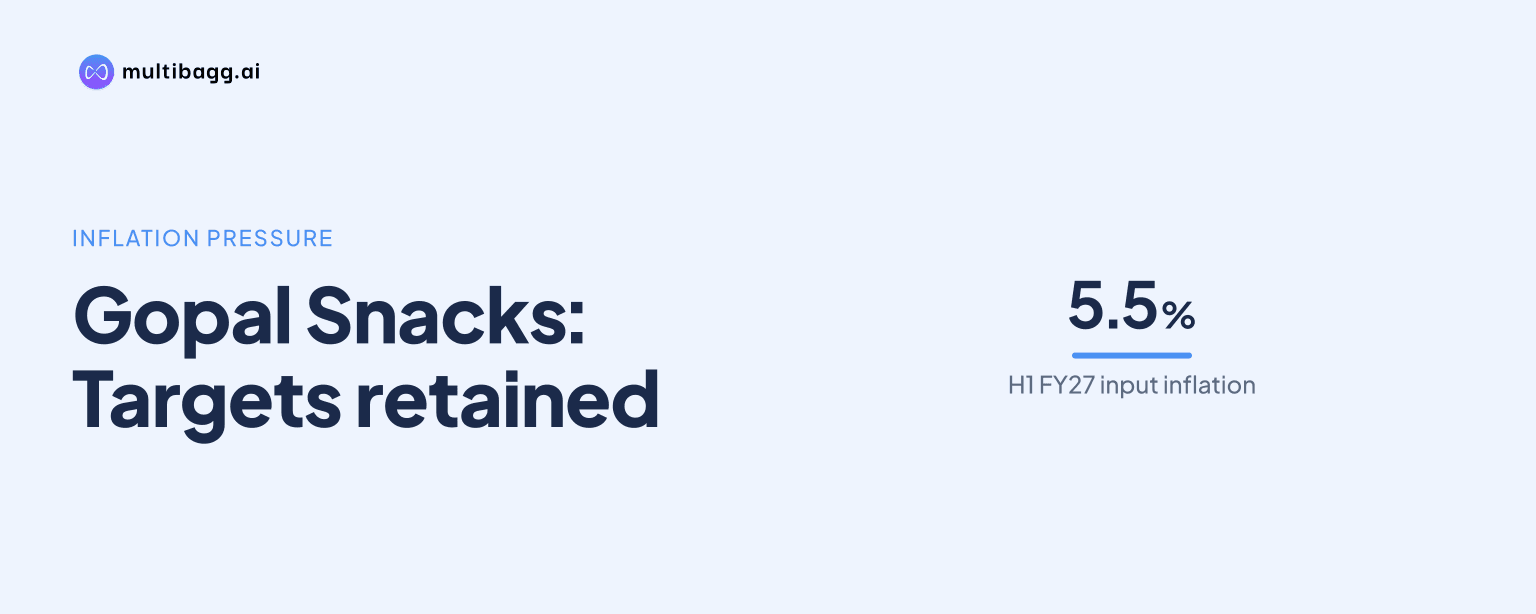
Gopal Snacks Limited retained FY27 revenue guidance of Rs 1,800 crore to Rs 1,900 crore and an 8.9% EBITDA margin target despite estimating 5.5% input-cost inflation in H1 FY27. Revenue from operations rose 26.7% year on year to Rs 883.9 crore in the half year, while EBITDA margin reached 8.3%.
Know Gopal Snacks inside out
Results, valuation, peers and who's buying, in one view.
Will Gopal Snacks meet its FY27 guidance?
Gopal Snacks maintained its FY27 revenue target of Rs 1,800 crore to Rs 1,900 crore and its EBITDA, or earnings before interest, tax, depreciation and amortisation, margin target of 8.9%. With H1 FY27 revenue at Rs 883.9 crore, the company would need Rs 916.1 crore to Rs 1,016.1 crore in H2 FY27 to reach that range. Management said current growth momentum was 22% to 23% when asked about trading following the Diwali shift into Q3.
H1 performance put EBITDA margin at 8.3%, compared with 5.6% in H1 FY26, while EBITDA rose 85.7% to Rs 73 crore. Q2 FY27 margin was 9%, ahead of 7.4% in Q1 FY27 and 6.4% in Q2 FY26, as quarterly EBITDA increased 72% year on year to Rs 41.6 crore. Management said it would seek to remain in a similar margin territory in H2 FY27.
How is Gopal Snacks offsetting input-cost inflation?
Gopal Snacks said H1 FY27 inflation of about 5.5% was addressed through grammage correction, price correction, lower trade discounts and a more profitable product mix. Management attributed about 4% to grammage correction, 0.6% to price correction, and roughly 0.7% to 0.8% to the combination of trade discounts and mix. In the Q1-to-Q2 period, it estimated the gross-margin inflationary impact at 2.3%.
For that sequential period, management said grammage correction contributed about 1.1%, price increases 0.4%, and lower trade discounts plus mix improvement 0.4%. Q2 gross margin nevertheless rose to 27.1% from 26.4% a year earlier, and gross profit increased 26.1% to Rs 125 crore. Management remains open to further grammage reductions or price increases after October, alongside expense controls and a better-margin product basket in Q4 FY27.
Are grammage cuts affecting Gopal Snacks volumes?
Gopal Snacks said grammage changes have affected Namkeen volumes more than its stronger Gathiya category. Namkeen value growth was 18.3% in H1 FY27, while volume growth was 8.6%; quarterly volume growth was 8% sequentially and 15% year on year. Management said its pricing power is greater in Gathiya, where grammage correction has had less effect on volumes.
Category growth in Q2 FY27 also varied: Gathiya sales increased 25.6% year on year, wafers rose 40%, and snack pellets and extruded snacks grew 23%. Management said grammage decisions were made at stock-keeping-unit level and that it would add a couple of Namkeen products in coming quarters. It did not provide a quantitative H2 FY27 volume-growth forecast.
Got a follow-up? Ask IRIS
Which growth levers support Gopal Snacks' FY27 plan?
Gopal Snacks is using distribution additions, deeper outlet servicing and new channels to support revenue. Its distributor network reached 1,057 at September 30, 2026, up from 1,007 at June-end and 953 at FY26-end, with a further 150 micro-distributors under its super-stockist model. The 130 distributors added in H1 FY27 contributed Rs 13 crore, and management said this cohort could contribute about Rs 60 crore during FY27.
In Gujarat, dual servicing reached 42% of outlets at September-end and 43.5% by October-end, compared with 38% in the preceding quarter. Management targets 65% to 70% dual-serviced outlets by FY27-end and plans to add about 25 to 30 ready-stock distributors for Western snacks in parts of Gujarat in Q4. The Gujarat distributor base had remained broadly steady at about 311 to 312 for three to four quarters.
What will determine Gopal Snacks' H2 margin delivery?
Gopal Snacks identified laminate packaging and palm oil as the principal inflation sources, with chana also higher than last year. At H1 FY27, palm oil accounted for 27% of the raw-material basket, laminate for about 22% to 23%, and chana for about 19%. Management said a September duty reduction lowered palm-oil prices, with the full impact visible in October, partly offsetting higher packaging costs linked to crude prices.
The company said chana inventory was likely to last until about mid-January and potato inventory until about mid-December. Its Besan manufacturing unit started at Nagpur in September 2026 and, according to management, should simplify material movement and reduce recurring transportation costs. Management also identified an annualised Rs 6.7 crore opportunity from reducing laminate-pack dimensions, although it said the full benefit was more likely next year because existing laminate stocks typically last about two months.
Conclusion
Gopal Snacks' retained FY27 outlook rests on H1 revenue growth of 26.7%, an 8.3% EBITDA margin and a 9% Q2 margin, despite management's estimate of 5.5% input inflation. Grammage corrections, selective price actions, lower trade discounts and mix changes have supported gross margin, while distribution expansion and category growth are intended to sustain sales.
The next factors to watch are whether the reported 22% to 23% growth momentum continues through H2 FY27, whether management takes further price or grammage actions after October, and whether Q4 brings the planned better-margin product mix. Management also plans to reach 65% to 70% dual-serviced Gujarat outlets by FY27-end and add about 25 to 30 Western-snack distributors in Gujarat in Q4.