










Gopal Snacks Ltd Reports Q2 FY27 Revenue of ₹461.5 Crore
Key highlights
- Gopal Snacks reported Q2 FY27 revenue of ₹461.5 crore, up 22.9% year-on-year.
- Q2 FY27 EBITDA rose 72% year-on-year to ₹41.6 crore, with margin improving to 9.0%.
- Wafers sales grew 40% year-on-year, while gathiya sales increased 25.6% in Q2 FY27.
- Aggregate insurance recovery related to the fire incident reached ₹77.4 crore in October 2026.
powered by IRIS
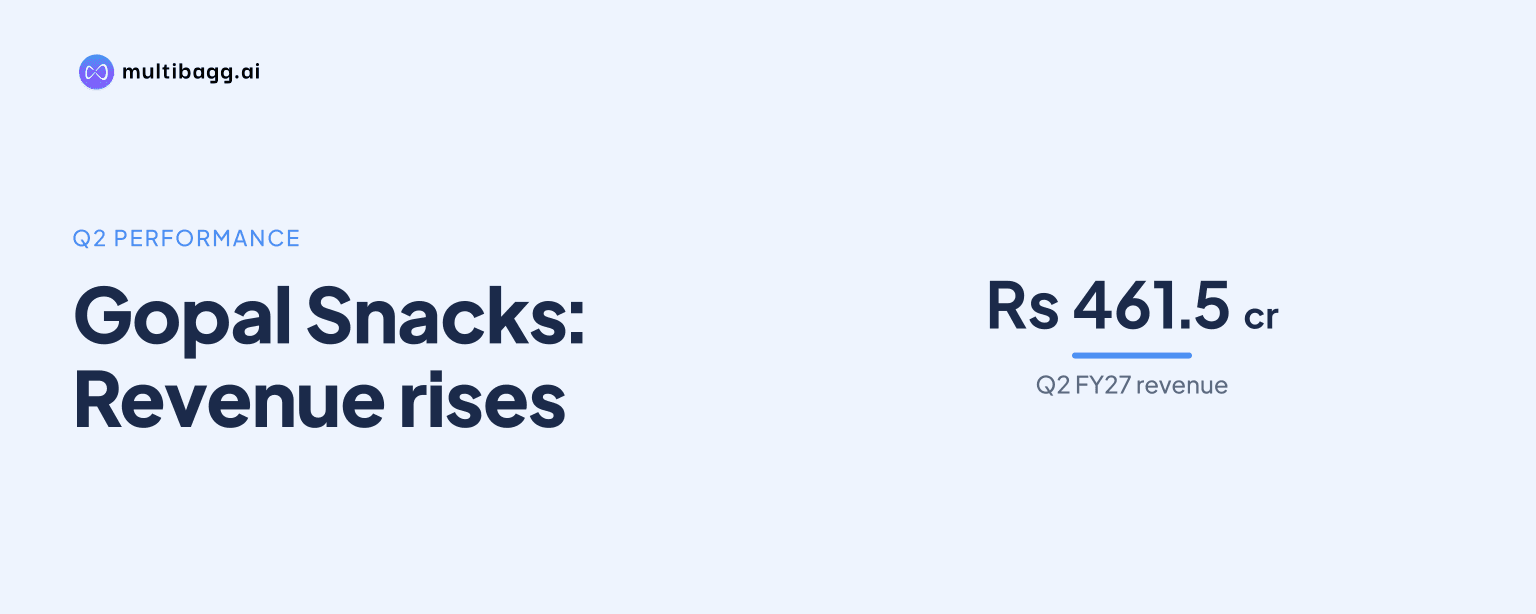
Gopal Snacks Ltd reported revenue from operations of ₹461.5 crore in Q2 FY27, up 22.9% year-on-year, while EBITDA increased 72% to ₹41.6 crore. The July-September 2026 performance reflected improved manufacturing availability, wider distribution coverage and growth across key snack categories.
Know Gopal Snacks inside out
Results, valuation, peers and who's buying, in one view.
What did Gopal Snacks report for Q2 FY27?
Gopal Snacks reported ₹461.5 crore of revenue from operations for Q2 FY27, compared with ₹375.7 crore in Q2 FY26. Revenue also rose 9.3% sequentially from ₹422.3 crore in Q1 FY27. The company discussed its unaudited standalone results in an earnings call hosted by DAM Capital Advisors on November 3, 2026.
Management said the quarter reflected progress in restoring manufacturing capabilities and expanding the distribution network. Its stated priorities during the first half of FY27 were improving product availability, strengthening manufacturing integration and reaching more consumers in its markets.
For the first half of FY27, revenue from operations increased 26.7% year-on-year to ₹883.9 crore. The company attributed the growth to demand across key product categories and its ability to serve that demand more effectively through broader distribution and improved availability.
Which product categories supported Gopal Snacks' revenue growth?
Gopal Snacks said gathiya, wafers, and snack pellets and extruded snacks all recorded year-on-year growth during Q2 FY27. Gathiya sales grew 25.6%, wafers grew 40%, and snack pellets and extruded snacks grew 23% during the quarter.
The category performance came alongside a 9.3% quarter-on-quarter increase in total revenue. Management linked the improvement to better product availability and broader distribution coverage, rather than identifying a single category as the sole driver of the quarterly increase.
The company also highlighted product consolidation and backward integration as operational focus areas. These initiatives are intended to lower operating, logistics and power costs over time, according to management. No quantified savings target was disclosed during the call.
How did Gopal Snacks' margins and profit change in Q2 FY27?
Gopal Snacks' EBITDA rose 72% year-on-year to ₹41.6 crore, taking its EBITDA margin to 9.0% from 6.4% in Q2 FY26 and 7.4% in Q1 FY27. Gross profit increased 26.1% year-on-year to ₹125 crore, while gross margin improved to 27.1% from 26.4% a year earlier.
Management said improved pricing, grammage correction and manufacturing efficiency helped it manage a challenging raw-material cost environment. It also cited operating leverage, a profitable product mix and continued cost discipline as reasons for the increase in EBITDA margin.
Profit before tax before exceptional items stood at ₹25.9 crore, up 93% year-on-year. Reported profit after tax was ₹45.9 crore, with a PAT margin of 9.9%. The reported profit included a net exceptional gain of ₹35.3 crore, which means the reported PAT should be read alongside the exceptional-item disclosure.
Got a follow-up? Ask IRIS
What was the insurance recovery and manufacturing update?
Gopal Snacks received a full and final insurance claim of ₹36.4 crore in October 2026 relating to a fire incident. Including an earlier interim payment, scrap-sale proceeds and the final approved claim, aggregate recovery reached ₹77.4 crore.
The company separately reported a net exceptional gain of ₹35.3 crore in Q2 FY27. Management did not provide further detail in the call on the accounting components behind the difference between the aggregate recovery figure and the quarterly net exceptional gain.
On manufacturing, a basin manufacturing unit commenced operations at Nagpur during September 2026. Management said the unit brings a key input closer to snack manufacturing operations, simplifying material movement and enabling recurring transportation-cost savings.
The restoration of manufacturing capability is relevant because product availability was a stated contributor to sales growth. Greater manufacturing integration could also support the company's efforts to manage logistics and power costs, although management did not specify the financial effect for FY27.
What does the Q2 performance mean for investors and operations?
Gopal Snacks' Q2 numbers show that revenue growth was accompanied by improvement in gross margin and EBITDA margin, even as management described raw-material costs as challenging. EBITDA grew faster than revenue, with the margin expanding by 260 basis points year-on-year.
For investors, the key distinction is between operating profitability and reported profit. EBITDA of ₹41.6 crore and profit before tax before exceptional items of ₹25.9 crore reflect the operating result disclosed for the quarter, while reported PAT of ₹45.9 crore includes the ₹35.3 crore exceptional gain.
For operations, the company is focused on profitable product mix, passing inflationary costs to consumers and maintaining cost discipline in the second half of FY27. Management also said it would manage working-capital requirements and capital allocation carefully, with the aim of converting revenue growth into sustainable profitability and cash generation.
Conclusion
Gopal Snacks delivered 22.9% year-on-year revenue growth in Q2 FY27 and expanded its EBITDA margin to 9.0%, supported by higher availability, wider distribution and growth in gathiya, wafers, and snack pellets and extruded snacks. The quarter also included a material exceptional gain, making it important to separate reported PAT from underlying operating metrics.
The next areas to watch are execution on profitable product mix, pricing actions to address input-cost inflation, and the operational contribution from the Nagpur basin unit. Management has also identified working-capital management, capital allocation and lower operating, logistics and power costs as ongoing priorities.