










Gopal Snacks cuts Gathiya core-state sales share to 65.6%
Key highlights
- Gathiya sales from Core States declined from 73.3% in FY24 to 65.6% in H1 FY27.
- Gopal Snacks’ reported distributor network rose to 1,057 in Q2 FY27 from 841 in Q1 FY26.
- Focused State and Other State shares of Gathiya sales reached 25.8% and 8.5%, respectively, in H1 FY27.
- Gujarat, Maharashtra and Uttar Pradesh accounted for 698 of 1,057 reported distributors in Q2 FY27.
powered by IRIS
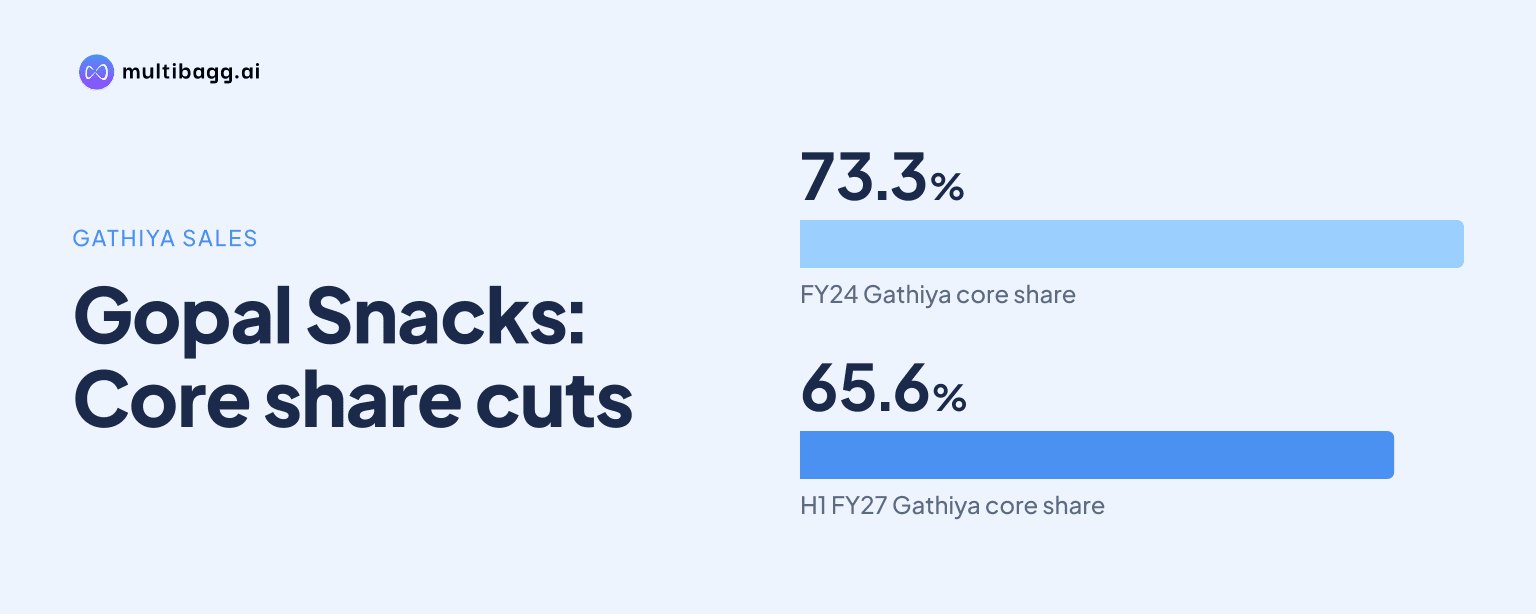
Gopal Snacks reduced core states’ share of Gathiya sales to 65.6% in the first half of financial year 2027, or H1 FY27, from 73.3% in FY24, while its reported distributor network reached 1,057 in the second quarter of financial year 2027, or Q2 FY27. Focused State and Other State contributions both increased over the period.
Know Gopal Snacks inside out
Results, valuation, peers and who's buying, in one view.
How has Gopal Snacks shifted Gathiya sales beyond core states?
Gopal Snacks reduced the core-state share of Gathiya sales by 7.7 percentage points between FY24 and H1 FY27. Core States represented 73.3% of Gathiya sales in FY24, 71.1% in FY25, 69.8% in FY26 and 65.6% in H1 FY27. As H1 FY27 covers six months, the latest sales mix is a partial-year disclosure rather than a full-year result.
Focused State sales increased by 3.1 percentage points of the Gathiya mix, reaching 25.8% in H1 FY27 from 22.7% in FY24. Other State contribution rose by 4.7 percentage points to 8.5%, while exports were 0.1% in H1 FY27 after 0.0% in FY26. Gopal Snacks said the change reflected improving penetration in Focus States and gradual revenue-mix diversification beyond Core States.
Gathiya remained the largest disclosed product category, contributing 28% of H1 FY27 revenue, compared with 23% for Namkeen, 16% for snack pellets and 12% for wafers. Gathiya revenue rose 27.2% year on year in H1 FY27 and volume rose 14.5%, while wafers revenue and volume increased 38.1% and 38.4%, respectively.
How quickly has Gopal Snacks expanded its distributor network?
Gopal Snacks added 216 reported distributors from Q1 FY26 to Q2 FY27, taking its network from 841 to 1,057. The company added 50 distributors in Q2 FY27 after adding 54 in Q1 FY27, and the reported network had reached 953 distributors by Q4 FY26.
The 1,057 figure excludes 150 micro distributors appointed in districts across Gujarat, Goa, Delhi, Jharkhand, Maharashtra, Madhya Pradesh, Rajasthan, Uttar Pradesh and West Bengal. Gopal Snacks said these appointments were made under a micro-distributor model to mitigate supply-chain disruption, so they are not included in the reported network count.
Management linked the larger network to wider market coverage and product availability in Q2 FY27. Revenue from operations rose 22.9% year on year to Rs 461.5 crore in the quarter, while Gathiya sales increased 25.6% and wafers sales increased 40.0%. The presentation does not quantify sales generated by the newly added distributors.
Got a follow-up? Ask IRIS
Where is Gopal Snacks’ distributor network concentrated?
Gopal Snacks’ network was concentrated in Gujarat, Maharashtra and Uttar Pradesh, which together had 698 of the reported 1,057 distributors in Q2 FY27. Gujarat had 311 distributors, Maharashtra had 214 and Uttar Pradesh had 173, making these the three largest listed markets in the company’s distribution footprint.
Madhya Pradesh had 95 distributors, Rajasthan had 70 and Chhattisgarh had 64. Jharkhand had 49, Odisha had 26, Karnataka had 23, West Bengal had 13 and Telangana had 10. Uttarakhand had five distributors, Delhi NCR had two, and Andhra Pradesh and Goa had one distributor each.
Gopal Snacks also reported more than 300 owned logistics vehicles alongside the 1,057-distributor network in Q2 FY27. The presentation does not disclose sales by state, sales per distributor or logistics costs by territory, but it identifies a presence across 15 listed states or regions.
The company reported different growth rates for its market groupings in H1 FY27. Revenue in Focus Markets, comprising Chhattisgarh, Madhya Pradesh, Maharashtra, Rajasthan and Uttar Pradesh, increased 35.6% year on year and volume grew 26.3%. Revenue in Other States rose 87.0%, while volume increased 89.1%, although the presentation does not provide the underlying revenue base for either grouping.
What manufacturing capacity supports Gopal Snacks’ wider reach?
Gopal Snacks recommenced operations at its Rajkot Main facility in Q1 FY27, restoring a site with installed capacity of 1,05,233 metric tonnes per annum, or MTPA. Rajkot reported 26.9% utilisation and makes Gathiya, Namkeen, snack pellets and extruded snacks. Management expects the consolidation of production from Gondal to Rajkot to reduce operating, transportation and power costs.
Modasa and Nagpur, the other two primary facilities, reported capacities of 83,431 MTPA and 72,943 MTPA, respectively. Modasa operated at 40.2% utilisation and Nagpur at 28.3%, compared with 26.9% at Rajkot. All three facilities make Gathiya, while Modasa and Nagpur also make wafers and other snack categories.
Gopal Snacks commissioned a Besan manufacturing unit at Nagpur in September with capacity of 19,642 MTPA and reported utilisation of 29.1%. Management said the unit would reduce the need to transport Besan from Rajkot to Nagpur, simplify material movement and generate recurring transportation-cost savings. It also said the unit strengthens Nagpur’s role in serving markets outside Gujarat.
At category level, Gathiya had installed capacity of 79,794 metric tonnes in H1 FY27 and utilisation of 36%. Wafers operated at 60% utilisation on capacity of 12,813 metric tonnes, while Besan operated at 70% utilisation on capacity of 65,987 metric tonnes. These figures show that utilisation differed by category as Gopal Snacks expanded distribution.
Conclusion
Gopal Snacks’ disclosures show a less concentrated Gathiya sales mix alongside a larger reported distribution base. Core States’ Gathiya share declined to 65.6% in H1 FY27, while Focused States and Other States reached 25.8% and 8.5%, respectively. The reported network increased to 1,057 distributors in Q2 FY27, with the largest counts in Gujarat, Maharashtra and Uttar Pradesh.
Management’s stated priorities are improving capacity utilisation, extending distribution reach and translating manufacturing efficiencies into sustained profitability. The next disclosures can show whether utilisation changes at Rajkot, Modasa and Nagpur, whether the September Nagpur Besan unit reduces transport requirements as planned, and whether the distributor count continues to rise beyond 1,057.