










Gretex Corporate Services links IPO mandates to two engines
Key highlights
- GCSL reports more than 60 successful SME IPO listings and says it is strategically expanding into mainboard IPOs.
- GSBL reports market making for 54 companies, 15 empanelled institutions and more than 400 retail clients.
- GCSL identifies four IPO-related revenue layers: listing fees, advisory retainers, AIF sponsorship and future mandates.
- GCSL states it has 63 IPO-listed clients across more than 40 sectors, while the displayed industry rows total 62 clients.
powered by IRIS
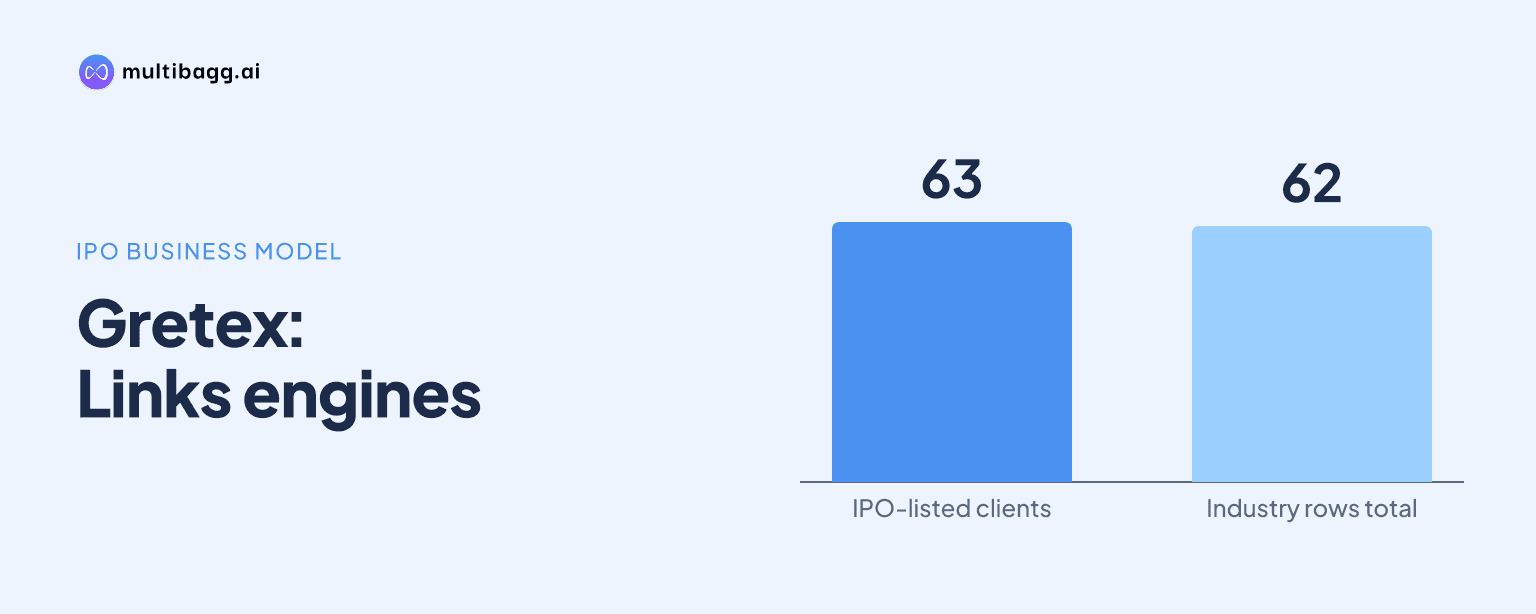
Gretex Corporate Services says its two-engine model connects IPO origination with advisory, alternative investment fund participation, market making and trade execution through separate regulated entities; its disclosed base includes more than 60 successful small and medium enterprise IPO listings and market making for 54 companies.
Know Gretex Corporate Services inside out
Results, valuation, peers and who's buying, in one view.
How does GCSL’s twin-engine model work?
GCSL divides origination and execution between two Securities and Exchange Board of India (SEBI)-registered entities. Engine 1, GCSL, originates IPO, advisory and debt-syndication mandates, manages issuer and promoter relationships, and sponsors alternative investment fund (AIF) investments alongside clients. Engine 2, Gretex Share Broking Ltd. (GSBL), provides market-making capacity and executes group AIF and institutional trades in-house.
The answer is that GCSL intends one issuer relationship to produce separate revenue opportunities without combining the regulated businesses. The presentation says capital, risk and compliance remain separate between the two entities. Advisory and syndication fees sit with GCSL, while execution and market-making income sit with GSBL; the stated link is referral flow, issuer mandates and market intelligence that can support the next mandate.
What revenue layers does GCSL add to an IPO mandate?
GCSL identifies four revenue layers around its core small and medium enterprise (SME) IPO mandate. The core is a one-time listing fee, followed by a recurring monthly advisory retainer, investment income through AIF sponsorship via Bhuthex, and future mandates covering debt, cross-sell and the next capital raise.
The change in GCSL’s stated model is from a transaction-led IPO relationship to a broader, recurring client relationship. Post-listing advisory, AIF participation and subsequent capital-market mandates are the disclosed mechanisms for that extension. The presentation provides no fee rate, AIF investment value, revenue split or profitability figure for any of the four layers, so it describes the model’s design rather than its financial contribution.
Which services create GCSL’s issuer pipeline?
GCSL lists seven integrated service segments, with SME and mainboard IPO advisory as the first. That IPO service covers due diligence, valuation, structuring, documentation and listing. The six other segments are corporate strategy and restructuring, valuation and financial advisory, private placements and private-equity advisory, mergers and acquisitions, debt syndication and credit advisory, and compliance and regulatory filings.
These seven segments create multiple potential entry points before or after an IPO. Valuation and financial advisory covers IPOs, private equity, mergers and acquisitions and filings under Insolvency and Bankruptcy Board of India, Foreign Exchange Management Act and Income-Tax norms. Debt work includes structured debt, working capital, term loans and refinancing from banks, non-banking financial companies and alternative credit platforms.
GCSL also sets out a six-stage execution lifecycle: origination and mandate; due diligence and structuring; documentation and filing; marketing and book building; listing and allotment; and post-listing market making. The sixth stage is the operating connection to GSBL, because the presentation places liquidity support, market making and compliance advisory after a company has listed on BSE SME, NSE Emerge or the mainboard exchanges.
Got a follow-up? Ask IRIS
What scale supports GCSL’s execution model?
GCSL reports more than 60 successful SME IPO listings and says it is strategically expanding into mainboard IPOs. Separately, it maps 63 IPO-listed clients across more than 40 granular sectors. Industrial products and manufacturing is the largest disclosed industry segment with 7 clients, ahead of real estate, infrastructure and construction with 6 clients.
The client mix is spread beyond the two largest categories. Pharmaceuticals and healthcare and packaging each have 5 clients, while chemicals and polymers and metals, castings and forgings each have 4. Jewellery, agri, food and fast-moving consumer goods, information technology and business services, hospitality and travel, textiles and apparel, and furniture and home furnishing each have 3 clients.
The displayed industry rows total 62 clients, while GCSL’s page headline states 63 IPO-listed clients. GCSL does not explain the one-client difference in the supplied presentation. The disclosed comparison nevertheless shows that the largest industry bucket accounts for 7 clients, rather than a majority of the stated 63-client base.
How does GSBL turn GCSL relationships into trades?
GSBL is a GCSL subsidiary, a SEBI-registered market maker and a BSE-registered stock broker. Its market-making function is to provide quotes and a readily available market for buyers and sellers, including during initial trading in newly listed securities. GCSL says this activity can facilitate liquidity and help establish a fair market price after listing.
GSBL reports market making for 54 companies, 15 empanelled institutions and more than 400 retail clients. Its institutional-broking focus includes mutual funds, AIFs, portfolio management service desks, foreign and domestic institutional investors, corporates and promoters executing block trades. The presentation names GIC among multiple institutions empanelled with the broking operation.
The 54-company market-making base is larger than the disclosed 15-institution network, although these are different operating measures. GCSL describes market making as an existing, already-capitalised capability, while it presents institutional broking as an additional execution-economics layer. Its stated group synergy is therefore based on separate advisory, market-making and trade-execution activities serving a shared issuer relationship.
Conclusion
GCSL’s disclosed model links IPO origination, advisory and debt syndication with post-listing market making and institutional trade execution. The model seeks to extend a one-time listing fee through recurring retainers, AIF sponsorship and subsequent mandates, using more than 60 successful SME IPO listings, 54 market-making assignments and an industry base stated at 63 IPO-listed clients.
The next disclosed development to watch is GCSL’s strategic expansion into mainboard IPOs and its plan to pursue future debt, cross-sell and capital-raise mandates. The presentation does not set a timetable, mandate target or revenue objective for mainboard work, and it does not quantify how much the four revenue layers or institutional broking contribute.