










Gretex Corporate Services Limited Q2 EBITDA margin falls to 12.7%
Key highlights
- Gretex reported Q2-FY27 revenue of Rs 75.6 crore, down 5.0% year-on-year.
- Gretex’s Q2-FY27 EBITDA fell 69.7% to Rs 9.6 crore and its EBITDA margin fell to 12.70%.
- Gretex’s H1-FY27 PAT increased 43.2% year-on-year to Rs 19.9 crore.
- Gretex reported four DRHP filings, one SME IPO listing and a Rs 25 crore fund first close in H1-FY27.
powered by IRIS
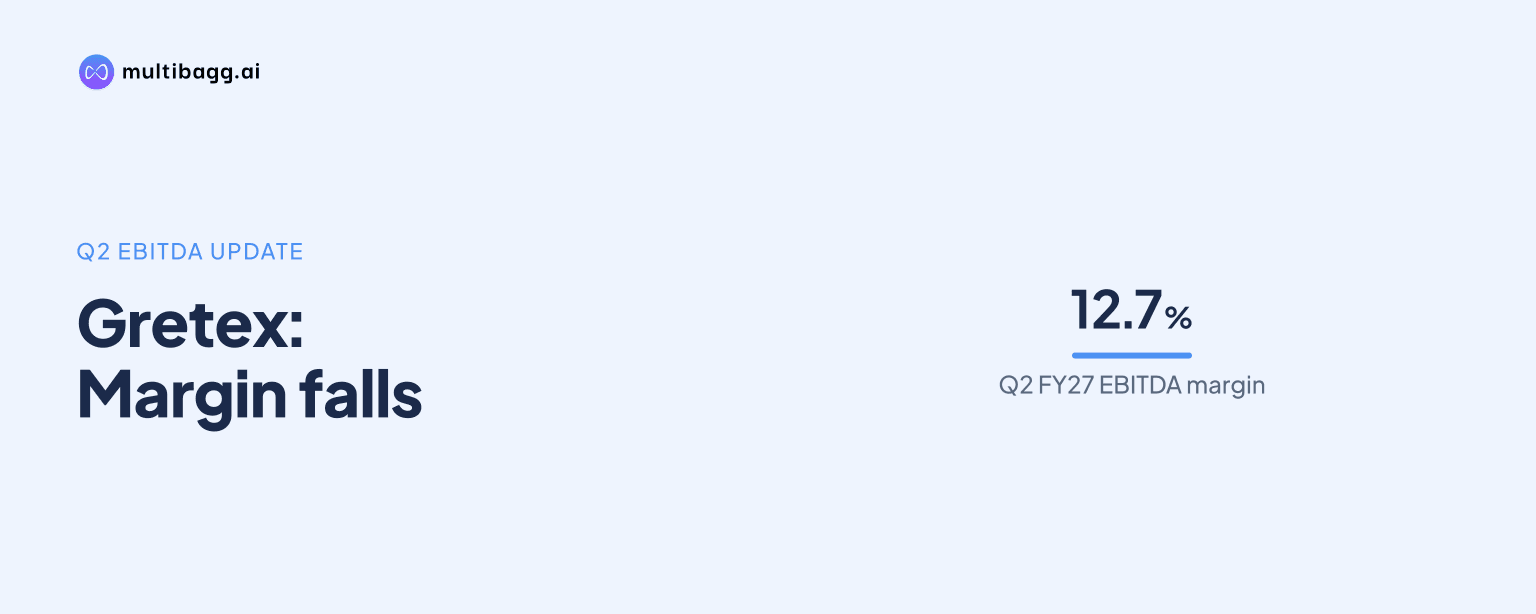
Gretex reported a Q2-FY27 earnings before interest, tax, depreciation and amortisation (EBITDA) margin of 12.70%, down 2,763 basis points year-on-year, as revenue from operations declined 5.0% to Rs 75.6 crore and operating expenses rose to Rs 66 crore. EBITDA fell 69.7% to Rs 9.6 crore, while profit after tax (PAT) fell 45.0% to Rs 7.1 crore.
Know Gretex Corporate Services inside out
Results, valuation, peers and who's buying, in one view.
Why did Gretex’s Q2-FY27 EBITDA margin fall to 12.7%?
Gretex’s Q2-FY27 EBITDA margin fell to 12.70% because revenue of Rs 75.6 crore was lower than Rs 79.6 crore in Q2-FY26 while operating expenses increased to Rs 66 crore from Rs 47.9 crore. EBITDA consequently declined by Rs 22.1 crore year-on-year, from Rs 31.7 crore to Rs 9.6 crore.
The 2,763-basis-point movement equals a 27.63-percentage-point reduction, with 100 basis points equal to one percentage point. Gretex also reported a sequential fall from Q1-FY27, when revenue was Rs 37.5 crore, EBITDA was Rs 17.2 crore and the EBITDA margin was 45.87%. Revenue rose 101.6% quarter-on-quarter in Q2, but EBITDA declined 44.2% and margin fell 3,317 basis points.
Operating expenses represented 87.3% of Q2-FY27 revenue, compared with 60.2% in Q2-FY26, based on the reported consolidated figures. The presentation does not provide a line-by-line explanation for the expense increase, so it supports the comparison of reported costs and revenue rather than an attribution to individual cost categories.
How did Gretex’s net profit and earnings per share change in Q2-FY27?
Gretex’s Q2-FY27 PAT fell 45.0% year-on-year to Rs 7.1 crore, while diluted earnings per share (EPS) fell 68.0% to Rs 1.83. PAT margin was 9.39%, compared with 16.21% in Q2-FY26, a reduction of 682 basis points.
Profit before tax (PBT) was Rs 9.6 crore in Q2-FY27, down 49.7% from Rs 19.1 crore a year earlier. Other income was Rs 90 lakh in Q2-FY27, following a negative other-income balance in Q2-FY26; depreciation was unchanged at Rs 60 lakh, while finance cost increased to Rs 40 lakh from Rs 20 lakh. Taxes declined to Rs 2.5 crore from Rs 6.2 crore as reported pre-tax profit decreased.
Gretex reported Rs 10 lakh as its share of profit of associates in Q2-FY27, compared with Rs 40 lakh in Q2-FY26. Sequentially, Q1-FY27 PAT was Rs 12.8 crore and PAT margin was 34.13%, compared with Rs 7.1 crore and 9.39% in Q2-FY27; PBT decreased from Rs 17.2 crore to Rs 9.6 crore and EPS declined from Rs 3.97 to Rs 1.83.
Got a follow-up? Ask IRIS
Did Gretex’s first-half FY27 profit remain above last year?
Gretex’s H1-FY27 PAT remained above the prior year, rising 43.2% to Rs 19.9 crore from Rs 13.9 crore in H1-FY26, despite a 20.6% decline in EBITDA to Rs 26.6 crore. Revenue from operations increased 11.4% to Rs 113.1 crore from Rs 101.5 crore in the prior first half.
The reported difference between EBITDA and bottom-line trends coincided with other income of Rs 1.5 crore in H1-FY27, compared with a negative Rs 11.5 crore in H1-FY26. Profit before share of profit of associate and exceptional item increased 30.2% to Rs 26.3 crore, while PBT rose 30.1% to Rs 26.8 crore. The share of profit of associates was Rs 50 lakh, compared with Rs 40 lakh a year earlier.
H1-FY27 EBITDA margin was 23.52%, down 948 basis points from 33.00% in H1-FY26, as operating expenses rose faster than revenue. In contrast, PAT margin increased 391 basis points to 17.60% from 13.69%. Diluted EPS was Rs 5.80, down 5.4% from Rs 6.13 despite the reported increase in PAT.
What operating developments did Gretex report for H1-FY27?
Gretex reported one small and medium enterprise (SME) initial public offering (IPO) listing, four draft red herring prospectus (DRHP) filings and one underwriting mandate during H1-FY27. The company said Vama Wovenfab Limited was listed on the BSE SME platform on September 22, 2026.
The four IPO mandates progressed to the DRHP filing stage across mainboard and SME segments. They were Sky Alloys and Power Limited and Tenty Limited for the NSE and BSE mainboards, plus Abacus Lifestyle Brands and Oremet Alloys for NSE Emerge. The presentation provides no expected fee, issue size or completion date for the four mandates.
Gretex also said it secured an underwriting mandate from Armee Infotech Limited. Through its subsidiary, Gretex Share Broking Ltd., it opened a branch office in Ahmedabad, Gujarat. Separately, Celestial Chakra Momentum Fund, jointly sponsored through Bahutex Ventures, marked its first close at Rs 25 crore.
The company snapshot lists 14 IPO pipeline mandates, 63 companies listed on stock exchanges and more than 200 transactions executed since its FY2017 capital-mobilisation starting point. It also reports about Rs 1,579 crore of capital mobilised since FY2017, but does not assign this figure to a particular H1-FY27 segment or mandate.
Conclusion
Gretex’s Q2-FY27 results show a much larger movement in operating profit than in revenue: revenue declined 5.0% year-on-year, while EBITDA fell 69.7% and the EBITDA margin reached 12.70%. For H1-FY27, revenue increased 11.4% and PAT increased 43.2%, although EBITDA declined 20.6% and the half-year EBITDA margin fell to 23.52%.
Next, readers can watch the conversion of the four DRHP-stage mandates, the underwriting mandate from Armee Infotech Limited and the Ahmedabad branch expansion disclosed for H1-FY27. Gretex reported 14 IPO pipeline mandates, but the presentation does not provide fee estimates, expense targets or completion dates for the four DRHP filings, leaving their timing and financial contribution unresolved.