










Gretex targets Rs 20,000 crore fundraising over three years
Key highlights
- Gretex targets about Rs 20,000 crore of IPO and private-equity fundraising over the next three years.
- Gretex reports about Rs 1,529 crore of cumulative capital mobilisation and 62 IPOs managed since FY17.
- Average IPO issue size increased from Rs 5 crore in FY17 to Rs 45 crore in FY26.
- FY26 EBITDA was Rs 42.8 crore with a 23.98% margin, versus Rs 1.3 crore and 0.50% in FY25.
powered by IRIS
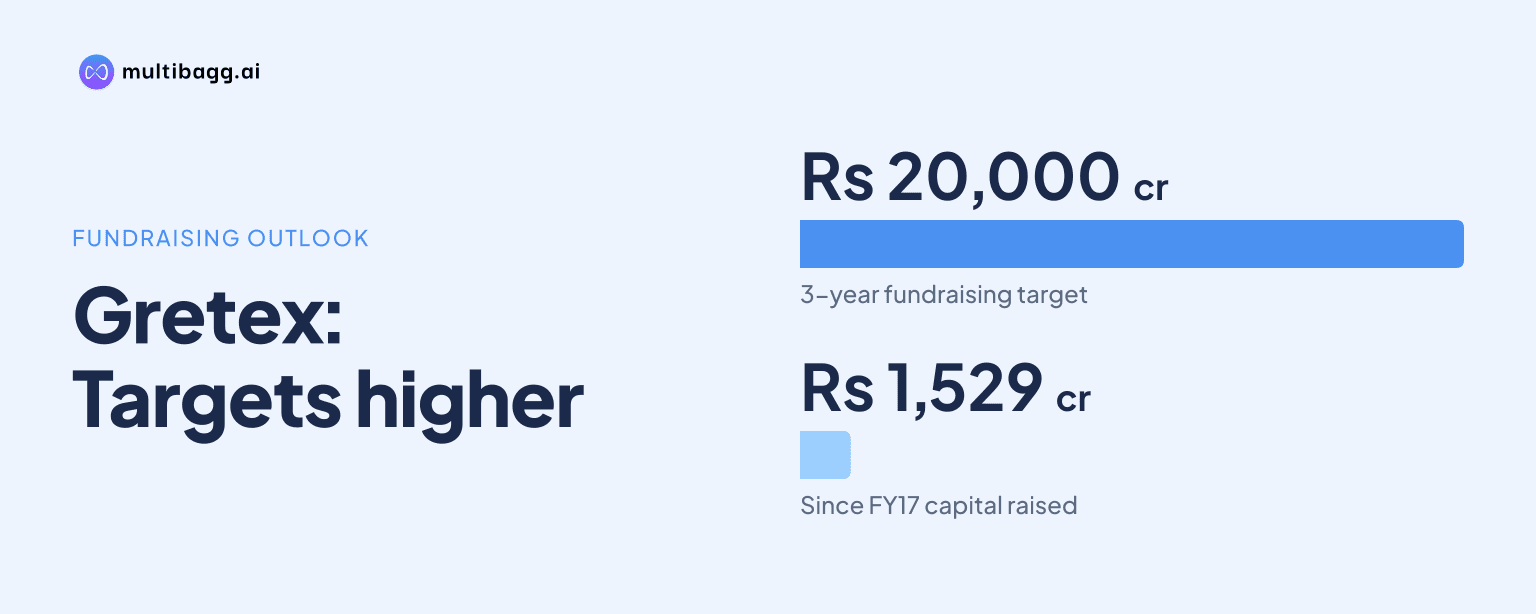
Gretex Corporate Services Limited targets about Rs 20,000 crore of fundraising through initial public offerings, or IPOs, and private-equity placements over the next three years, versus about Rs 1,529 crore cumulatively mobilised since FY17. The presentation does not state annual milestones, a period-by-period timetable, or a split between the two fundraising routes.
Know Gretex Corporate Services inside out
Results, valuation, peers and who's buying, in one view.
What is Gretex's three-year fundraising target?
Gretex's stated target is about Rs 20,000 crore of total fundraising through private-equity placements and IPOs over the next three years. The presentation gives no individual year target, no specified start or end financial year, and no allocation between IPOs and private-equity placements.
Measured against the Rs 1,529 crore cumulative capital mobilisation reported since FY17, the target is about 13 times the historical amount cited in the presentation. The deck separately identifies Rs 495 crore as Gretex's record annual capital mobilisation, placing the three-year target at a substantially higher scale than the disclosed historical annual record.
The disclosed IPO record shows a move toward larger mandates over time. Average issue size increased from Rs 5 crore in FY17 to Rs 45 crore in FY26, while IPOs managed rose from two to 11. FY25 had six IPOs against 11 in FY24, but its Rs 52 crore average issue size exceeded FY24's Rs 30 crore, showing a larger average mandate mix.
How does Gretex plan to pursue the Rs 20,000 crore goal?
Gretex plans to pursue the target by expanding larger mainboard IPO mandates and private-equity placements. For mainboard work, it identifies governance, research and investor education as readiness measures intended to improve strike rates and pricing outcomes; the presentation says Gretex migrated to the mainboard in September 2025.
The plan also includes expanding institutional broking through new institutional clients across mutual funds. Gretex intends to use GSBL's market-making platform to build an execution-economics layer, alongside corporate origination. The presentation describes the model as corporate origination and GSBL execution capturing fee income at both ends of a mandate.
Other disclosed initiatives broaden the offering around capital raising. Bahutex, identified as a partner company, received Category II Alternative Investment Fund, or AIF, registration, which the presentation says will deepen buy-side engagement. Gretex also acquired PlatinumOne Insurance Broking Pvt. Ltd. for insurance-broking facilities for clients of its material subsidiary, while GSBL opened a Navrangpura, Ahmedabad branch in line with subsidiary expansion plans.
Got a follow-up? Ask IRIS
What track record supports Gretex's expansion plan?
Gretex reports 62 IPOs managed since FY17 and about Rs 1,529 crore of cumulative capital mobilisation, alongside an 8.5 times increase in average issue size from FY17 to FY26. Its year-wise data show the average issue increasing from Rs 5 crore in FY17 to Rs 45 crore in FY26.
Gretex describes itself as a five-time Top Volume Performer for SME IPOs on BSE. Its model spans pre-IPO strategy, post-listing liquidity and market support, while the combination of merchant banking and market making allows GSBL to participate after listing. The presentation also identifies a Securities and Exchange Board of India, or SEBI, Category-I registration, numbered INM000012177.
The presentation contains two historical mobilisation figures. Its competitive-strengths page cites about Rs 1,579 crore mobilised, while the IPO activity and investment-highlights pages cite about Rs 1,529 crore. The latter figure appears with the detailed FY17-to-FY26 IPO record, but the difference remains unexplained in the disclosed material.
How has Gretex's financial performance changed before this expansion?
Gretex's consolidated revenue from operations declined to Rs 178.5 crore in FY26 from Rs 258.9 crore in FY25, while earnings before interest, tax, depreciation and amortisation, or EBITDA, increased to Rs 42.8 crore from Rs 1.3 crore. EBITDA margin increased to 23.98% in FY26 from 0.50% in FY25; H1-FY27 reported Rs 113.1 crore of revenue and Rs 26.6 crore of EBITDA.
Profit after tax, or PAT, increased to Rs 27.9 crore in FY26 from Rs 1.8 crore in FY25, and PAT margin rose to 15.63% from 0.70%. In H1-FY27, PAT was Rs 19.9 crore and PAT margin was 17.60%, maintaining a margin above the FY26 level despite the period being only the first half.
Cash flow from operating activities was negative Rs 31 crore in FY25 and negative Rs 28.3 crore in FY26, before turning positive at Rs 31 crore in H1-FY27. Total assets rose to Rs 334.9 crore in H1-FY27 from Rs 244.1 crore at FY26, while cash and cash equivalents stood at Rs 3.7 crore in H1-FY27.
Conclusion
Gretex's about Rs 20,000 crore three-year fundraising target is substantially larger than its disclosed Rs 1,529 crore cumulative mobilisation since FY17. The plan combines larger mainboard IPO mandates and private-equity placements with institutional broking, market making, AIF activity, insurance broking and equity-research capabilities.
The next disclosures to watch are progress in building larger mainboard mandates, the eventual division of fundraising between IPOs and private-equity placements, and any annual milestones for the three-year target. Investors can also watch for clarification of the difference between the presentation's Rs 1,529 crore and Rs 1,579 crore historical mobilisation figures.