










GRP Limited domestic sales reach 52%, overtaking exports
Key highlights
- GRP’s domestic standalone revenue increased 40% to Rs 167.8 crore in H1 FY27.
- Export revenue rose 19% to Rs 154.8 crore in H1 FY27.
- Domestic sales reached about 52% of standalone revenue, up from about 48% a year earlier.
- Pyrova had cumulative investment of Rs 114 crore at September 30, 2026, including Rs 11 crore of capital work in progress.
powered by IRIS
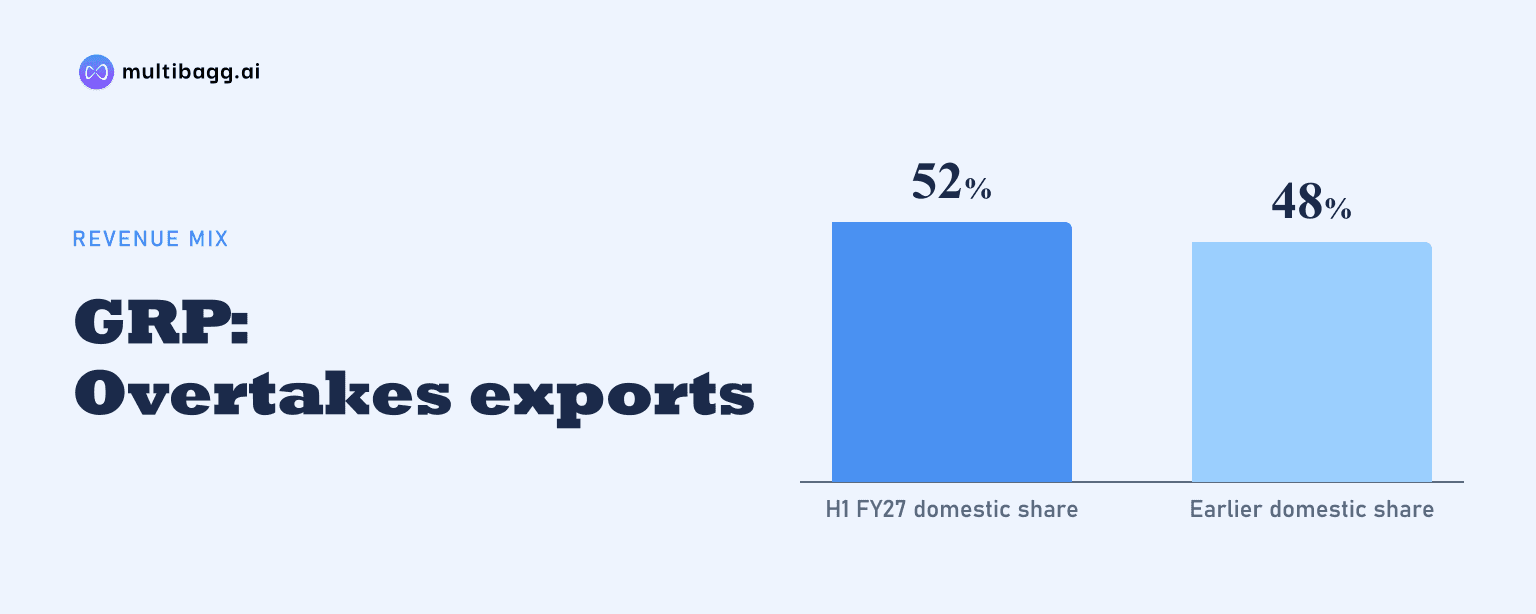
In H1 FY27, GRP Limited’s domestic standalone revenue rose 40% to Rs 167.8 crore, reached about 52% of revenue and exceeded Rs 154.8 crore of exports, marking a domestic-led sales mix. Management attributed the crossover chiefly to largely domestic Pyrova Energy sales and Indian demand for Reclaim Rubber.
Know GRP inside out
Results, valuation, peers and who's buying, in one view.
How did GRP’s domestic revenue overtake exports?
GRP’s domestic revenue overtook exports in H1 FY27, reaching Rs 167.8 crore against export revenue of Rs 154.8 crore. Domestic sales grew 40% year on year, more than twice the 19% growth in exports. The two disclosed revenue streams totalled Rs 322.6 crore, with domestic business accounting for about 52% of standalone revenue.
This marked a reversal from H1 FY26, when domestic sales represented about 48% of standalone revenue. The shift was therefore about 4 percentage points toward India in one year. Management said exports remain central to GRP, but described the faster domestic growth as a visible reshaping of a company that had been export-led for more than a decade.
Exports nevertheless recovered in H1 FY27. Management said the reset of US tariffs on Indian goods earlier in calendar 2026 allowed export order patterns to normalise after disruption in the prior year. Export revenue rose 19%, but the 40% increase in domestic sales was sufficient to move domestic revenue ahead in absolute terms.
What drove GRP’s domestic sales growth in H1 FY27?
GRP said Pyrova Energy and domestic Reclaim Rubber demand drove the faster domestic growth in H1 FY27. Pyrova recovers crumb rubber, tyre pyrolysis oil, recovered steel and, once commissioned, recovered carbon black, or rCB. Its sales are largely domestic, giving the newer platform a direct effect on the standalone revenue mix.
The core recycling business also supported the change. Standalone segment revenue increased 30% in H1 FY27, while Reclaim Rubber volume grew 8%. Management cited healthy Indian demand for Reclaim Rubber and said sales from its new reclaim-technology platform continued to rise quarter on quarter.
Management also pointed to stronger automobile production in the September quarter and growth across original-equipment and replacement channels reported by tyre manufacturers. Reclaimed-rubber consumption in India rose 5% year on year in the June quarter, according to management, providing industry context for the 8% rise in GRP’s Reclaim Rubber volumes.
Pyrova began recognising extended producer responsibility, or EPR, income in Q2 FY27 after completing its registration. Consolidated EPR income was Rs 11.5 crore in H1 FY27, including Rs 1.49 crore from Pyrova. GRP did not disclose Pyrova’s total revenue or profitability separately.
GRP had cumulatively invested Rs 114 crore in Pyrova as of September 30, 2026, including Rs 11 crore of capital work in progress. The Solapur rCB facility was being commissioned and pyrolysis-capacity expansion was under way through March 2027. Management clarified on the October 30, 2026 call that the commercial rCB plant was not operational and that GRP had only a pilot facility for market work.
Got a follow-up? Ask IRIS
What risks does GRP’s more domestic sales mix reduce and create?
GRP said the larger domestic share lowers exposure to tariffs, currency movements and international freight. This was management’s assessment of the mix change, not a quantified financial benefit. It followed export disruption from US tariffs and elevated energy and freight costs amid shipping disruption through the Strait of Hormuz.
The domestic mix does not remove commodity-price exposure. Management said tyre pyrolysis oil is used mainly as an industrial fuel and its price tracks crude oil and, more directly, furnace-oil prices. Crude rose from the mid-US$60s a barrel at the start of calendar 2026 to around US$100 by the end of September.
Management cautioned that Pyrova’s current oil realisations could soften if energy markets normalise. Its longer-term case for Pyrova rests on rCB, recovered steel, EPR income and integration with reclaimed-rubber operations. Management expects rCB to make the business less sensitive to fuel prices over time, subject to commissioning and commercial customer development.
A domestic-led model also changes operating requirements. GRP said it was adjusting internal processes for pricing, credit and working capital as domestic sales rise. For pyrolysis, management said the business relies entirely on domestic waste because imports are not permitted for that operation, while tighter imports of end-of-life tyre materials and higher freight costs have pressured domestic tyre-waste prices.
How is GRP’s financial performance supporting the mix transition?
GRP’s consolidated total income rose 28% to Rs 330 crore in H1 FY27, while earnings before interest, tax, depreciation and amortisation, or EBITDA, increased 60% to Rs 35.6 crore. These consolidated results include Plastics as well as rubber recycling, so they do not measure the profitability of standalone domestic sales alone.
H1 EBITDA margin rose to 10.8% from 8.6%, despite management saying gross margin fell by 5 percentage points because of raw-material inflation. In Q2 FY27, total income was Rs 172.7 crore, up 30% year on year, while EBITDA rose 60% to Rs 18.2 crore. Management attributed the operating outcome to higher volumes, manpower productivity, energy optimisation and newer-business contributions.
Working-capital management improved during the expansion. GRP reduced its working-capital cycle by 11 days, from 95 days on March 31, 2026 to 84 days on September 30, 2026. At September 30, gross debt was Rs 219.1 crore, net debt was Rs 214 crore and the consolidated debt-to-equity ratio was 1.13 times, compared with 1.08 times at March 31.
Conclusion
GRP’s H1 FY27 sales crossover means growth is no longer led solely by exports: domestic revenue of Rs 167.8 crore exceeded Rs 154.8 crore of exports as Pyrova and Reclaim Rubber expanded in India. The mix reduces some cross-border exposure, while increasing the importance of domestic pricing, receivables and end-of-life tyre sourcing.
The next markers are commissioning of the Solapur rCB facility, pyrolysis expansion through March 2027 and approvals in key markets. Management has said its platform-wide target is a mid-teen EBITDA margin as scale builds and rCB becomes operational, while cautioning that current pyrolysis-oil realisations are not necessarily a continuing run rate.