










GRP Limited targets Q2 FY28 gains from 45,000-tonne Pyrova
Key highlights
- GRP expects 45,000 tonnes of Pyrova capacity to have its full effect from Q2 FY28.
- Pyrova capacity is planned to rise from 15,000 tonnes to 45,000 tonnes a year around March-April 2027.
- Management expects the two new pyrolysis lines to stabilize within 30 to 60 days, versus four to five months for the first line.
- The Solapur facility is expected to require about Rs 140 crore for 45,000 tonnes of pyrolysis and 15,000 tonnes of rCB capacity.
powered by IRIS
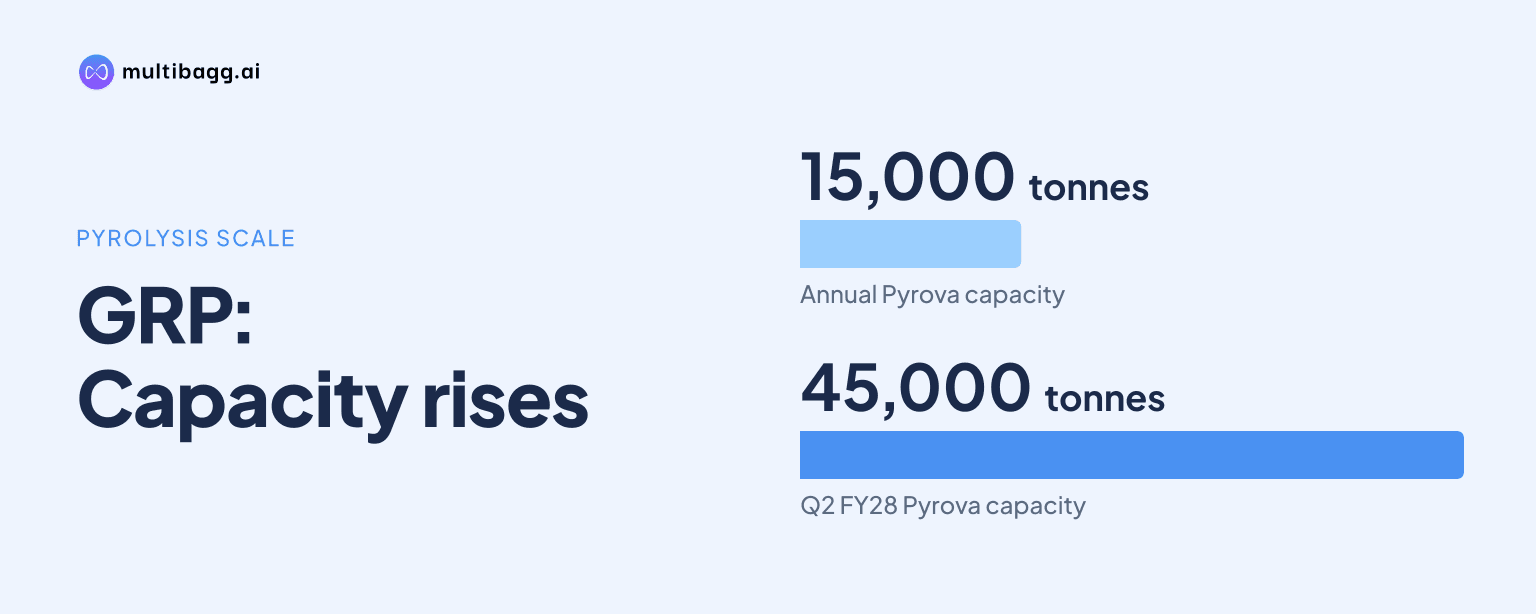
GRP Limited expects its Pyrova pyrolysis capacity expansion to 45,000 tonnes a year to have its full effect from Q2 FY28, after commissioning around late March to early April 2027 and a 30-to-60-day stabilization period. Management said the original 15,000-tonne line took four to five months to stabilize.
Know GRP inside out
Results, valuation, peers and who's buying, in one view.
When will GRP's Pyrova expansion affect earnings?
GRP expects the full effect of the additional Pyrova capacity from Q2 of the next financial year, which its stated commissioning timetable places in Q2 FY28. Management said equipment for the two additional pyrolysis lines was expected to arrive and be commissioned between the end of March and the first week of April 2027, followed by up to 60 days to establish steady operations.
The expected ramp-up is shorter than the experience with the first 15,000-tonne reactor. GRP said that line took four to five months to stabilize after ordering and commissioning, while the next two lines should take 30 to 60 days at most. Management attributed the shorter expected period to lessons from the first installation rather than to a disclosed change in reactor technology.
The project adds 30,000 tonnes of annual capacity and triples the existing 15,000-tonne base. GRP said the 45,000-tonne pyrolysis operation should be viewed with the planned 15,000-tonne recovered carbon black, or rCB, line at Solapur, because the assets form part of the same recycling location and wider platform.
What utilization does GRP expect at the enlarged Pyrova plant?
GRP said Pyrova utilization needs to be as close to 95% as possible because the reactors are designed to run uninterrupted for a prescribed number of days. Management said the current 15,000-tonne line had achieved the desired utilization, which supports its expectation that the additional lines can reach full utilization after their 30-to-60-day commissioning phase.
The utilization requirement makes the March-April 2027 start-up schedule important for the anticipated Q2 FY28 effect. A stabilization period of up to 60 days could allow operations to settle before the quarter in which management expects the full impact, although GRP did not provide a monthly output target for the 45,000-tonne facility.
GRP linked the larger scale to a site-level financial framework rather than providing separate Pyrova economics. Management expects the completed location to generate asset turns of close to two times and described a mid-teen earnings before interest, tax, depreciation and amortization, or EBITDA, margin objective for the combined platform. It did not disclose a Pyrova-only EBITDA margin, revenue target or return-on-capital target.
Got a follow-up? Ask IRIS
How much is GRP investing in Pyrova and rCB capacity?
GRP said the Solapur facility is expected to require total investment of about Rs 140 crore, including roughly 45,000 tonnes of pyrolysis capacity, about 15,000 tonnes of rCB capacity and associated upgrades. The figure presents the Pyrova expansion as part of an integrated site rather than as a stand-alone reactor investment.
An analyst referred to Rs 114 crore invested in Pyrova Energy, but management said that figure included infrastructure intended to support the full 45,000-tonne pyrolysis configuration. GRP added that a large part of the rCB investment was included in that amount and that the final expansion of the two extra pyrolysis lines would need only incremental spending. Management therefore said Rs 114 crore was not representative of the final full-scale project cost.
The rCB plant was expected to be commissioned by the end of the quarter in which the call took place. GRP said it could not provide an EBITDA target for rCB alone because management views pyrolysis, rCB and other recycling activities as one ecosystem and platform business. The company said it had recorded an 11% EBITDA margin consistently in the prior two quarters and targets a mid-teen margin once the broader platform is operating at scale.
Is Pyrova profitable and what could constrain the expansion?
GRP said Pyrova Energy generated a positive contribution in the current Q2, marking the first quarter in which the business had moved beyond cash losses. Management cautioned that profit was not yet at the level it expects once pyrolysis capacity reaches 45,000 tonnes and the 15,000-tonne rCB line is commissioned, assuming comparable pricing and margins continue.
Domestic end-of-life tire availability is the principal operating challenge identified for Pyrova. GRP said its pyrolysis activity relies entirely on domestic waste because imported waste is not permitted for pyrolysis, even though it imports some end-of-life tire waste for its separate reclaim-rubber business under Advance Licenses. Management said broadening domestic sourcing geography will be important to stabilizing margins at the larger facility.
Management also identified geopolitical conditions, higher freight costs and tighter waste-tire imports as pressures on domestic end-of-life tire prices. GRP said these factors were reflected in its financials and could affect input costs as pyrolysis capacity rises from 15,000 to 45,000 tonnes. It said the current regulatory framework does not allow imported waste for pyrolysis and did not comment on the status of industry representations seeking such permission.
Conclusion
GRP's plan is to triple Pyrova capacity from 15,000 to 45,000 tonnes a year and seek the resulting full-quarter benefit in Q2 FY28. The existing line has achieved management's desired utilization and Pyrova made a positive contribution in the current Q2, but management has not disclosed separate Pyrova revenue, EBITDA or return-on-capital figures.
The next milestones are commissioning around late March to early April 2027, the following 30-to-60-day stabilization period and commissioning of the 15,000-tonne rCB line by the end of the quarter discussed on the call. Management's progress in securing domestic end-of-life tires and managing input-price volatility will determine whether the Solapur location can approach its close-to-two-times asset-turn and mid-teen platform-margin targets.