










Gulf Oil maintains AdBlue volume growth target at 10%-15%
Key highlights
- Gulf Oil retained guidance for 10% to 15% AdBlue volume growth in the second half and the coming year.
- Gulf Oil said AdBlue volumes dipped slightly in the monsoon quarter but expects near-double-digit growth going forward.
- Gulf Oil reported lubricant sales growth of 17% in the first quarter and 16% in the second quarter.
- Gulf Oil increased its B2C outlet count by 16% from a previously cited base of 90,000 outlets.
powered by IRIS
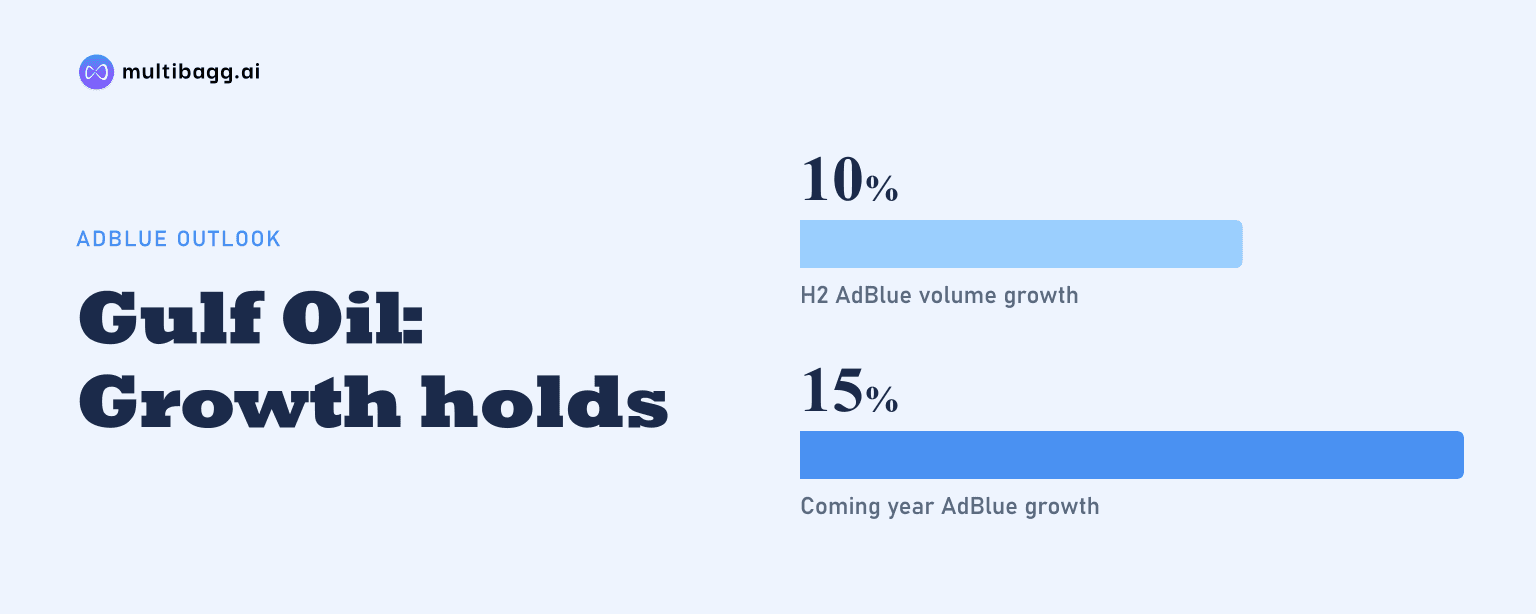
Gulf Oil retained its 10% to 15% AdBlue volume-growth target for the second half and the coming year, despite a slight monsoon-quarter decline, because the product is required only in BS-VI vehicles. Management said future demand should rise with the BS-VI vehicle population, but not at the exponential pace seen over the previous five years.
Know Gulf Oil Lubricants India inside out
Results, valuation, peers and who's buying, in one view.
Why is Gulf Oil guiding for 10% to 15% AdBlue volume growth?
Gulf Oil is guiding for 10% to 15% AdBlue volume growth because AdBlue is applicable only to BS-VI vehicles and management expects demand to increase as that vehicle population expands. Management said this remains its guidance for the second half and the coming year.
The outlook changes the expected pattern of category growth rather than withdrawing from AdBlue. Management said AdBlue demand will no longer be exponential as it was over the previous five years, and will instead be calibrated to market growth and the population of BS-VI vehicles. The installed BS-VI fleet is therefore the stated mechanism behind the 10% to 15% volume target.
What happened to Gulf Oil's AdBlue volumes in the monsoon quarter?
Gulf Oil reported a slight dip in AdBlue volumes in the quarter, which management attributed to the monsoon season. Management said AdBlue volumes are usually lower in a monsoon quarter, while continuing to expect near-double-digit growth in the second half.
The quarterly decline contrasts with the 10% to 15% forward target. Gulf Oil did not quantify the AdBlue volume decline or give a second-half volume figure, but said the expected recovery depends on additions to the BS-VI vehicle base. Its guidance therefore incorporates seasonal variation while retaining a double-digit growth objective for the period ahead.
How does Gulf Oil's AdBlue target compare with its lubricant outlook?
Gulf Oil's 10% to 15% AdBlue target is broadly in line with management's aim for near-double-digit lubricant volume growth in the second half, although the drivers differ. For lubricants, management said the industry normally grows by 3% to 4% in the second half and Gulf Oil aims to grow at two to three times that rate.
Gulf Oil reported lubricant sales growth of 17% in the first quarter and 16% in the second quarter. Management said first-quarter growth also benefited from supply security, while the October-to-March period normally has favourable conditions. It also cited weaker agricultural-season demand during the current month as a factor in second-half planning.
The comparison shows that Gulf Oil expects lubricant growth to depend on channel execution and seasonal conditions, whereas its AdBlue view is explicitly tied to the BS-VI vehicle population. In the business-to-consumer, or B2C, lubricant segment, management said first-half growth was twice the market growth rate and that it aims to sustain growth of at least two times the market rate.
Got a follow-up? Ask IRIS
What channel and product trends could affect Gulf Oil's volume plans?
Gulf Oil said its B2C distribution network grew 16% in outlet count from a previously cited base of 90,000 outlets. Management said it targets 10% to 15% outlet growth each year and is investing with mechanics to add touch points, supporting its aim to grow B2C lubricant volumes at least twice as fast as the market.
The usual revenue mix is roughly 55% B2C and 45% business-to-business, or B2B, including industrial business, Gulf Oil said. The reported quarter was closer to 50-50, compared with the usual 55-45 mix, as industrial business grows. The mix matters because B2C, original equipment manufacturer, or OEM, and B2B customers use different pricing mechanisms.
Gulf Oil said personal mobility accounts for about 21% of volume, while its passenger-car lubricant market share is below 5%. Management wants personal mobility to increase by 3% to 4%, with much of that increase coming from passenger cars. It is investing in independent workshops through its Custom Car Stop programme and aims for synthetic products to represent about 10% of its portfolio over the next three to four years.
How could costs and pricing influence Gulf Oil's second-half execution?
Gulf Oil said it has taken three price increases in its B2C channel business, while OEM contracts generally include quarterly price-variation clauses. During the previous six months, management said many OEM customers accepted monthly variations because raw-material costs moved quickly. B2B price changes take longer because they require negotiation with individual customers.
Base oil, a key crude-derived raw material, reflects crude-price movements with a lag, management said. Gulf Oil carries base-oil inventory for about 45 to 60 days and said a sustained rise in crude that affects base oil after roughly 40 to 50 days could require segment-specific price increases. Its stated objective is to protect per-litre margins rather than impose a uniform price increase across the portfolio.
Gulf Oil reported a margin of 11.8% and reiterated a medium- to long-term target range of 14% to 16%, rather than a target for the next one or two quarters. Management said inflation had increased revenue and profit in absolute terms, which can reduce percentage margins even when per-litre margins are maintained. It added that freight increases are reflected in base-oil costs because most purchases are on cost, insurance and freight, or CIF, terms.
Conclusion
Gulf Oil's 10% to 15% AdBlue target signals a more measured growth phase for a product whose demand management links directly to the expanding BS-VI fleet. The slight monsoon-quarter volume decline illustrates the seasonal effect, while lubricant sales growth of 17% in the first quarter and 16% in the second quarter provides the wider operating context.
What to watch next is whether AdBlue volumes recover in the second half toward management's 10% to 15% target as the BS-VI vehicle population rises. Management's pricing response also remains conditional on sustained crude and base-oil cost increases, which could emerge after the stated 40- to 50-day lag.