










Gulf Oil says working capital is near peak after inflation
Key highlights
- Gulf Oil said gross working-capital days remained within its usual 95-to-105-day range in H1 FY27.
- Core lubricant volume rose 16% year on year to 47,000 kilolitres in Q2 FY27.
- Gulf Oil said base-oil inventory typically covers at least 45 days and sometimes 60 days.
- The Valsad fire cost inventory equal to about four to five days of production, while 25 warehouses remained operational.
powered by IRIS
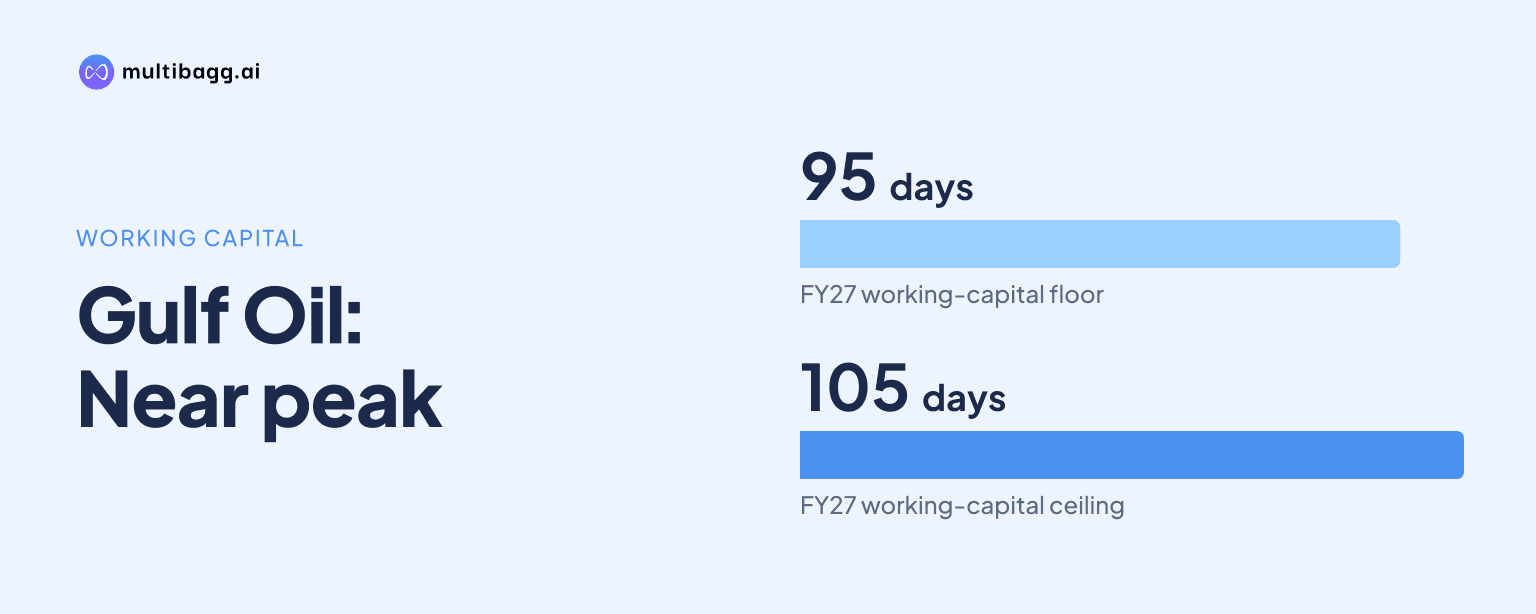
Gulf Oil Lubricants India Ltd. said on October 30, 2026 that its working-capital amount was near a peak because inflation increased inventory and receivable values, while gross working-capital days remained within its usual 95-to-105-day band. Management said moderation should follow if prices do not rise significantly further.
Know Gulf Oil Lubricants India inside out
Results, valuation, peers and who's buying, in one view.
Why did Gulf Oil's working capital rise in H1 FY27?
Gulf Oil's working capital rose because higher input costs and selling prices increased the rupee value of inventory and receivables. Chief Financial Officer Manish Gangwal said the increase reflected pricing that had become “tremendously high,” rather than a material change in the operating cycle measured in days. Gulf Oil did not disclose its absolute working-capital balance or separate inventory and debtor-day figures on the October 30 call.
The increase came during a period of higher lubricant sales and pricing actions. Core lubricant volume rose 16% year on year to 47,000 kilolitres in Q2 FY27 from 40,500 kilolitres a year earlier, while revenue grew 44%. Management said calibrated price increases helped it maintain supplies for customers, distributors and original equipment manufacturer, or OEM, partners amid higher costs and supply-security requirements.
Distributor support can also increase funding needs when product values rise. Gangwal said Gulf Oil must support distributors pragmatically because their own working-capital requirement increases in absolute terms as product prices increase. That mechanism can raise the value of Gulf Oil's receivables and inventory without requiring a longer operating cycle.
Has Gulf Oil's working-capital cycle changed?
Gulf Oil said its gross working-capital cycle has not meaningfully changed and remains within its usual 95-to-105-day range. Management made that distinction after an analyst said inventory and debtor days had increased meaningfully in H1 FY27 compared with FY26. The company therefore separated the higher cash amount tied up in operations from the number of days in the cycle.
The analyst said Gulf Oil's working capital had historically been below 80 days and asked whether about 100 days would become the new level. Management did not set a new target or endorse that comparison. Instead, it said the current amount was near a peak and should moderate if prices do not escalate significantly, leaving the future day count undisclosed.
Core lubricant growth provides part of the operating context for the higher values. H1 FY27 core lubricant volume reached 95,000 kilolitres, roughly 17% above the prior year's first half, while AdBlue volume was close to 73,000 kilolitres and broadly flat. The difference indicates that core lubricants, together with higher pricing, were the principal disclosed drivers of the working-capital increase.
What could reduce Gulf Oil's working capital in H2 FY27?
Gulf Oil expects working capital to moderate if prices stop escalating significantly. Gangwal tied this outlook to the pricing environment rather than to a stated year-end cash-release target. Management gave no forecast for H2 FY27 working-capital days, inventory value, receivables or operating cash flow.
Base oil is the key variable because it is Gulf Oil's main raw material and responds to crude-price movements with a lag. Management said it generally carries base-oil inventory for at least 45 days and sometimes 60 days. If crude remains elevated long enough to affect base-oil prices, Gulf Oil may take calibrated, segment-wise price actions that could again increase the value of stock and receivables.
Management said it had already passed on the current cost impact and protected per-litre margins. Earnings before interest, tax, depreciation and amortisation, or EBITDA, rose 37% year on year in Q2 FY27, while the EBITDA margin was 11.8%, close to Gulf Oil's stated 12% to 14% range. Gangwal said per-litre performance is more useful during inflation because higher selling prices can expand revenue while reducing the percentage margin.
Got a follow-up? Ask IRIS
Can Gulf Oil reduce stock without affecting customer supplies?
Gulf Oil's stated priority is to protect customer supply while recalibrating pricing and inventory as costs change. Management said supply security had been important during the inflationary period and that it had delivered every litre sought by customers and OEM partners. This approach can require higher inventory when input availability or future cost changes remain uncertain.
The October 30 call also addressed a fire at Gulf Oil's Valsad facility. Management said the lost inventory equalled about four to five days of production and was covered by insurance. Gulf Oil plans extra shifts at both plants, said both plants were running fully, and cited 25 operational warehouses across India that could support transfers if needed.
Management said it did not anticipate customer-supply disruption after the Valsad fire. That means an immediate reduction in inventory is not the disclosed operating objective, even though working capital may moderate with stable prices. The balance between service levels and stock values will depend on base-oil costs, distributor support and supply conditions through H2 FY27.
How does Gulf Oil's H2 FY27 sales outlook affect working capital?
Gulf Oil expects H2 FY27 lubricant-volume growth at two to three times the industry's normal 3% to 4% growth rate, which management said could result in close to double-digit growth. Higher sales can require more inventory and receivables in absolute terms, but management's near-peak assessment indicates that stable prices could offset some of that volume-related requirement.
Management also flagged weaker agricultural demand in the current month as a factor for H2 FY27. In Q2 FY27, it reported high-double-digit growth in OEM franchisee workshops and in the business-to-business industrial segment, and said nearly one-third of incremental industrial growth came from new customers. These channels can affect the pace of stock movement and distributor support as sales progress.
Conclusion
Gulf Oil's message is that elevated working capital reflects higher-priced inventory and receivables, customer support and supply-security requirements rather than a confirmed deterioration in its stated gross-day cycle. The 16% increase in Q2 FY27 core lubricant volume and 44% revenue growth show why operating funding needs rose as prices and sales expanded together.
The next issue to watch is whether base-oil costs rise after the 45-to-60-day inventory period if crude stays elevated. Management said it may take calibrated, segment-wise price actions if required, while aiming for H2 FY27 lubricant growth at two to three times industry growth and using extra shifts and 25 warehouses to maintain supplies after the Valsad fire.