










Gulf Oil targets synthetics at 10% in three to four years
Key highlights
- Gulf Oil aims for synthetic lubricants to represent about 10% of its portfolio within three to four years.
- Gulf Oil's PCMO market share is below 5%, while personal mobility contributes about 21% of lubricant volume.
- Gulf Oil expects B2C to remain about 50% to 55% of business, with B2B including industrial sales.
- Gulf Oil estimates Chennai and Silvassa expansion spending at Rs 60 crore to Rs 62 crore.
powered by IRIS
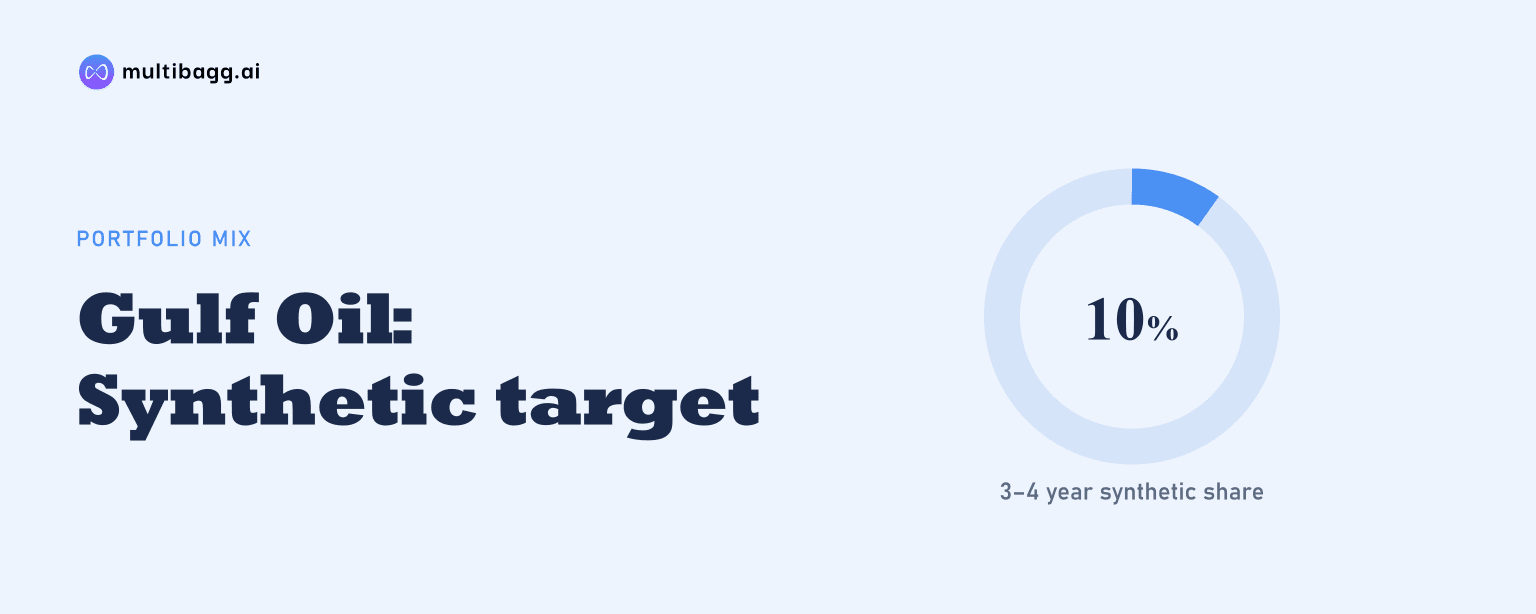
Gulf Oil said in its latest earnings call that it aims to make synthetic lubricants about 10% of its portfolio within three to four years, while using premium motorcycle and passenger-car products to support management's eventual 14% to 16% earnings before interest, tax, depreciation and amortisation, or EBITDA, margin trajectory.
Know Gulf Oil Lubricants India inside out
Results, valuation, peers and who's buying, in one view.
What is Gulf Oil's synthetic-lubricant target?
Gulf Oil's target is for its synthetic range to represent about 10% of the portfolio over the next three to four years. Management said it is moving both motorcycle and car ranges towards high-end synthetic products, and expects the initiative to show traction in the second half.
The synthetic target forms part of Gulf Oil's “Unlock 2.0” plan, which management described as acceleration, premiumisation and transformation. Premiumisation is intended to apply across original equipment manufacturer, or OEM, franchise workshops, the bazaar or aftermarket channel, and other parts of the lubricant business rather than one customer group alone.
Management referred to Syntrac while discussing the premium motorcycle programme and said it had launched the Pride campaign for its motorcycle range. The company said it does not want to lose focus on motorcycles while building its passenger-car lubricant presence, making the synthetic push an addition to, rather than a replacement for, its established two-wheeler franchise.
Why is Gulf Oil prioritising passenger-car lubricants?
Gulf Oil is prioritising passenger-car motor oil, or PCMO, because its market share in that category is below 5%, while personal mobility already accounts for about 21% of lubricant volume. Management said its motorcycle business is substantial in both the bazaar channel and OEM sales, leaving passenger cars as the stated area for further inroads.
Gulf Oil is investing in new independent workshops through its Custom Car Stop programme. Management said it would ideally like personal mobility to rise by at least 3% to 4%, with a large part of that increase coming from passenger cars, although it did not give a timetable for achieving that increase.
The company also said pricing and brand positioning differ by category, identifying motorcycles and diesel engine oils as product areas where it has a strong brand. Advertising and promotion spending was similar to slightly higher in the quarter because of the Pride campaign, while management said it was continuing to invest in brand and distribution for the bazaar business.
How is Gulf Oil balancing B2C and B2B growth?
Gulf Oil expects business-to-consumer, or B2C, sales to remain around 50% to 55% of its mix, with business-to-business, or B2B, sales comprising the balance. Historically, management put the split at roughly 55% B2C and 45% B2B, but said the reported quarter was closer to 50-50 because of the fast-growing industrial business.
The B2B component includes industrial sales, according to management. Gulf Oil said it would be satisfied if B2C and B2B both grew within the current broad range, rather than seeking a deliberate shift towards one channel, because each segment has its own growth and margin profile.
Exports were around 10% of the lubricants business at the time of the call. Management said that contribution had risen during the last six months because of global supply and supply-demand conditions, compared with the investor's estimate of 9% to 10% of the business.
Got a follow-up? Ask IRIS
Can synthetics support Gulf Oil's margin objective?
Management said a rising contribution from synthetic and other high-end products should further improve Gulf Oil's margin profile and reiterated confidence in an eventual 14% to 16% EBITDA margin trajectory. That is a management target, not a reported margin for the period covered by the call.
Gulf Oil said percentage margins looked lower during the recent inflationary period, but per-litre margins were stable to higher versus the prior-year first half, the prior-year second quarter and sequentially from the first quarter. Management attributed the difference to a higher cost base, rather than stating that unit profitability had declined.
Management's view is that the overall mix can support margin improvement even if B2C and B2B remain near the 55-45 range. It illustrated that B2C growing at twice the market and B2B at three times the market could still lift margin contribution because the two segments have different margin profiles and incremental volumes can provide operating leverage.
The company nevertheless said the last six months had been challenging and did not state that premiumisation had already expanded margins. Management said Gulf Oil would take profitable OEM franchise-workshop business when available, but that it was not trying to change its approach by pursuing one segment disproportionately.
What operational issues could affect the strategy?
Gulf Oil reported other expenses of Rs 283 crore in the quarter, down from Rs 321 crore in the preceding quarter. Management cited freight, OEM-linked royalties and lower AdBlue volumes as major influences, while advertising and promotion remained similar to slightly higher because of the Pride campaign.
Higher input costs have also increased inventory values and working-capital needs. An analyst cited inventory adjustments of about Rs 109 crore in Q1 FY27 and Rs 88 crore in Q2 FY27, compared with relatively insignificant amounts in the preceding four quarters; management attributed the change to higher end-product prices, copper inflation in the charger business and tactical purchases to secure supply.
Management said Chennai capacity expansion was on track for completion by the end of the quarter. Silvassa expansion could be delayed by one to two months into Q1 of the next year, instead of the earlier March 2027 readiness target, while Gulf Oil runs third shifts at plants when needed to meet demand.
Conclusion
Gulf Oil's strategy combines a premium-product programme with expansion in an underpenetrated passenger-car category and continued industrial growth. The company is seeking to preserve a B2C mix of roughly 50% to 55% while increasing the contribution of higher-end motorcycle and car lubricants, rather than relying on a major channel-mix change.
The next developments to watch are management's expected second-half traction in high-end products, Chennai's planned capacity addition by the end of the quarter and the potential Silvassa spillover into Q1 of next year. Management has also said its eventual 14% to 16% EBITDA-margin trajectory depends on premiumisation, volume growth and operating leverage as the current cost environment evolves.