










Tirex Q2 revenue rises 78%, capacity set for 3,000 chargers
Key highlights
- Tirex reported more than Rs 33 crore of Q2 revenue, up 78% from about Rs 18 crore a year earlier.
- Tirex plans to increase charger capacity to 3,000 units by the end of the year.
- Management cited EV cars, buses, OEMs and CPOs as demand channels for Tirex.
- Tirex is considering product expansion for buses, mining and construction equipment.
powered by IRIS
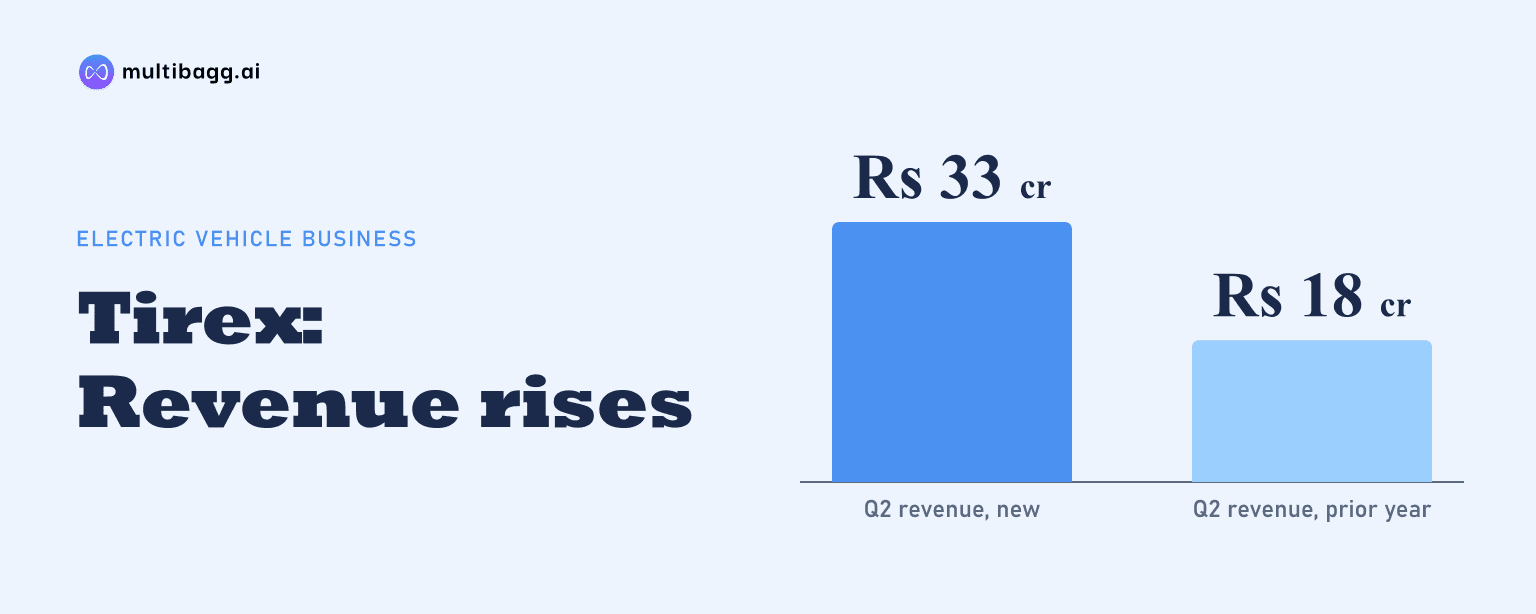
Tirex reported more than Rs 33 crore of Q2 revenue, 78% above about Rs 18 crore a year earlier, and management plans to raise capacity to 3,000 chargers by the end of the year. The quarterly increase, which management said came from a low base, accompanied demand discussions with original equipment manufacturers, charging-point operators and bus customers.
Know Gulf Oil Lubricants India inside out
Results, valuation, peers and who's buying, in one view.
How fast did Tirex revenue grow in Q2?
Tirex grew Q2 revenue by 78% year on year to more than Rs 33 crore, from about Rs 18 crore in the prior-year quarter. Management said the comparison had a low base, but cited higher electric-car sales and increasing bus requirements as factors supporting charger demand.
The more than Rs 33 crore disclosure applies to Q2, not to the first half, management clarified during the call. Tirex did not disclose an H1 revenue total, charger shipment volume, order book, profit or margin, so the Q2 revenue figure is the available measure of its reported sales scale.
Management presented the 78% rise as revenue growth rather than a volume increase. It identified original equipment manufacturers, or OEMs, and charging-point operators, or CPOs, among the customer groups it is approaching, but did not split Q2 revenue between those channels, buses and other applications.
When will Tirex reach 3,000-charger capacity?
Tirex plans to take capacity to 3,000 chargers by the end of the year, management said after reporting more than Rs 33 crore of Q2 revenue. The company described the capacity increase as part of its response to expanding electric-vehicle charging requirements.
Management did not state Tirex's current capacity, the capital expenditure required for the expansion or the utilisation expected once 3,000 chargers of capacity is available. It also did not specify whether the 3,000-charger figure represents an annual production measure, so the disclosed commitment is the capacity level and end-of-year timing.
The planned expansion is linked to Tirex's portfolio in direct-current, or DC, chargers and buses. Management did not attribute the 3,000-charger plan to a named customer, committed order quantity or a particular OEM or CPO contract.
Which end markets is Tirex targeting for chargers?
Tirex is targeting EV cars, buses, mining and construction equipment, while management also said private buses and construction-equipment operators are considering charging options. These segments extend the company's stated opportunity beyond passenger electric vehicles following Q2 revenue of more than Rs 33 crore.
Management said electric cars are selling more and buses are increasing, but gave no market-size estimate or revenue forecast for either segment. It also did not disclose the contribution of private buses, mining or construction equipment to the 78% Q2 revenue increase.
The bus market is a stated focus because management referred to Tirex's DC-market and bus portfolio when discussing the planned capacity increase. The company did not provide charger pricing, equipment specifications or a timetable for sales into mining and construction equipment.
Got a follow-up? Ask IRIS
How could ElectreeFi support Tirex's expansion?
Tirex expects synergies with ElectreeFi, the company's software-as-a-service business, to materialise as new OEMs are added, management said. The comments were made alongside the more than Rs 33 crore Q2 revenue disclosure and the plan for 3,000 chargers of capacity.
Management did not quantify ElectreeFi revenue, identify the additional OEMs or state whether software was included in Tirex's Q2 revenue. As a result, the call establishes a planned commercial linkage between the charger and software operations, rather than a measured financial contribution.
Tirex is also looking to expand its product portfolio, according to management. The company connected new products with its existing DC charging and bus offerings and with potential uses in mining and construction equipment, but gave no model names or launch dates.
What does the wider business commentary mean for Tirex?
Tirex's 78% revenue growth was disclosed during a quarter in which the company's core lubricant volume rose 16% to 47,000 kilolitres from 40,500 kilolitres a year earlier. The two measures are not directly comparable, but both indicate that the charger operation's update came alongside higher lubricant volumes.
Management said higher copper prices had lifted end-product pricing in the charger business as well as in lubricants. It did not quantify copper's impact on Tirex's Q2 margin, inventory or selling prices, meaning revenue growth should not be read as a measure of profitability or cash generation.
The company also cited tactical buying to secure supplies when discussing elevated inventory values in Q1 and Q2 of FY27. That commentary included chargers, but management did not provide Tirex-specific data on component inventory, working capital, production output or supply sourcing.
Conclusion
Tirex delivered a reported Q2 revenue increase of 78% to more than Rs 33 crore, compared with about Rs 18 crore a year earlier. Management is broadening the stated market focus from EV cars and buses to CPOs, OEMs, private buses, mining and construction equipment, while also linking the business to ElectreeFi's software platform.
The next disclosed marker is Tirex's plan to reach capacity of 3,000 chargers by the end of the year, with new products also described as being in the pipeline. The unresolved matters are current capacity, expansion spending, utilisation, customer orders and Tirex-specific profitability, none of which management quantified in the Q2 discussion.