










Gulf Oil says M&A comes before further shareholder payouts
Key highlights
- Gulf Oil said last year's dividend payout was around 65% to 70% of profit.
- Core lubricant volume rose nearly 16% to 47,000 kilolitres in the second quarter.
- Tirex second-quarter revenue increased 78% to about Rs 33 crore.
- Gulf Oil reported an 11.8% quarterly EBITDA margin against its 12% to 14% guidance band.
powered by IRIS
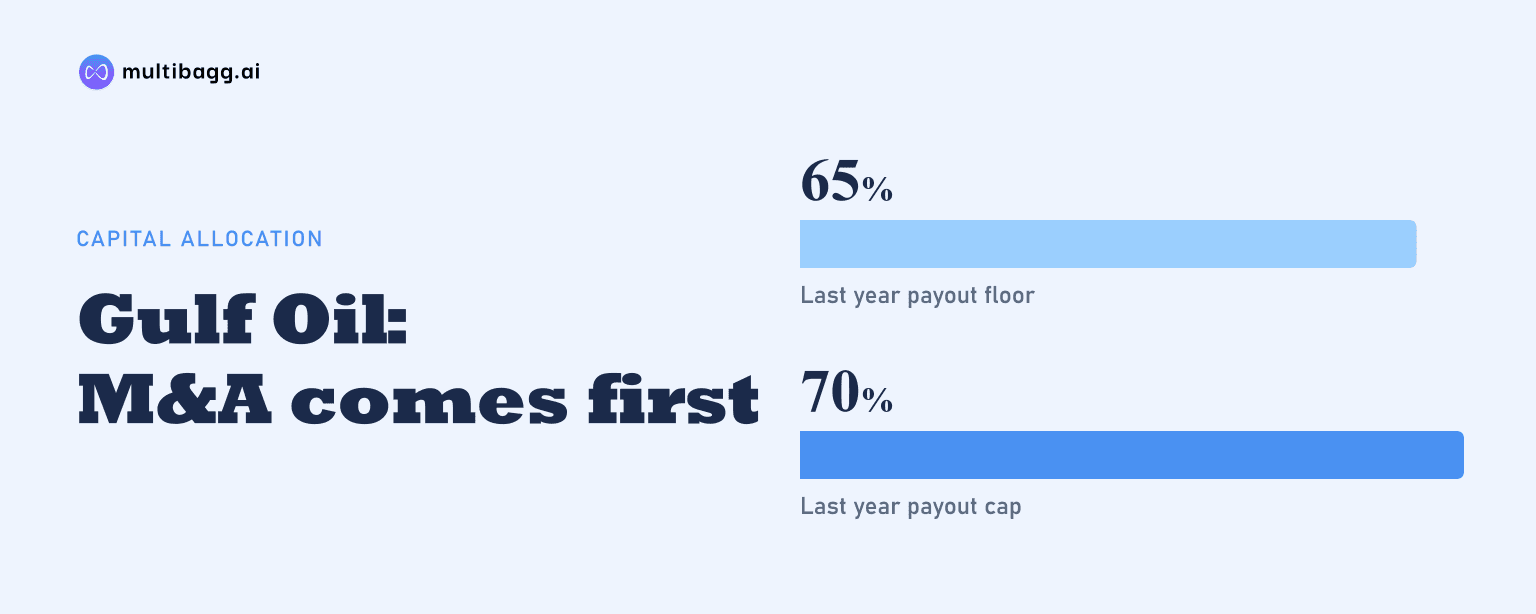
Gulf Oil said it will prioritise M&A, investment in its existing business and adjacent businesses before additional shareholder cash returns, after paying around 65% to 70% of profit as dividends last year. The company reported core lubricant volume of 47,000 kilolitres in the second quarter, nearly 16% above 40,500 kilolitres a year earlier.
Know Gulf Oil Lubricants India inside out
Results, valuation, peers and who's buying, in one view.
Will Gulf Oil put M&A before higher payouts?
Yes. Gulf Oil said it is closely examining the use of cash on its balance sheet and will prioritise M&A, investments in the existing business and business adjacencies before deciding on further shareholder distributions. Management made the statement while answering a question about whether the company could pay a dividend similar to the prior year.
Gulf Oil said its dividend payouts have risen over the years and were around 65% to 70% last year. It did not commit to a current-year payout ratio, announce a special dividend or set a date for a capital-return decision. Management said it would return cash to shareholders in line with past practice if it continues generating cash and has no immediate use for it.
The disclosure sets an order of capital allocation rather than a committed deal programme. Gulf Oil will first assess investment opportunities, while dividend distributions remain conditional on surplus cash after those needs. The call did not disclose a Rs 1,200 crore cash balance, a formal acquisition reserve or a specific acquisition budget.
What acquisition plans has Gulf Oil actually disclosed?
Gulf Oil has disclosed that it is considering M&A in or around its existing businesses, but it has not announced a target, transaction size, valuation range, funding structure or completion timetable. Management referred broadly to the existing business and adjacent businesses rather than naming a lubricant, industrial or electric-vehicle acquisition candidate.
The company’s operating comments identify businesses it is developing, not acquisition plans. In the second quarter, Gulf Oil said Tirex revenue was about Rs 33 crore, compared with Rs 18 crore in the prior-year quarter, representing 78% growth. Management also said Tirex capacity is planned to rise to 3,000 chargers by the end of the year.
Gulf Oil said Tirex is seeing potential demand from electric buses, construction equipment and mining, while ElectreeFi, its software-as-a-service business, is adding original equipment manufacturers, or OEMs. Those remarks indicate areas of commercial activity, but management did not say that Gulf Oil intends to buy a charging, software, industrial or lubricant company.
How did Gulf Oil perform in the second quarter?
Gulf Oil delivered nearly 16% growth in core lubricant volume in the second quarter, reaching 47,000 kilolitres from 40,500 kilolitres in the prior-year quarter. The increase of 6,500 kilolitres followed 17% first-quarter growth, according to management.
For the first half, Gulf Oil reported core lubricant volume of 95,000 kilolitres, about 17% above the prior-year first half. Management said this growth was three to four times industry growth in the first half, while also estimating its overall market share at 7% to 8%.
Revenue rose 44% year on year and earnings before interest, tax, depreciation and amortisation, or EBITDA, rose 37%, management said. Quarterly EBITDA margin was 11.8%, close to the company’s stated 12% to 14% band. Gulf Oil said it focuses on protecting per-litre margin because higher prices can lift revenue and reduce the percentage margin even when per-litre economics are maintained.
Got a follow-up? Ask IRIS
What could affect Gulf Oil's cash deployment?
Working capital and raw-material pricing are potential calls on Gulf Oil’s cash. Management said gross working-capital days were within its usual 95-to-105-day range, although inventory and receivable values had increased because input costs and selling prices had risen. It expects some moderation if prices do not escalate significantly further.
Gulf Oil said it typically carries 45 to 60 days of base-oil inventory. Base oil is its key crude-derived raw material, and management said changes in crude prices reach base-oil prices with a lag. If elevated crude prices persist and affect base oil after about 40 to 50 days, the company may consider segment-specific price increases.
The company has already taken three price increases in its business-to-consumer, or B2C, channel over the last six months. OEM business generally has quarterly price-variation clauses, although management said some OEMs accepted monthly variations during rapid cost changes. Business-to-business pricing requires separate negotiations, making the pricing response different across segments.
A fire at Gulf Oil’s Valsad site also reduced inventory by the equivalent of about four to five days of production. Management said the stock was insured, both plants were operating fully and its 25 warehouses remained operational. The company said extra shifts and possible transfers from other locations should prevent disruption to customer supplies.
What does Gulf Oil expect in the second half?
Gulf Oil expects the lubricant industry to grow about 3% to 4% in the second half and aims to grow at two to three times that rate. Management said that outcome could take its second-half lubricant volume growth close to double digits, after 17% growth in the first quarter and nearly 16% in the second quarter.
Management said October through March normally provide favourable seasonal conditions, but it also flagged weak agricultural demand at the time of the call. It distinguished first-half growth from normal demand because supply-security conditions had contributed to sales. The company’s stated second-half objective is therefore a target, not a reported result.
In B2C, Gulf Oil said its outlet network had previously stood at 90,000 outlets and the number of outlets grew 16%. Management said it seeks B2C growth of at least twice the market rate and reported that B2C grew at twice the market rate in the first half.
For AdBlue, Gulf Oil reported 33,000 kilolitres in the second quarter and close to 73,000 kilolitres in the first half. Management attributed the second-quarter softness partly to monsoon-related lower truck movement. It retained guidance for 10% to 15% AdBlue volume growth, linked to the growing population of Bharat Stage VI vehicles.
Conclusion
Gulf Oil’s stated capital-allocation position is that M&A, investment in existing operations and adjacent businesses come before additional cash returns. The company’s 65% to 70% prior-year dividend payout, 47,000-kilolitre second-quarter lubricant volume and 11.8% EBITDA margin provide the operating context, but they do not constitute a declared acquisition fund or a promised dividend level.
The next disclosures to watch are whether Gulf Oil identifies a specific M&A opportunity, completes the planned expansion of Tirex capacity to 3,000 chargers by the end of the year, and delivers its target of growing lubricant volumes two to three times faster than the industry in the second half. Management also said movement in base-oil costs after a 40-to-50-day lag could determine whether further pricing actions are needed.