








Happiest Minds says 55% of projects use AI delivery in Q2 FY27
MAX Plan at ₹4,999/yr

Find your next multibaggerBe a Pro Investor
Research stocks and track your picks on the go. Download the app.
Key highlights
- Happiest Minds said 55% of all projects used AI-enabled delivery in Q2 FY27.
- Happiest Minds said 72% of developers and testers used advanced AI tools in customer delivery work in Q2 FY27.
- Happiest Minds' generative AI services unit grew approximately 135% year-on-year in constant currency in H1 FY27.
- Happiest Minds reported Q2 FY27 operating revenue of Rs 645 crore, up 2.7% sequentially.
powered by IRIS
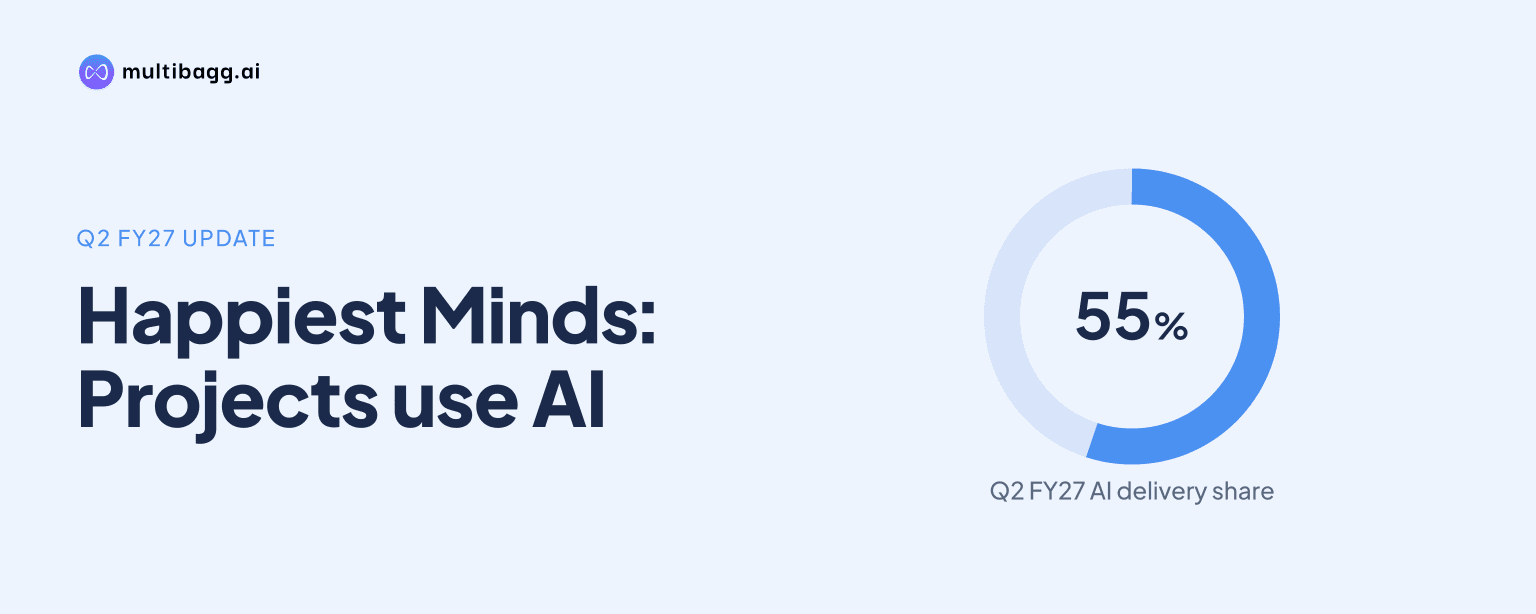
Happiest Minds said 55% of all projects used AI-enabled delivery in Q2 FY27, while its generative AI services business unit grew about 135% year-on-year in constant currency during H1 FY27. Management said the unit is scaling from a relatively smaller base, but linked the growth to rising adoption of AI use cases and AI-native solutions.
Know Happiest Minds Technologies inside out
Results, valuation, peers and who's buying, in one view.
How widely does Happiest Minds use AI in project delivery?
Happiest Minds said AI-enabled delivery was used on 55% of all projects in Q2 FY27, and 72% of its developers and testers used advanced AI tools in customer project delivery. The figures measure delivery adoption rather than employee access to AI tools, and management said both percentages should continue to rise through training and skill-development programmes.
Happiest Minds is using Rel(AI)Build, its AI service-delivery platform, to support collaboration between human engineers and AI agents across the software development life cycle, or SDLC. The company said the platform and related tools are being applied to coding, testing, documentation, application modernisation and quality engineering, with the objective of improving productivity, quality and delivery speed.
The company described the delivery approach as a redesign of workflows, rather than automation of isolated SDLC tasks. Happiest Minds said it combines automation with engineering controls and human oversight so that its use of AI agents in delivery does not compromise quality or security.
What is driving Happiest Minds' AI delivery strategy?
Happiest Minds said its AI spending is centred on three priorities: making AI native to solution design, embedding it across engineering and delivery, and building the platforms, skills and governance needed for enterprise adoption. Its enterprise AI platform is intended to combine different AI models, enterprise data and industry-specific use cases within a governed architecture.
The platform is designed to avoid building every customer solution separately, according to management. Happiest Minds is also investing in reusable agents, accelerators, enterprise AI frameworks and industry offerings, with agentic AI aimed at orchestrating more complex technology and business workflows.
Management said the enterprise AI platform can produce higher AI productivity than using agents with foundation models alone. It said this capability enabled more aggressive fixed-bid proposals than competitors, including a multimillion-dollar BOTAT engagement with a global digital asset-management company. BOTAT stands for Build, Operate, Transform, Agentify and Transfer.
In that BOTAT engagement, Happiest Minds committed to a specified AI productivity percentage as part of the transformation outcome by agentifying the full SDLC by FY28. The company did not disclose the productivity percentage or contract value, but said AI productivity elements were a key reason it secured the deal.
How fast is Happiest Minds' generative AI business growing?
Happiest Minds' generative AI services business unit grew approximately 135% year-on-year in constant-currency terms in H1 FY27. Management cautioned that the unit is scaling from a relatively smaller base and did not disclose its revenue contribution.
The company said generative AI and agentic AI use cases are moving towards live, repeatable solutions. Management expects reusable offerings to reduce implementation effort, speed deployment and allow proven capabilities to be applied across multiple customer environments, rather than treating each engagement as an isolated implementation.
The reported growth was faster than Happiest Minds' overall revenue expansion in H1 FY27. Company-wide operating revenue was approximately Rs 1,274 crore in H1 FY27, up 13.4% year-on-year in rupee terms and about 6.8% in constant currency, compared with the generative AI unit's approximately 135% constant-currency growth from its smaller base.
In Q2 FY27, operating revenue was Rs 645 crore, up 2.7% sequentially and 12.5% year-on-year in rupee terms. Those company-wide figures do not identify AI revenue, but they provide the financial context for management's statement that generative AI services are seeing increasing customer adoption.
Got a follow-up? Ask IRIS
How is Happiest Minds applying AI in customer engagements?
Happiest Minds is using AI in customer projects, reusable industry products and fixed-price transformation proposals. In Q2 FY27, it secured an engagement with an Indian steel manufacturer to build a unified digital planning and execution platform intended to move production planning from a reactive process to a structured, transparent and AI-enabled one.
The company also cited end-to-end test automation for a warehousing platform where no product documentation or manual test-case details were available. Happiest Minds said AI enabled it to create a complete set of automation test cases for a project that would previously have been near impossible or would have taken a very long time.
Its reusable solutions include EduWeave for universities, Arttha and Insurance in a Box. Happiest Minds said EduWeave is generating interest in Southeast Asia, the Middle East and India, with a pipeline covering academic, administrative and student-facing processes at multiple institutions.
Happiest Minds is positioning AI alongside digital engineering, data, cloud and enterprise platforms for industry-specific requirements. The company said customers increasingly seek solutions that can move from experimentation into core technology and business environments, while security, data governance, model reliability and human oversight are being built into its platforms and delivery approach.
What operating evidence supports Happiest Minds' AI expansion?
Happiest Minds ended Q2 FY27 with 311 active customers, while repeat business increased to 95.1%. The company said 95 billion-dollar corporations contributed almost 60% of revenue, up from 92 such corporations in Q1, providing a large-enterprise customer base for its transformation and engineering engagements.
The company reported that intellectual-property-led revenue rose to 10.5% in Q2 FY27 from 9.3% in Q1. That sequential increase coincides with its stated focus on platforms, reusable solutions and intellectual property, including EduWeave, Arttha, Insurance in a Box and enterprise AI frameworks.
Happiest Minds' Q2 operating profit was Rs 119 crore, up 9.6% sequentially and 22.4% year-on-year, while operating margin rose by 100 basis points to about 18.5% from 17.5% in Q1. Management attributed the margin movement to improved utilisation, operating efficiencies and continuing cost discipline, rather than separately quantifying AI's contribution.
Conclusion
Happiest Minds has provided measurable evidence that its AI strategy is being used in mainstream delivery, with 55% of projects using AI-enabled delivery and 72% of developers and testers using advanced AI tools in Q2 FY27. The generative AI services unit's approximately 135% constant-currency growth in H1 FY27 indicates commercial momentum, although management said the unit remains relatively small.
The next developments to watch are management's plan to increase AI adoption across projects and employees, industrialise reusable intellectual property and expand repeatable solutions across customer environments. The disclosed FY28 milestone is the BOTAT engagement's planned full-SDLC agentification, while the company has not provided a revenue target for generative AI services or a target percentage for AI-enabled projects.

