










HEG Advanced Materials maps Rs 5,500 crore capex through FY29
Key highlights
- HEG Advanced Materials plans approximately Rs 5,500 crore of capital expenditure through FY29.
- Anode investment totals Rs 3,950 crore for planned capacity of 44,000 metric tonnes by March 2029.
- Management expects approximately Rs 2,300 crore of capex in FY27 and Rs 1,600 crore to Rs 1,700 crore in FY28.
- RePlus is planned to expand from 1 GWh to 6 GWh, with added capacity targeted for COD in March 2027.
powered by IRIS
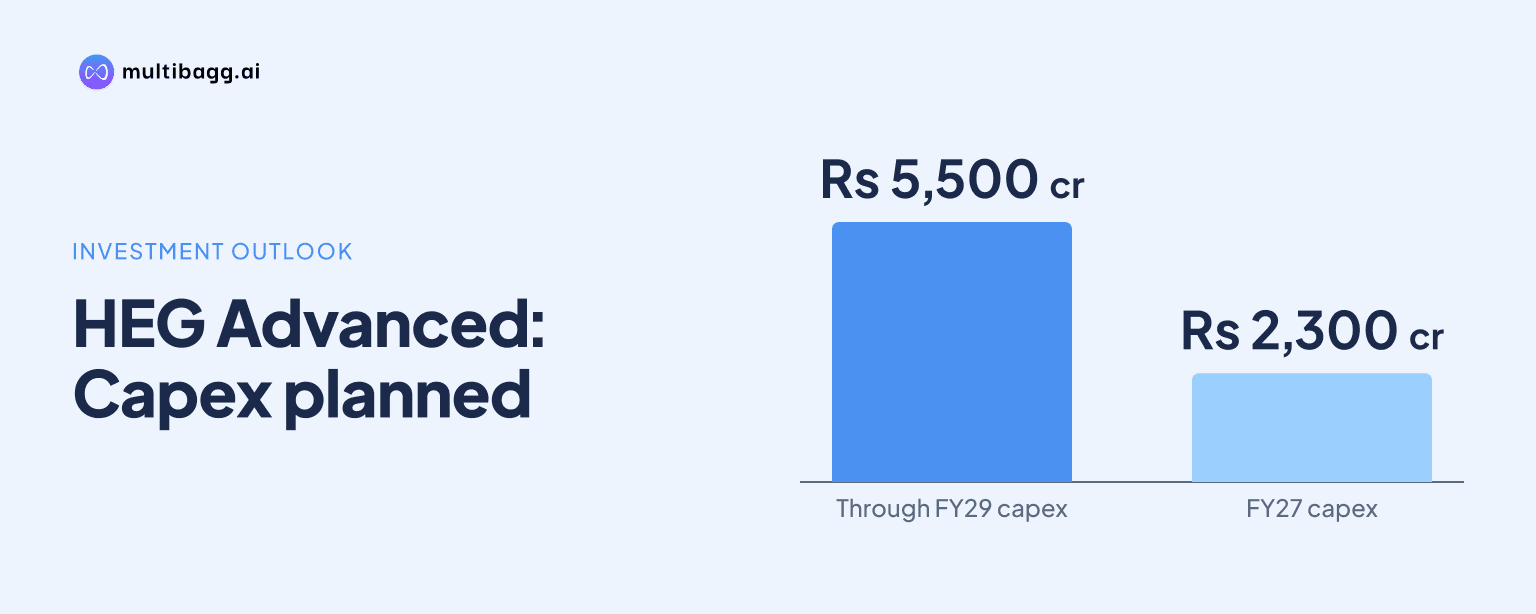
HEG Advanced Materials Limited plans approximately Rs 5,500 crore of capital expenditure through FY29, including Rs 3,950 crore for 44,000 metric tonnes of anode capacity. Management expects approximately Rs 2,300 crore to be incurred in FY27, Rs 1,600 crore to Rs 1,700 crore in FY28, and the remaining balance in FY29.
Know HEG Advanced Materials inside out
Results, valuation, peers and who's buying, in one view.
What is HEG Advanced Materials spending Rs 5,500 crore on?
HEG Advanced Materials is allocating its approximately Rs 5,500 crore programme across anode materials, graphene, graphitized crucibles and battery energy storage system, or BESS, activities. The largest allocation is Rs 2,350 crore for the existing 20,000-metric-tonne anode plant and Rs 1,600 crore for a further 24,000 metric tonnes, taking planned anode capacity to 44,000 metric tonnes by March 2029.
Management also identified Rs 500 crore for graphene, Rs 475 crore for an 80,000-unit crucible facility, Rs 250 crore for RePlus expansion and Rs 230 crore for a BESS independent power producer, or IPP, project in Gujarat. These identified allocations total approximately Rs 5,405 crore, compared with the overall programme of approximately Rs 5,500 crore.
When will HEG Advanced Materials incur the expansion spending?
HEG Advanced Materials expects the major part of its approximately Rs 5,500 crore programme to be spent in FY27 and FY28, with the remaining expenditure due in FY29. Chief Financial Officer Neha Rajvanshi said approximately Rs 2,300 crore is planned in FY27 and Rs 1,600 crore to Rs 1,700 crore in FY28.
The schedule corresponds with the company’s main project milestones. The 20,000-metric-tonne Dewas anode plant was 61% complete and targeted for commercial commissioning by June 2027, while Phase 2 is intended to increase total anode capacity to 44,000 metric tonnes by March 2029. Management said a large part of almost Rs 490 crore of capital expenditure incurred in H1 FY27 related to the anode business.
Graphene has a separate timetable within the FY29 programme. HEG Advanced Materials operates a 10-metric-tonne pilot plant and targets a 500-metric-tonne commercial plant by September 2028. Management said the project is divided into an initial 200-tonne phase and a later 300-tonne phase, for which land and environmental permissions are required.
How will HEG Advanced Materials expand its anode capacity?
HEG Advanced Materials plans to add 24,000 metric tonnes of anode capacity to its initial 20,000-metric-tonne project, lifting total planned capacity to 44,000 metric tonnes by March 2029. The Rs 1,600 crore Phase 2 allocation is lower than the Rs 2,350 crore Phase 1 allocation despite adding more capacity because management expects a comparatively lower capital cost per metric tonne for the expansion.
The company said the first 20,000 metric tonnes will be mainly exported and that it is in advanced discussions for more than 100,000 metric tonnes of customer memorandums of understanding, or MOUs. Management has assumed 35% utilisation in the first year, reflecting commissioning requirements at a large plant, and said ramping from more than 50% utilisation toward 90% should be manageable because the equipment and layout are linear.
Management did not disclose anode pricing, but gave an indicative anode asset-turnover ratio of 0.8 times and an earnings before interest, tax, depreciation and amortisation, or EBITDA, margin range of 28% to 33%. It said in-house crucible production could lift anode EBITDA margin to 35%, which is a management expectation rather than a reported outcome.
Got a follow-up? Ask IRIS
Why is HEG Advanced Materials investing in crucibles and graphene?
HEG Advanced Materials is spending Rs 475 crore on an 80,000-unit graphitized crucible facility to reduce dependence on imports for anode graphitisation. Management said crucibles are the only raw material in its anode process then sourced from China and that the facility is designed to meet internal requirements before selling surplus output to outside customers.
Management said the crucible technology is in-house and based on work undertaken with HEG over many years, rather than on a licence. It did not provide a revenue target for the 80,000-unit facility, but said it expects healthy EBITDA and a short payback period. The investment therefore supports both supply-chain integration for anodes and a potential external-sales business.
For graphene, HEG Advanced Materials has allocated Rs 500 crore to build 500 metric tonnes of capacity, compared with its current 10-metric-tonne pilot plant. Management said it has 90 metric tonnes of confirmed orders and letters of intent, with supply expected to begin in H2 FY28 from the first commercial phase. It indicated graphene EBITDA margins above 45%, while noting that product specifications and realisations vary by customer application.
How is HEG Advanced Materials changing its energy-storage business?
HEG Advanced Materials is allocating Rs 250 crore to expand RePlus from 1 gigawatt hour, or GWh, to 6 GWh, alongside Rs 230 crore for a Gujarat BESS IPP project. Management said the additional 5 GWh of RePlus capacity is expected to be operational from next year, with a commercial operation date, or COD, of March 2027.
RePlus is also intended to shift from engineering, procurement and construction, or EPC, work toward manufacturing and supplying products. Management said EPC currently accounts for about 70% to 80% of the business and manufacturing and supply for 20% to 30%; it expects a 50:50 mix from next year and EPC to decline to 20% in two years.
Management said EPC work has longer working-capital cycles because projects depend on factors including land and connectivity. It expects the planned shift toward product manufacturing and supply to alter that working-capital profile, but did not provide a working-capital target or a specific EBITDA-margin range for RePlus.
How is HEG Advanced Materials positioned to fund the programme?
HEG Advanced Materials reported Rs 1,300 crore of cash and bank balances against Rs 1,036 crore of long-term borrowings as of September 30, 2026. The company described itself as net-cash-positive on an overall cash-to-borrowing basis and said its priority is to balance growth investment with financial flexibility.
Its continuing-operations results improved in Q2 FY27, although management noted the seasonal nature of hydro and wind generation. Revenue was Rs 430 crore, compared with Rs 176 crore in Q2 FY26; EBITDA rose to Rs 313 crore from Rs 129 crore; and profit after tax increased to Rs 209 crore from Rs 69 crore. The FY26 figures were restated to exclude the demerged graphite business.
In H1 FY27, continuing-operations revenue was Rs 726 crore against Rs 329 crore in H1 FY26, while EBITDA increased to Rs 438 crore from Rs 270 crore. Management said a substantial portion of green-power generation is concentrated between April and September, meaning results across reporting periods may not be directly comparable.
Conclusion
HEG Advanced Materials has set out a project-level capital plan of approximately Rs 5,500 crore through FY29, concentrated on a 44,000-metric-tonne anode platform but also covering graphene, crucible integration and battery storage. The disclosed spending profile places the largest outlays in FY27 and FY28, while the anode programme accounts for Rs 3,950 crore of identified investment.
The next milestones are approximately Rs 2,300 crore of FY27 expenditure, the March 2027 COD target for added RePlus capacity, the June 2027 commissioning target for the Dewas anode plant and graphene supplies planned from H2 FY28. Management also needs land and environmental permissions for the later 300 metric tonnes of graphene capacity, while the remaining capex balance is scheduled for FY29.