










HEG Advanced Materials Targets 20% RePlus EPC Share
Key highlights
- HEG Advanced Materials plans to reduce RePlus EPC share from 70%-80% currently to about 20% within two years.
- RePlus capacity is planned to rise from 1 GWh to 6 GWh, with the extra 5 GWh facility targeted for March 2027.
- HEG Advanced Materials has allocated Rs 250 crore to expand RePlus capacity from 1 GWh to 6 GWh.
- Management indicated RePlus EBITDA of around 10%, plus or minus 1%-2%.
powered by IRIS
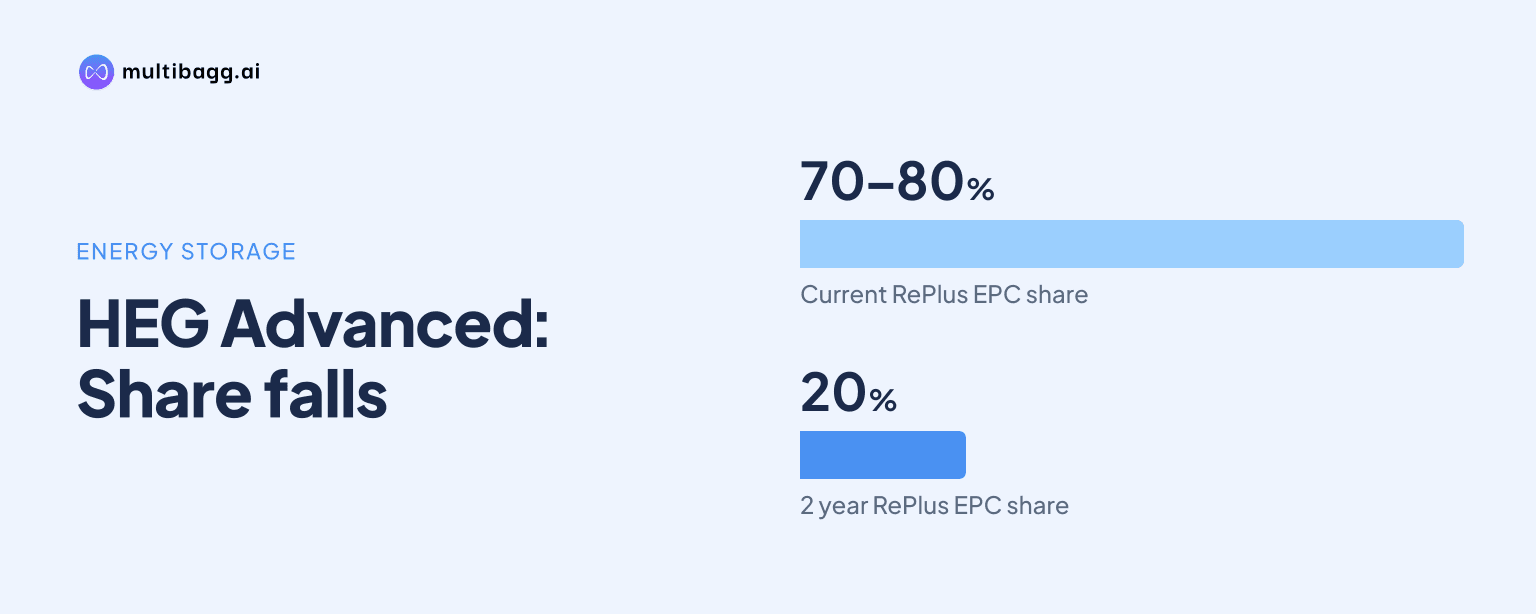
HEG Advanced Materials Limited plans to reduce engineering, procurement and construction, or EPC, to about 20% of RePlus business within two years, from 70%-80% currently, as capacity rises from 1 gigawatt hour, or GWh, to 6 GWh. Management said the additional 5 GWh facility has a March 2027 commercial operation date.
Know HEG Advanced Materials inside out
Results, valuation, peers and who's buying, in one view.
Why is HEG Advanced Materials changing RePlus to product supply?
HEG Advanced Materials is moving RePlus toward product manufacturing and supply because EPC was initially used to establish relationships with independent power producers, developers and utilities while the business developed its factory, products and certifications. Management said this approach also helped RePlus study battery-energy-storage market requirements during its first two to three years.
RePlus began with 1 GWh of capacity focused on high-voltage electric-vehicle products and selected uninterruptible power supply, or UPS, applications. The new 5 GWh capacity is intended to add locally manufactured energy storage system, or ESS, containers and products for data centres. Management said RePlus has in-house battery management system, energy management system, thermal management, design and engineering capabilities.
Management also cited certification work as part of the transition to supply. It said its ESS containers have international-standard certifications, data-centre products are UL certified, telecom products are TSEC approved, residential and UPS products are IEC approved, and electric-vehicle products are approved by ARAI and ICAT. These certifications support the plan to sell into several categories rather than depend mainly on project execution.
The demand rationale is management’s view rather than a disclosed order forecast. Management cited 480 GWh of renewable-energy storage demand over the next 10 years and said total lithium-ion battery demand across renewable energy, electric vehicles, data centres, diesel-generator replacement and lead-acid replacement could exceed 1,000 GWh over the next 10 to 12 years.
How will HEG Advanced Materials change the RePlus revenue mix?
HEG Advanced Materials plans to change RePlus from 70%-80% EPC today to a 50:50 EPC and supply mix from next year, followed by about 20% EPC in two years. That would leave manufacturing and product supply at about 80% of RePlus business under management’s stated rollout plan.
HEG Advanced Materials linked the mix shift to working-capital requirements. Management said EPC cycles are longer because projects depend on multiple factors, including land and connectivity, and noted that EPC represented about 80% of business when discussing current working capital. The company did not disclose a working-capital target, but said a greater production-and-supply share should change the cycle over time.
Management did not provide separate margin guidance for each product category. It said data-centre products have the highest earnings before interest, tax, depreciation and amortisation, or EBITDA, margin among RePlus categories, followed by electric vehicles, battery energy storage systems and UPS or inverter products. For RePlus overall, management indicated EBITDA of around 10%, plus or minus 1%-2%, in a market it described as highly competitive.
Got a follow-up? Ask IRIS
When will HEG Advanced Materials reach 6 GWh capacity?
HEG Advanced Materials expects the additional 5 GWh RePlus facility to begin commercial operations in March 2027, taking total capacity to 6 GWh from 1 GWh. Management put the capital expenditure for this capacity increase at Rs 250 crore.
The RePlus expansion is one part of a wider approximately Rs 5,500 crore capital programme. Management allocated about Rs 2,350 crore to the existing 20,000-tonne anode-material facility, Rs 1,600 crore to an additional 24,000 tonnes, Rs 500 crore to graphene, Rs 475 crore to an 80,000-unit crucible facility, Rs 230 crore to a battery-energy-storage independent power producer project in Gujarat and Rs 250 crore to RePlus.
Management said the largest share of this programme would fall in FY27 and FY28. It expects about Rs 2,300 crore of capital expenditure in the current year and Rs 1,600 crore to Rs 1,700 crore next year, with the remaining amount in financial year 2029. The company said a separate 300-megawatt commercial-and-industrial solar project, estimated at Rs 1,200 crore, was not included because the project was still under signing.
RePlus has different disclosed economics from the group’s anode-material business. Management characterised RePlus as low-capex and high-turnover, without providing a turnover multiple. For anode material, it cited a 0.8 times asset-turnover ratio and EBITDA margins of 28%-33%, demonstrating that management expects different operating profiles across its expansion projects.
What could support HEG Advanced Materials product sales?
HEG Advanced Materials said local manufacturing could support RePlus as it supplies more products. Management pointed to new tenders featuring viability gap funding, or VGF, and local-content requirements associated with National Thermal Power Corporation tenders. It did not quantify any expected financial benefit or identify how many tenders RePlus expects to win.
The company also described early international activity. Management said RePlus has an office and representatives in Dubai and is seeing traction in Europe, the Middle East and Africa, or EMEA, from customers seeking a China-plus-one option. However, management said not much business in the region had been converted, so this remains an early commercial opportunity rather than reported order backlog.
EPC is not planned to disappear under the new model. The target of about 20% of RePlus business in two years means project execution would remain part of the operation while product supply becomes the larger revenue stream. That differs from the initial period, when EPC was the principal route for developing customer relationships and learning project-delivery requirements.
Management gave a group-level, rather than RePlus-specific, steady-state indication for FY29-FY30. It said revenue across anode, graphene and RePlus could be about Rs 7,500 crore to Rs 8,200 crore, with group EBITDA of 25%-28%. The call did not disclose RePlus revenue, order backlog or its expected share of those group figures.
Conclusion
HEG Advanced Materials is setting out a measurable RePlus transition: capacity is to increase sixfold to 6 GWh, while EPC’s business share is planned to fall from 70%-80% to about 20% in two years. The company is using locally made ESS containers, data-centre products, electric-vehicle products and UPS applications to move the business toward manufacturing and supply, while retaining some EPC activity.
The key disclosed milestone is the March 2027 commercial operation date for the additional 5 GWh facility. Investors can watch whether RePlus reaches the planned 50:50 EPC-supply mix from next year, whether local-content tender opportunities produce orders, and whether early EMEA activity converts into business, which management said had not yet happened in significant volume.