










HEG Advanced Materials says 40% of Q2 power EBIT was one-time
Key highlights
- HEG Advanced Materials said approximately 40% of Rs 190 crore Q2 power EBIT was one-time income.
- Power revenue increased 15% quarter on quarter to about Rs 212 crore, while EBIT increased 64%.
- HEG Advanced Materials said about 75% of annual generation occurs in the first half and 25% in the second half.
- Management said current-year power realisation ranged from Rs 6 to Rs 6.5 per unit, while peak rates were around Rs 9 to Rs 10 per unit.
powered by IRIS
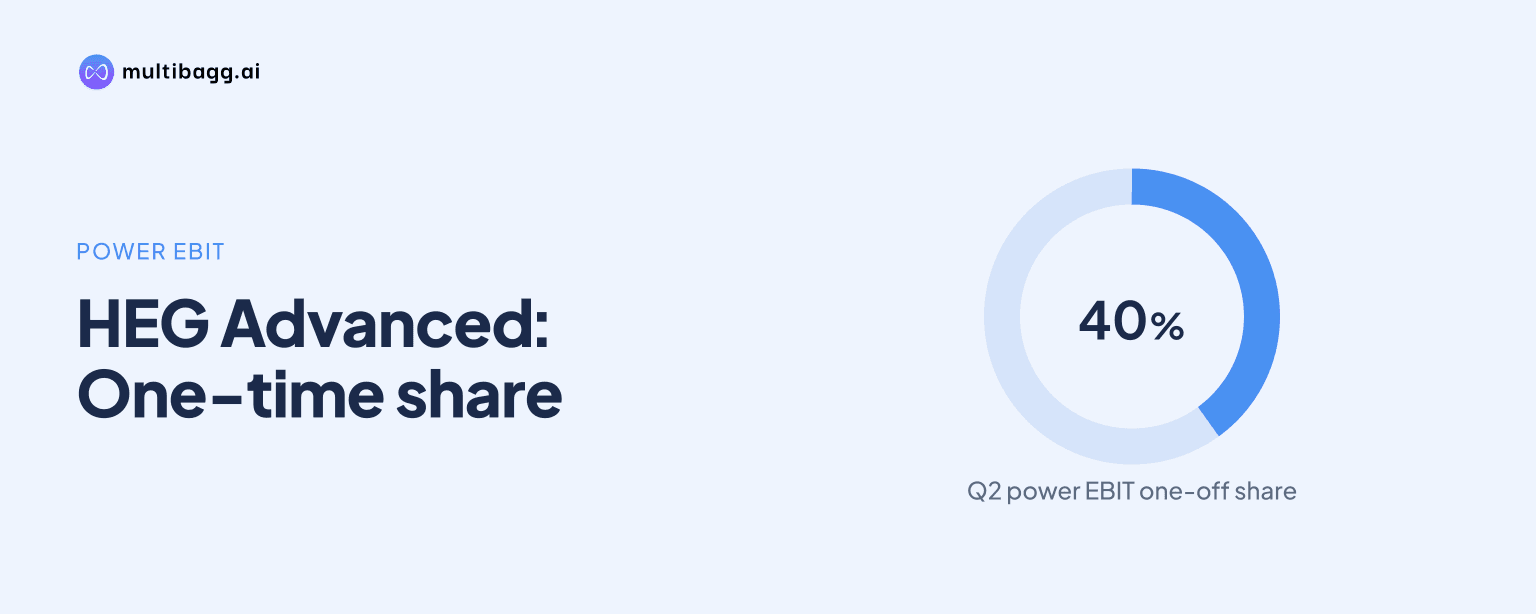
HEG Advanced Materials Limited said approximately 40% of its Rs 190 crore power-segment earnings before interest and tax (EBIT) in Q2 was one-time income that would not recur in Q3 or Q4, explaining much of the 64% quarter-on-quarter EBIT increase versus a 15% rise in revenue to about Rs 212 crore.
Know HEG Advanced Materials inside out
Results, valuation, peers and who's buying, in one view.
Why did HEG Advanced Materials' Q2 power EBIT rise faster than revenue?
HEG Advanced Materials' Q2 power EBIT rose 64% quarter on quarter to Rs 190 crore because of higher one-time income, while power revenue increased 15% to about Rs 212 crore. Management attributed the difference between the revenue and EBIT growth rates to one-time receipts recorded in the power segment during the second quarter.
The main non-recurring items related to a dedicated 175-kilometre transmission line and an insurance claim. Management said the line, built in 2011, was designated a deemed inter-state transmission system, or ISTS, with retrospective effect from August 2011. That designation allowed recovery of revenue from other developers using the line, including arrears relating to the preceding 10 years that were received last year, with some amount continuing in the current year.
The receipts were included in other income, which also contains regular transmission income, Renewable Energy Certificate (REC) sales from eligible hydro projects, and interest on fixed deposits and mutual funds. Management separately said insurance-claim income would not continue in future periods. The Q2 EBIT increase therefore reflected a mixture of generation-related earnings, financial income and non-recurring receipts rather than a comparable rise in merchant power sales alone.
How much of HEG Advanced Materials' Q2 power EBIT was recurring?
HEG Advanced Materials said approximately 60% of Q2 power EBIT was regular and approximately 40% was one-time. Applied to reported Q2 EBIT of Rs 190 crore, that indicates an approximate Rs 114 crore regular component and an approximate Rs 76 crore one-time component, based on management's stated split.
Management confirmed that the 40% one-time component would not recur in Q3 and Q4. This provides the direct comparison point for later quarters: power-segment results will need to be assessed without the Q2 transmission-related receipts and insurance gain that lifted reported EBIT.
The regular category includes more than electricity generation. Management said about half of overall other income was interest earned on bank deposits and mutual funds, supported by cash held in fixed deposits. Regular transmission income from the 175-kilometre line and REC income are also recurring items, meaning the approximate Rs 114 crore regular EBIT component is not a measure of hydro and wind generation profit alone.
Got a follow-up? Ask IRIS
What supports HEG Advanced Materials' underlying power earnings?
HEG Advanced Materials said its two hydro plants and one wind plant produce about 100 crore units annually on a normative basis, although water availability and other factors can increase or reduce output. Management said 20% of that generation is supplied free to the Government of Himachal Pradesh, leaving 80% available for sale.
Generation is seasonal, with about 75% of annual output produced in the first half and 25% in the second half, according to management. That seasonal mix means a lower second-half power contribution can occur even if the assets continue operating at the disclosed 43% to 44% plant load factor (PLF) for the two projects combined.
The portfolio has a peak-power mechanism because its reservoir permits generation during higher-priced periods. Management said about 70% of normative output is non-peak power and 30% is peak power; peak rates during the period discussed were around Rs 9 to Rs 10 per unit. Overall current-year realisation ranged from Rs 6 to Rs 6.5 per unit, reflecting daily sales in the merchant market.
What could change HEG Advanced Materials' power outlook?
HEG Advanced Materials' power earnings can change with monsoon conditions, water availability, coal availability at thermal plants and nationwide electricity demand. Management said the Indian exchange market, where it sells power, accounts for about 10% of the country's total electricity consumption, making prices sensitive to broader supply-demand conditions.
Management said demand had increased recently while thermal-power availability in the market had declined, contributing to firmer power prices. It said it believed this trend could continue for the next couple of years, but did not provide a view beyond about five years. That view is management's assessment and remains conditional on the market factors it identified.
An analyst referred to a Rs 350 crore power-business earnings before interest, tax, depreciation and amortisation (EBITDA) framework based on power pricing of about Rs 5 to Rs 5.5 per unit. Management agreed that its planning uses reasonable and conservative assumptions because the business operates in a merchant market. The difference between that assumption and the current-year Rs 6 to Rs 6.5 realisation shows the sensitivity of earnings to actual merchant prices.
Management is also evaluating options to consolidate the power business and use cash for growth after a subsidiary acquired a 49% stake from Statkraft. It said the acquisition was funded 50% by banks and 50% by the company and family office, and requested a few quarters before providing an update on the consolidation and cash-use plan.
Conclusion
HEG Advanced Materials' Q2 power EBIT contained a material non-recurring component: management identified about Rs 76 crore of the Rs 190 crore total as one-time income and about Rs 114 crore as regular EBIT. That distinction changes the reading of the 64% sequential EBIT increase, particularly because power revenue rose 15% to about Rs 212 crore and the excess profit growth included transmission-related receipts and an insurance gain.
The next results should be viewed against the disclosed 75%-25% first-half and second-half generation pattern, the current-year Rs 6 to Rs 6.5 per-unit realisation range, and the absence of the stated 40% one-time Q2 EBIT component. Management has also said it will provide an update in a few quarters on options to consolidate the power business and deploy its cash.