










HEGAM targets 44,000-tonne anode capacity on customer pull
Key highlights
- HEGAM targets 44,000 tonnes of anode capacity by March 2029, up from its initial 20,000-tonne Phase 1 plan.
- HEGAM reported advanced customer MOU discussions exceeding 100,000 tonnes and said it had three or four signed letters of intent.
- The 20,000-tonne Dewas anode plant was 61% complete and is targeted for commercial commissioning in June 2027.
- HEGAM allocated Rs 3,950 crore to its combined 44,000-tonne anode-capacity plan.
powered by IRIS
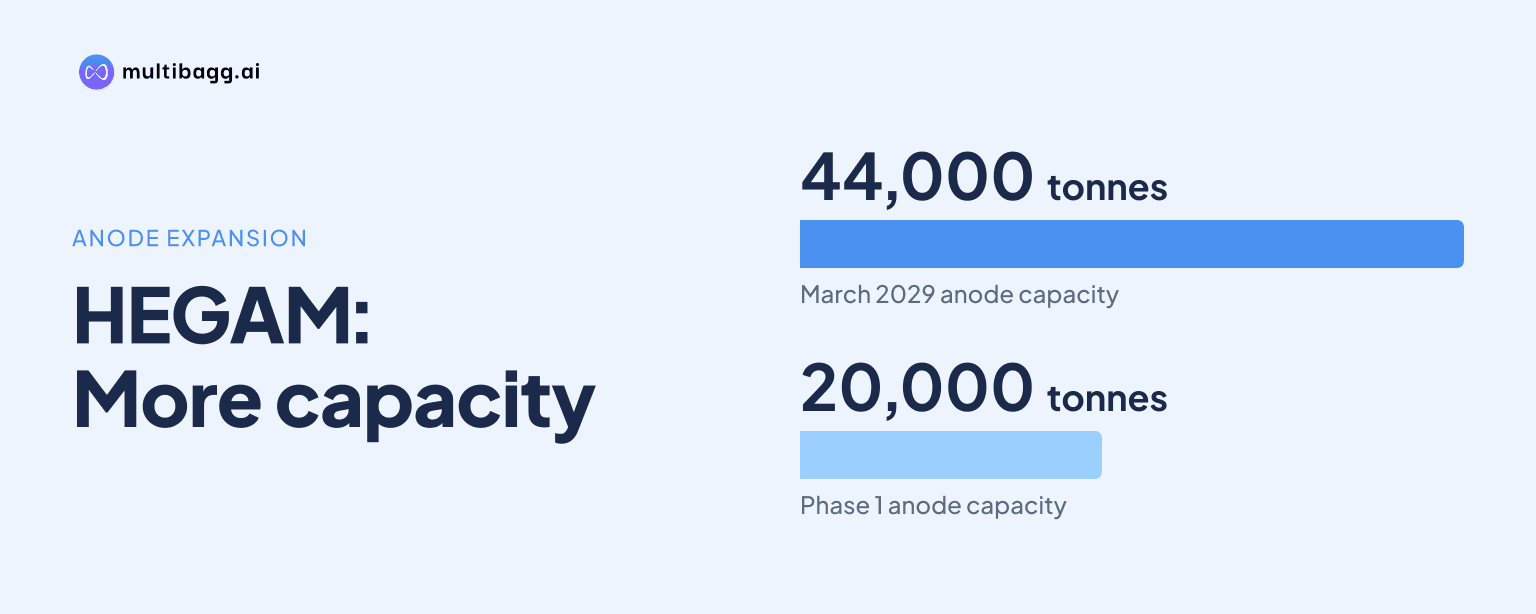
HEG Advanced Materials Limited targets 44,000 tonnes of battery-anode capacity by March 2029 after management reported advanced customer memorandum of understanding discussions exceeding 100,000 tonnes. HEGAM’s initial 20,000-tonne Dewas plant was 61% complete on November 5, 2026, with commercial commissioning planned for June 2027.
Know HEG Advanced Materials inside out
Results, valuation, peers and who's buying, in one view.
Why is HEGAM expanding anode capacity to 44,000 tonnes?
HEGAM says customer demand, rather than an internal volume ambition, prompted it to raise planned anode capacity from 20,000 tonnes to 44,000 tonnes. Chairman Riju Jhunjhunwala said the company had completed 1,500 to 2,000 rounds of product sampling through a pilot plant established about 2.5 years earlier, serving prospective buyers including non-Chinese cell makers and automotive companies.
Management disclosed advanced discussions for more than 100,000 tonnes of customer MOUs. It also said it had three or four confirmed signed letters of intent and expected to sign at least three or four more in the following months. These discussions and letters of intent are not the same as disclosed binding orders, but management said the original 20,000-tonne plant would have met no more than 25% of the customer needs under discussion.
The 44,000-tonne limit reflects the capacity that HEGAM could accommodate at its 105-acre Dewas site after engineering work, according to management. Jhunjhunwala said the company would have preferred to build 60,000 tonnes at the location if space had allowed. Phase 2 is planned on the same land and power footprint as Phase 1.
When will HEGAM's Dewas anode plants start production?
HEGAM expects its 20,000-tonne Phase 1 Dewas plant to begin commercial operations by June 2027, while the additional 24,000 tonnes are targeted by March 2029. Management said the first plant was 61% complete at the November 5, 2026 earnings call.
TACC Managing Director Ankur Khaitan said HEGAM has assumed 35% capacity utilisation in the first year because a large new plant requires commissioning and a gradual operating ramp-up. He said moving from more than 50% utilisation to 90% and above should be easier because the equipment and capacity have been designed in a linear manner.
Jhunjhunwala said the plant should become stable about six months after commissioning, while Khaitan described the 35% first-year assumption as deliberately conservative. Neither executive gave quarterly production targets or a date for reaching 90% utilisation. These are management expectations rather than reported operating results.
The first 20,000 tonnes will be exported “majorly,” according to management. The customer pipeline discussed on the call centred on overseas non-China supply opportunities, including Korea, Japan, the United States, Germany and the Middle East. Management also sees a future Indian market, estimating that 100 gigawatts of domestic cell production by 2030 could require 100,000 tonnes of anode material.
Got a follow-up? Ask IRIS
How will HEGAM support anode production and margins?
HEGAM plans to build an 80,000-unit graphitized-crucible facility to support anode production and reduce its dependence on Chinese imports. Management said crucibles are needed for graphitising anode powder and are the only intended anode-supply-chain input currently sourced from China.
The company expects to use about half of the crucible plant’s output internally and sell the balance externally over time. Management said its graphite-electrode experience gives it in-house crucible technology knowledge. For anode materials, it identified green petroleum coke and power as the two main inputs, together accounting for more than 60% of overall cost.
Management said it is seeking non-Chinese raw-material suppliers, with key supply geographies including the United States, the United Kingdom and Japan. It did not disclose input prices because these vary by material grade and supplier arrangements. The company said suppliers familiar with the group’s graphite-electrode operations had indicated that raw-material availability would not constrain its planned volumes.
HEGAM said Phase 1 required capital intensity of Rs 11 lakh per tonne, versus Rs 6 lakh per tonne for the added 24,000 tonnes. Management put blended capital intensity for the 44,000-tonne project at Rs 9 lakh per tonne, reflecting the use of existing Dewas land and power infrastructure for the second phase.
Chief Financial Officer Neha Rajvanshi indicated an anode earnings before interest, tax, depreciation and amortisation margin range of 28% to 33% before the full effect of crucible integration. Management said backward integration could lift the margin to 35%, while Jhunjhunwala said the company expected anode EBITDA margins above 35% after integration. These are management projections, not reported margins.
What is HEGAM's capital plan for anodes and related projects?
HEGAM has outlined approximately Rs 5,500 crore of capital expenditure across anodes, graphene, crucibles, RePlus and a Gujarat battery energy storage system independent power producer project. The initial 20,000-tonne anode plant accounts for Rs 2,350 crore, while the extra 24,000 tonnes account for Rs 1,600 crore.
The disclosed line items add to Rs 5,405 crore, while management described the wider programme as approximately Rs 5,500 crore. HEGAM expects about Rs 2,300 crore of the programme to be incurred in FY27, Rs 1,600 crore to Rs 1,700 crore in FY28, and the remaining spending in FY29.
Management separately discussed a 300-megawatt commercial-and-industrial solar project that could require about Rs 1,200 crore. It said the project was still under signing and was not included in the stated capital-expenditure programme. As of September 30, 2026, HEGAM had Rs 1,300 crore of cash and bank balances against Rs 1,036 crore of long-term borrowings.
HEGAM’s continuing-operations revenue rose to Rs 430 crore in Q2 FY27 from Rs 176 crore in Q2 FY26, while EBITDA increased to Rs 313 crore from Rs 129 crore. Management cautioned that green-power output is seasonal and depends on weather, wind patterns and water availability, which can limit direct comparisons across reporting periods.
Conclusion
HEGAM’s move from 20,000 tonnes to 44,000 tonnes of planned anode capacity rests on management’s reported customer discussions above 100,000 tonnes, its export-led initial sales plan and a second-phase design that uses the same Dewas site and power footprint. The project also links anode production with in-house crucible manufacturing to reduce a China-linked import dependency.
The next milestones are the June 2027 commercial commissioning target for the first 20,000-tonne Dewas facility, management’s planned 35% first-year utilisation and the March 2029 target for 44,000 tonnes of total capacity. Investors will also watch whether customer MOUs and letters of intent convert into disclosed binding orders and whether the Rs 5,500 crore capital programme follows its FY27 to FY29 spending plan.