










HEGAM says in-house crucibles could cut costs by 40%
Key highlights
- HEGAM says the Rs 475 crore crucible project could reduce costs by about 40% versus imports.
- HEGAM plans an 80,000-unit crucible facility designed to meet 100% of peak internal requirements.
- Management says crucible integration could lift anode EBITDA margin above 35%.
- HEGAM targets 20,000 metric tonnes of Dewas anode capacity by June 2027 and 44,000 metric tonnes by March 2029.
powered by IRIS
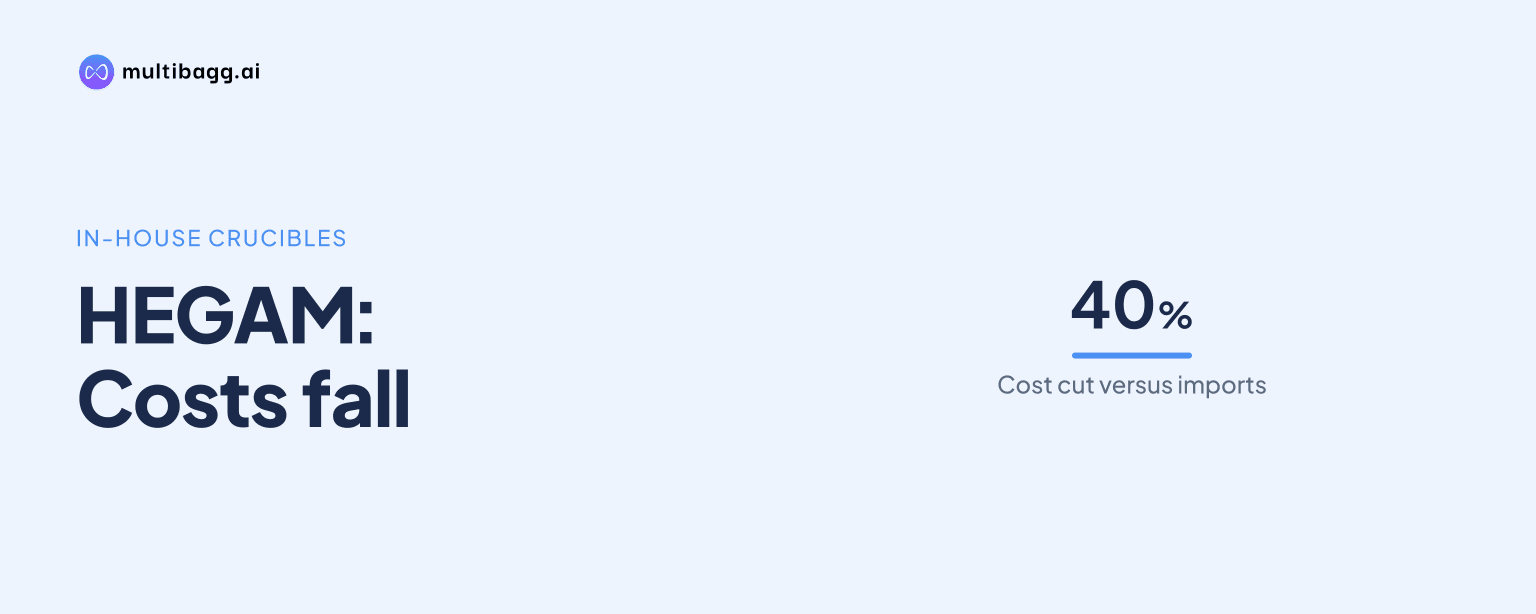
HEG Advanced Materials Limited says its Rs 475 crore in-house crucible project could make crucibles about 40% cheaper than imports, meet 100% of peak internal anode-plant requirements and leave capacity for external sales. Management said the facility is intended to reduce China dependence while supporting an anode EBITDA margin above 35%.
Know HEG Advanced Materials inside out
Results, valuation, peers and who's buying, in one view.
How will HEGAM's crucible project reduce anode costs?
HEGAM says in-house crucibles could be about 40% cheaper than imported products. Crucibles are cylindrical graphite components used in the graphitisation process for anode powder, and management identified them as the only raw material for its anode operation then sourced from China.
Management said the benefit extends beyond the purchase price because imported crucibles require more working capital. The company plans to use packing media from its anode graphitisation furnaces as crucible raw material, linking the Rs 475 crore project to the operating flow of its planned Dewas anode facility.
The cost reduction is part of management's forward-looking anode margin case. HEGAM had indicated an anode earnings before interest, tax, depreciation and amortisation, or EBITDA, margin of 28% to 33%, and said crucible backward integration could take that margin above 35% once the anode business operates at scale.
Can HEGAM meet all its internal crucible demand?
HEGAM says the planned facility will meet 100% of its peak internal crucible requirement. The company plans an 80,000-unit plant and said it would require around 40,000 to 45,000 tonnes of crucibles internally at peak, while management also described the project as using about half its output for captive consumption.
The balance of capacity is intended for third-party sales. Management said the company would sell surplus crucibles externally after meeting its own requirement, positioning the project as a separate revenue stream rather than only a captive cost-saving measure.
HEGAM did not provide a commissioning date, projected sales volume or contracted customers for the crucible plant in the November 5, 2026 call. It did say the facility should have a short payback and healthy EBITDA, but neither the payback period nor estimated annual revenue was disclosed.
Is HEGAM using licensed crucible technology?
HEGAM says its crucible technology is in-house, not licensed. TACC management said the wider HEG group had worked on crucibles for many years and understood the process, which it described as a difficult part of the anode graphitisation chain.
Management did not disclose a patent for the crucible process, manufacturing specifications or output yields. That differs from graphene, where HEGAM said its customised production process is patented and has been developed over more than seven years.
The company's anode raw-material plan also focuses on reducing China exposure. Management said green petroleum coke and power together account for more than 60% of anode costs, and that it was in advanced discussions with non-Chinese suppliers in the United States, United Kingdom and Japan.
Got a follow-up? Ask IRIS
How does the project fit HEGAM's anode expansion?
HEGAM says the crucible project supports its planned expansion of synthetic graphite anode capacity at Dewas. The first 20,000-metric-tonne anode plant was 61% complete in the call and was targeted for commercial commissioning by June 2027.
A second phase is planned to add 24,000 metric tonnes, taking Dewas capacity to 44,000 metric tonnes by March 2029 on the same land and power footprint. Management said it was in advanced discussions for more than 100,000 metric tonnes of customer memoranda of understanding, or MOUs, while the first 20,000 metric tonnes are intended mainly for exports.
The second phase changes the capital intensity of the anode plan. Management said Phase 1 cost about Rs 11 lakh per metric tonne and Phase 2 about Rs 6 lakh per metric tonne, lowering the blended average to about Rs 9 lakh per metric tonne.
What could HEGAM earn from external crucible sales?
HEGAM says surplus crucible production could generate an external-sales EBITDA margin of about 30% to 40%. Management linked this expectation to the estimated 30% to 40% saving from internal use versus imported crucibles, but did not disclose customer names, pricing or signed external orders.
The company said China is currently the dominant source of crucibles and described supply outside China as limited. This is management's assessment of the market, rather than a reported external-sales result, because the project has not yet reported production or revenue.
The Rs 475 crore crucible investment is included in HEGAM's approximately Rs 5,500 crore wider expansion programme. The programme includes Rs 500 crore for graphene, Rs 250 crore for RePlus capacity expansion from 1 gigawatt hour to 6 gigawatt hours, and Rs 230 crore for a battery energy storage system project in Gujarat.
Management expects about Rs 2,300 crore of the wider capital expenditure in FY27, followed by Rs 1,600 crore to Rs 1,700 crore in FY28, with the remaining spend in FY29. As of September 30, 2026, HEGAM had Rs 1,300 crore of cash and bank balances and Rs 1,036 crore of long-term borrowings.
Conclusion
HEGAM's crucible project is designed to serve two purposes: lower the cost and working-capital burden of a China-sourced anode input, and create a surplus-capacity sales business. The stated 40% cost saving, 100% internal-need coverage and 30% to 40% external-margin expectation are management projections rather than reported operating results.
The next disclosed operating milestone is the targeted June 2027 commissioning of the 20,000-metric-tonne Dewas anode plant, followed by the March 2029 target for 44,000 metric tonnes of capacity. Investors will need to watch for a crucible-plant commissioning schedule, customer orders for surplus output and evidence that the estimated savings are realised as the Rs 5,500 crore expansion programme advances through FY29.