










HUDCO uses US$2 billion ECBs to defend 3% NIM target in FY27
Key highlights
- HUDCO reported a 1.96% spread and 2.93% NIM before excluding Rs 20,000 crore of 40-basis-point Government of India lending.
- HUDCO raised US$2 billion of ECBs in FY 2027 at a roughly 6.75% effective blended post-hedging cost.
- HUDCO increased MCLR by 15 basis points and expects around Rs 20,000 crore of loans to reset in H2 FY 2027.
- HUDCO’s blended cost of funds was around 7.07%, while management said domestic bond yields had recently hovered around 8%.
powered by IRIS
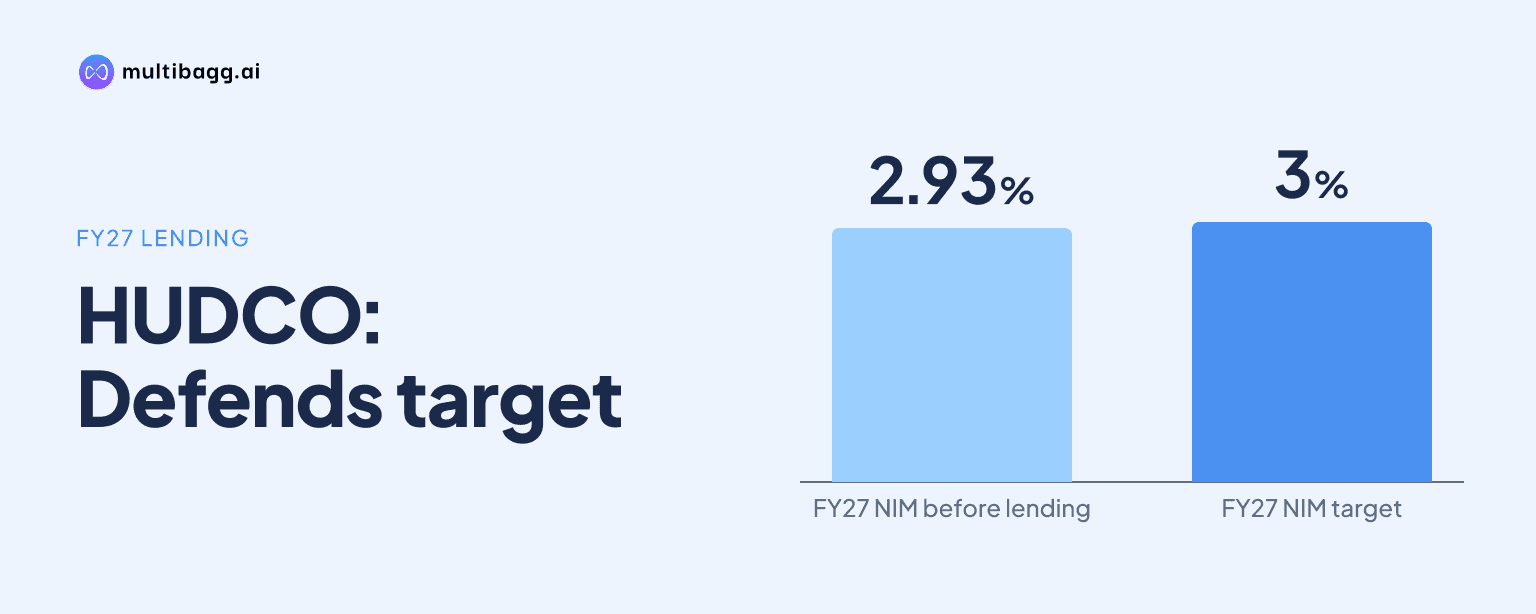
Housing and Urban Development Corporation Limited said on November 6, 2026 that US$2 billion of external commercial borrowings at an effective hedged cost of roughly 6.75%, alongside loan repricing, should help it maintain a 2% spread and 3% net interest margin in FY 2027. The company reported a 1.96% spread and 2.93% net interest margin before adjusting for a low-spread government loan.
Know Housing & Urban Development Corporation inside out
Results, valuation, peers and who's buying, in one view.
How will HUDCO maintain its 2% spread?
HUDCO said it aims to end each financial year with a spread of about 2%, although market movements, borrowing costs, disbursement timing and tranche-level loan resets can cause temporary changes during the year. Management also said it is targeting net interest margin, or NIM, of at least 3%, rather than providing a separate forecast for lending yields.
The company reported a 1.96% spread and 2.93% NIM at the time of the November 6 call. Management said these measures were affected by Rs 20,000 crore of lending to the Government of India, which earns a spread of only 40 basis points. One basis point equals one-hundredth of a percentage point. Excluding that exposure, management said the spread was around 2% and NIM was 3%.
The Rs 20,000 crore Government of India loan is due to run off in FY 2028-2029, according to management. HUDCO did not quantify the future effect on its reported spread or NIM, but the loan's exit would remove an exposure with a 40-basis-point spread. The company’s loan book stood at Rs 1.86 lakh crore in H1 FY 2027, representing 29% growth from the previous year.
Why is ECB funding important to HUDCO’s margin plan?
HUDCO said it had raised US$2 billion of external commercial borrowings, or ECBs, during FY 2027 so far, at an effective blended post-hedging cost of roughly 6.75%. Director Finance Daljeet Singh Khatri gave the 6.75% figure after management initially described the cost as being between 6.5% and 6.75%.
Management said it was targeting total foreign borrowing of slightly more than US$3 billion, with other loans tied up for disbursement before December 31 or before the Reserve Bank of India, or RBI, swap window closes. It expects about Rs 35,000 crore of borrowings to carry costs of around 6.5% to 6.75%, using 6.75% as the working rate in its explanation.
This funding is cheaper than the domestic alternatives discussed on the call. HUDCO said bond yields had hovered around 8% for the preceding two to two-and-a-half months, leading it not to issue bonds in the latest quarter. It raised Rs 22 crore through bonds in Q1 FY 2027 at roughly 7% to 7.25%, while bank funding was available at around 7.25%.
The company’s total borrowings were around Rs 1.65 lakh crore against a Rs 1.86 lakh crore loan book. Management said lower-cost ECBs should reduce pressure on the borrowing side, while its overall blended cost of funds was around 7.07%. The strategy relies on the RBI swap window because management said recent foreign-currency exposure under the facility has full protection against currency fluctuations.
Got a follow-up? Ask IRIS
How will HUDCO pass higher funding costs to borrowers?
HUDCO said all loans have a one-year, tranche-wise reset: each tranche is repriced after completing one year. Its marginal cost of funds-based lending rate, or MCLR, is revised quarterly, giving the company a mechanism to transmit changes in funding costs at scheduled reset dates rather than immediately across the whole loan book.
Management said it had increased MCLR by 15 basis points after a two-year gap. It estimated that around Rs 20,000 crore of loans would reset during the second half of FY 2027, and said the income effect of this repricing should appear in Q3 FY 2027. It also expects the benefit of ECBs raised during FY 2027 to be visible in Q3 results.
HUDCO is discussing quarterly resets in some cases, replacing the usual annual reset structure for selected borrowers. Management said state borrowers understand the higher-rate environment because they also issue state development loans, or SDLs. It described the ability to pass on higher costs as manageable, but did not identify the size of the portfolio that could move to quarterly repricing.
Management told an analyst that yields would increase from current levels, while emphasizing the 2% spread and 3% NIM targets. The expected transmission therefore rests on three disclosed measures: the 15-basis-point MCLR increase, resets on around Rs 20,000 crore in H2 FY 2027 and possible quarterly resets for certain loans.
What could change HUDCO’s margin outcome?
HUDCO’s 2% spread and 3% NIM measures are management targets, not outcomes supported by a fixed forecast for bond yields or borrowing costs. Management specifically cited market fluctuations, funding costs, disbursement timing and the timing of resets as reasons the spread could move during a financial year, even while it seeks to restore the target by year-end.
Loan deployment will affect the timing of both asset yields and funding use. HUDCO disbursed more than Rs 35,000 crore in H1 FY 2027 and has an internal full-year disbursement target of Rs 65,000 crore. Management said the remaining Rs 30,000 crore depends on project progress and could increase if project execution accelerates.
The sanctioned pipeline is substantial but converts over long periods. Management said sanctioned projects in the pipeline ranged from Rs 3 lakh crore to Rs 4 lakh crore and typically have gestation periods of three to five years. This contrast with the Rs 65,000 crore FY 2027 disbursement target shows that sanctions alone do not determine the near-term pace of lending or yield generation.
HUDCO had also sanctioned around Rs 9,000 crore of public-private partnership, or PPP, projects, including Dharavi redevelopment, road projects and renewable energy projects, but said no PPP disbursement had started as of the call. For non-sovereign lending, management said it requires investment-grade entities, strong concession agreements, third-party appraisal, project monitoring arrangements and a trust and retention account, with no separate PPP lending target.
Conclusion
HUDCO’s margin strategy combines US$2 billion of ECBs at a roughly 6.75% hedged cost, a 15-basis-point MCLR increase and scheduled loan resets to protect a 2% spread and 3% NIM target. The reported 1.96% spread and 2.93% NIM were close to those levels, while Rs 20,000 crore of Government of India lending at a 40-basis-point spread reduced the reported figures.
The next disclosed checkpoint is Q3 FY 2027, when management expects the ECB funding benefit and part of the repricing effect to appear. Investors can also monitor whether additional foreign borrowings are disbursed before December 31, progress toward the Rs 65,000 crore FY 2027 disbursement target, and any expansion of quarterly loan resets for selected borrowers.