










HUL posts fastest underlying sales growth in 14 quarters
Key highlights
- HUL delivered 15% underlying sales growth and 7% underlying volume growth in the September quarter of 2026.
- Home Care grew 22% and Beauty & Wellbeing grew 16%, with double-digit volume growth in both segments.
- Turnover was Rs. 18,071 crore and profit after tax before exceptional items rose 9% to Rs. 2,795 crore.
- HUL reported a 22.6% EBITDA margin and retained 22% to 24% medium-term guidance.
powered by IRIS
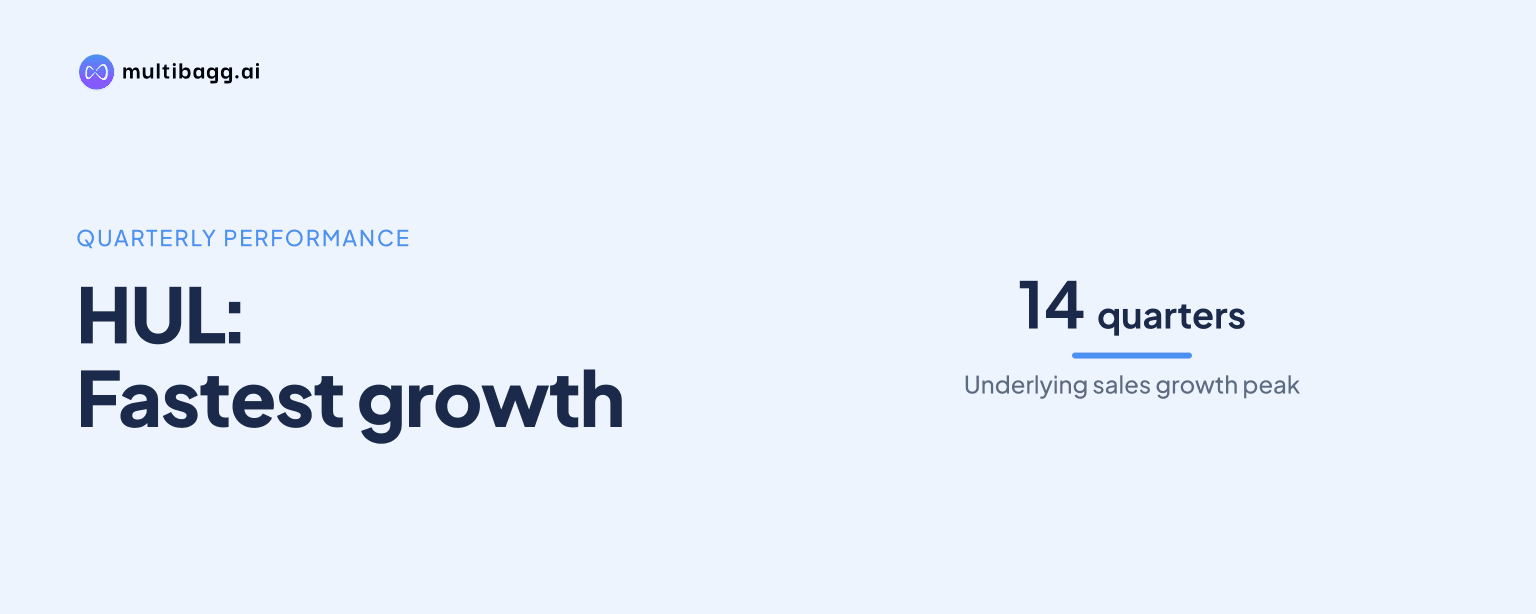
Hindustan Unilever Limited recorded 15% underlying sales growth in the September quarter of 2026, its fastest rate in 14 quarters, on turnover of Rs. 18,071 crore and 7% underlying volume growth. HUL’s expansion was led by 22% growth in Home Care and 16% in Beauty & Wellbeing, both supported by double-digit volume growth.
Know Hindustan Unilever inside out
Results, valuation, peers and who's buying, in one view.
How did HUL achieve its fastest sales growth in 14 quarters?
HUL achieved its fastest underlying sales growth in 14 quarters through a 15% increase in the September quarter of 2026, combining 7% underlying volume growth with pricing and broad-based segment momentum. Turnover reached Rs. 18,071 crore, while profit after tax before exceptional items increased 9% year on year to Rs. 2,795 crore. Management said the volume outcome reflected disciplined execution and continuing portfolio transformation amid elevated commodity prices.
The September-quarter result accelerated from the first half’s 12% underlying sales growth and 6% underlying volume growth. First-half turnover was Rs. 35,255 crore, and profit after tax before exceptional items also rose 9%. This comparison indicates that sales and volume momentum improved in the second quarter relative to the April-to-September period as a whole, rather than being limited to a higher-price outcome.
Which HUL businesses drove September-quarter growth?
HUL’s two largest reported growth engines were Home Care, with 22% underlying sales growth, and Beauty & Wellbeing, with 16%, and both were underpinned by double-digit underlying volume growth. Personal Care and Foods each delivered 9% underlying sales growth. The gap between Home Care’s 22% and Foods’ 9% shows that quarterly growth was broad-based but materially faster in household and beauty categories.
In Home Care, Fabric Wash posted strong double-digit growth across bars, powders and liquids, while Household Care accelerated to double-digit, volume-led growth. HUL said its Rs. 99 Surf excel Easy Wash powder was scaling well and delivering double-digit growth. It also continued market-development work in Home Care liquids, which management said deepened format penetration and supported volume resilience.
What changed across HUL’s beauty, personal care and foods portfolio?
HUL’s Beauty & Wellbeing business delivered 16% underlying sales growth as Hair Care, Skin Care and Colour Cosmetics each recorded double-digit, volume-led growth. Premium Hair Care and innovation, including TRESemme Hydra Matrix, performed well, while HUL used sampling and media investment to build newer formats such as hair masks and serums. Minimalist’s growth accelerated sequentially as the company expanded its offline presence.
Personal Care grew 9%, with Skin Cleansing delivering double-digit growth and Oral Care reporting low-single-digit growth. HUL attributed Skin Cleansing’s volume-led growth to market-development actions in Pears and Dove bars, while sampling and in-store activations supported Bodywash penetration. In Oral Care, premium innovations grew at a double-digit rate, according to management, despite slower growth for the category overall.
Foods also grew 9%, though its underlying volume growth was low single digit, below the company-wide 7% volume figure. Coffee grew at a high-single-digit rate on volumes, whereas inflation moderated Tea performance through softer mass-tea sales. Lifestyle Nutrition and Packaged Foods both delivered double-digit growth; Horlicks biscuits and ready-to-drink formats grew well, and HUL launched Horlicks Protein Powder during the quarter.
Got a follow-up? Ask IRIS
How is HUL expanding distribution and new product spaces?
HUL added 30,000 general-trade outlets during the September quarter while delivering healthy double-digit assortment growth, supporting its channel-specific go-to-market plan. In modern trade, it nearly doubled asset deployment over the last two quarters to support category development. Management also cited sequential service-level improvements in e-commerce and quick commerce through technology-led capabilities.
The company’s product activity included the Simple barrier-repair range for sensitive skin, using pro-ceramide, and the September-quarter Horlicks Protein Powder launch. Management said early traction for the protein offering was encouraging, but did not provide sales figures. These initiatives sit within HUL’s “Winning In New India” strategy, which identifies consumption, premiumisation, market making and new spaces as four growth pools.
HUL also reported productivity actions alongside growth investment. It used scale-led buying efficiencies and its Sangam artificial-intelligence tool to improve advertising and promotion effectiveness, while selectively rationalising Home Care spending and increasing spending across the rest of the portfolio. The company said its global sourcing network helped ensure continuity in key input materials during a period of elevated commodity prices.
What does HUL expect for demand and profitability?
HUL expects the underlying demand environment to remain resilient, supported by healthy macro indicators, and management said it remains confident of growing ahead of the market. The September quarter produced earnings before interest, tax, depreciation and amortisation (EBITDA) of Rs. 4,089 crore, up 8% year on year, with a 22.6% margin. Management said it used calibrated price increases to cover the absolute impact of higher costs while seeking to protect volume growth.
Profit after tax before exceptional items rose 9% to Rs. 2,795 crore, but reported profit after tax was unchanged from a year earlier because the prior-year base included Rs. 273 crore of one-off tax-related gains. The board approved an interim dividend of Rs. 19 per share for the financial year ending March 31, 2027. That distinction between reported and pre-exceptional profit is important when comparing the quarterly earnings result with the prior year.
Conclusion
HUL’s September-quarter performance combined 15% underlying sales growth, 7% volume growth and 9% growth in profit after tax before exceptional items. The result was led by Home Care at 22% and Beauty & Wellbeing at 16%, while Personal Care and Foods each contributed 9% growth. The comparison with first-half growth of 12% in sales and 6% in volume indicates faster momentum in the quarter.
The next issue to watch is HUL’s ability to maintain volume-led growth while commodity inflation remains elevated. Management expects medium-term EBITDA margin to remain within its 22% to 24% guided range, while continuing portfolio and channel transformation under its “Winning In New India” strategy.