










HUL’s September-quarter underlying sales growth rose to 15%
Key highlights
- HUL reported 15% underlying sales growth in SQ'26, up from 10% in JQ'26.
- HUL’s underlying volume growth rose to 7% in SQ'26 from 5% in JQ'26.
- HUL reported 2025 turnover of €6.3 billion and more than 85 billion packs sold annually.
- India’s quarterly penetration was below 1% for hair masks and 2% for both suncare and bodywash.
powered by IRIS
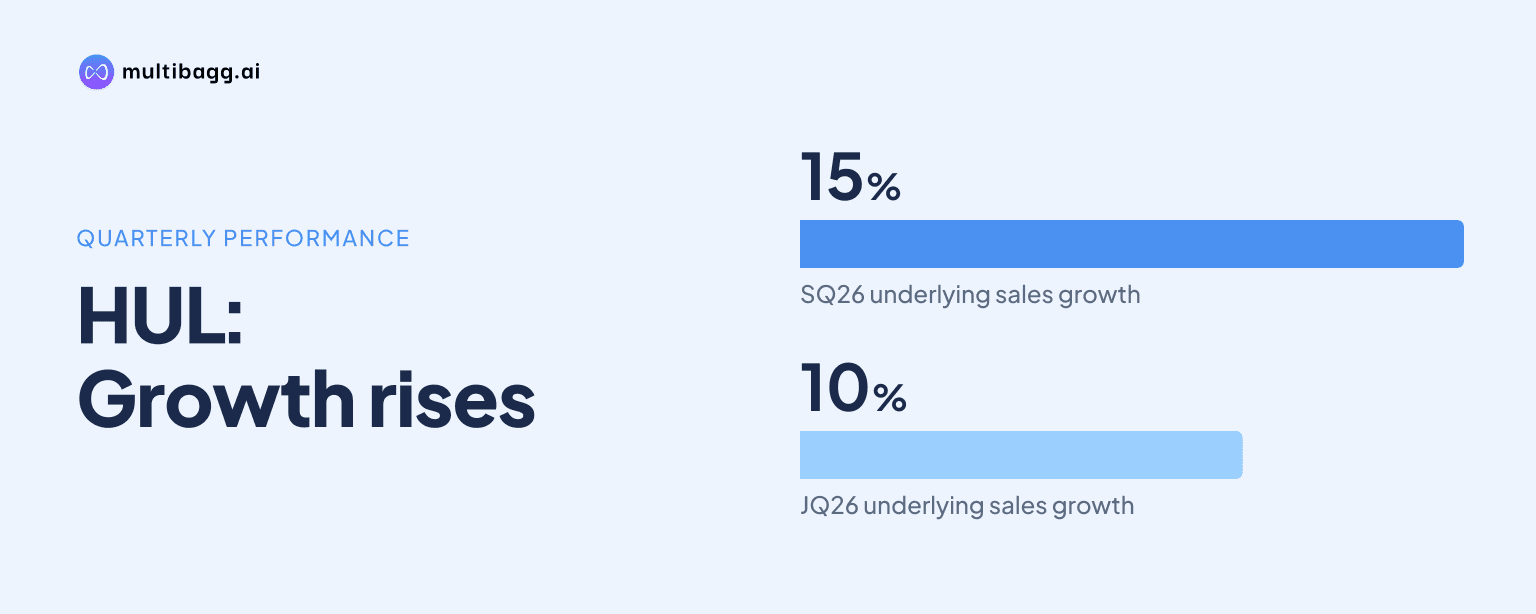
Hindustan Unilever Ltd. (HUL) reported 15% underlying sales growth in SQ'26, compared with 10% in JQ'26, as underlying volume growth increased to 7% from 5%. HUL linked the acceleration to sharper execution and positioned competitive-share activity in laundry and dishwash alongside longer-term category-development plans.
Know Hindustan Unilever inside out
Results, valuation, peers and who's buying, in one view.
How fast did HUL’s growth accelerate in SQ'26?
HUL’s underlying sales growth rose by 5 percentage points sequentially to 15% in SQ'26 from 10% in JQ'26, while underlying volume growth increased by 2 percentage points to 7% from 5%. The SQ'26 outcome was the highest underlying sales-growth rate in the five periods displayed by HUL.
The series shows a 13-percentage-point increase in underlying sales growth from SQ'25 to SQ'26, from 2% to 15%. Underlying volume growth moved from 4% in DQ'25 to 7% in SQ'26, although HUL did not disclose a volume-growth figure for SQ'25.
HUL defines underlying sales growth as turnover growth excluding changes from acquisitions and disposals. It defines underlying volume growth as volume growth including the impact of the turnover-realisation mix of products sold, so the 15% and 7% measures are HUL’s underlying indicators rather than reported turnover or unit-sales totals.
What does HUL say drove the SQ'26 acceleration?
HUL says sharper execution translated into stronger volume-led revenue growth in SQ'26, when underlying sales growth reached 15%. Its market-leadership framework identifies elevated brand desire, sharper resource allocation, execution across channels and a unified India organisation as actions strengthened over the past year.
HUL does not quantify how much each of those actions contributed to the 2-percentage-point sequential increase in underlying volume growth, from 5% in JQ'26 to 7% in SQ'26. The presentation nevertheless links the aggregate growth trend to execution and does not identify acquisitions or disposals as the source of the higher underlying sales-growth rate.
HUL also describes its approach as accelerating growth through competitive share gains. The presentation identifies activity in laundry powders, laundry bars, laundry liquids and dishwash, but provides no category sales growth, market-share percentage or share-point change for any of those segments.
Which products support HUL’s competitive-share activity?
HUL highlights Surf excel in laundry powders, Rin in laundry bars, Surf excel Matic in laundry liquids and Vim in dishwash as the products supporting its competitive-share programme. The material features new Surf excel powder activity, a new Surf excel Matic formula for tough dirt stains, and Vim ProClean positioned as gentle on hands.
Rin is shown in a Rs 10 pack within HUL’s laundry-bar activity. HUL does not disclose revenue, unit sales, distribution, market share or profitability for the Rs 10 pack, Surf excel, Surf excel Matic or Vim ProClean, so the presentation does not establish the individual financial contribution of these products to SQ'26 growth.
The product focus sits within a broad India portfolio: HUL reported 2025 turnover of €6.3 billion, six brands with turnover above €300 million and more than 85 billion packs sold annually. HUL also said nine in 10 households used one or more of its brands and that it reached more than 9 million outlets, but those portfolio figures are not measures of SQ'26 performance.
Got a follow-up? Ask IRIS
What longer-term categories is HUL targeting?
HUL has set out eight multi-year bets: home-care liquids, Dove across beauty and personal care, masstige beauty, hair care, face cleansers and light moisturisers, deodorants, Horlicks nutrition and wellbeing. These plans extend beyond the 15% underlying sales-growth result in SQ'26 and include Surf excel Matic, Simple, Rexona, Horlicks and OZiva.
HUL’s category data indicate market-making headroom in several areas. India’s quarterly penetration was below 1% for hair masks, 2% for suncare, 2% for bodywash, 8% for dishwash liquid, 13% for laundry liquid and 17% for face cleansing, based on data for the three months to August 2026.
The presentation compares Indonesia’s category penetration with India’s at more than 60 times for hair masks, 17 times for suncare, 16 times for bodywash, seven times for dishwash liquid, three times for laundry liquid and two times for face cleansing. These comparisons describe category penetration, not sales forecasts or growth targets for HUL.
How is HUL tailoring its portfolio and distribution?
HUL is tailoring its frontline across big cities, small towns, and tier 4 plus rural markets, using online, modern trade and general trade in the first two geographies and large and small general trade in tier 4 plus rural markets. Its stated mechanisms include platform partnerships, in-store investment, category captaincy, higher service frequency, specialised ecosystems and broader outlet coverage.
HUL groups consumers into power spenders, premiumisers and democratisers, which it associates with household disposable-income benchmarks comparable with France, Indonesia and parts of Africa. The accompanying framework assigns 5% of population to power spenders, 60% to premiumisers and 35% to democratisers, while placing Minimalist, OZiva, Simple and Nexxus with power spenders; Surf excel, Horlicks and Pond’s with premiumisers; and Clinic Plus, Lux and Wheel with democratisers.
HUL reported market-share multiples relative to its nearest competitor of 3.5 times in hair care, four times in skin care, 2.5 times in skin cleansing, four times in laundry, four times in dishwash and five times in lifestyle nutrition. Those figures are based on Nielsen moving annual totals to September 2026 and provide context for HUL’s stated competitive-share strategy, rather than evidence of SQ'26 share movements.
Conclusion
HUL’s disclosed growth acceleration was material across both measures: underlying sales growth rose to 15% in SQ'26 from 10% in JQ'26, and underlying volume growth increased to 7% from 5%. HUL attributes that result to sharper execution, while its category activity spans laundry, dishwash, beauty, personal care, nutrition and wellbeing.
The next evidence to watch is whether HUL’s eight multi-year bets translate into disclosed progress in low-penetration categories, including hair masks at below 1%, suncare and bodywash at 2%, dishwash liquid at 8% and laundry liquid at 13%. HUL has outlined channel and portfolio mechanisms, but the presentation does not provide financial or market-share targets for those plans.