










Unilever says quick-commerce USG grew over 50% in SQ’26
Key highlights
- Unilever reported more than 50% quick-commerce USG in SQ’26.
- Unilever’s AI-enabled availability engine improved customer-reported fill rate by 1,400 basis points.
- Open-format stores reported 3 times growth and more than 11% per-store assortment growth in SQ’26.
- Shikhar had 1.3 million active users and generated about 33,000 bills per day in SQ’26.
powered by IRIS
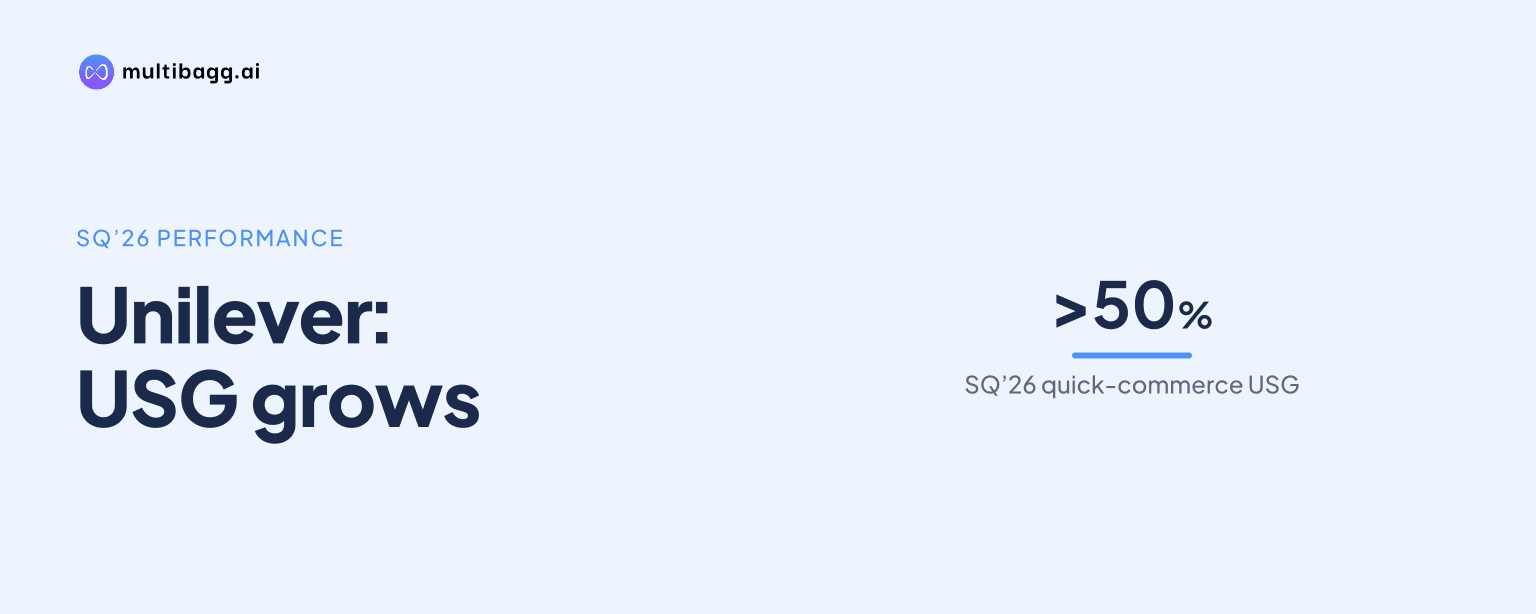
Unilever reported quick-commerce underlying sales growth (USG) of more than 50% in SQ’26, while reporting a 1,400-basis-point improvement in customer-reported fill rate from an AI-enabled availability engine. The company is applying separate availability, visibility, conversion and digitisation models to quick commerce, open-format stores, health and beauty stores, and traditional grocers.
Know Hindustan Unilever inside out
Results, valuation, peers and who's buying, in one view.
How is Unilever changing execution across retail channels?
Unilever is treating four retail routes as distinct operating models, while retaining availability, visibility, conversion and digitisation as common disciplines. In quick commerce, its model starts with pin-code-level dark-store availability, then uses search and browse visibility, conversion-focused content and targeted sampling. The channel’s digitisation component is an AI-led optimisation engine, alongside reported USG of more than 50% in SQ’26.
Open-format stores use store-specific expanded assortment, category leadership, retail theatre, shopper-soulmate programmes, image recognition and digitised tracking. Health and beauty stores instead use a curated beauty portfolio, premium assets, assisted selling by beauty advisers and beauty technology. Traditional grocers are assigned assortment and coverage, high-impact physical visibility, access packs, and the Shikhar and IQ tools, with Unilever reporting double-digit assortment growth in traditional trade in SQ’26.
The channel distinctions are most visible in the conversion mechanisms. Quick commerce uses targeted sampling and content designed to convert digital shoppers, whereas open-format stores use shopper programmes and health and beauty stores rely on assisted selling. For traditional grocers, access packs are the specified conversion lever, showing that Unilever is linking product availability and pack architecture to the operating requirements of each route.
What did Unilever report for quick commerce in SQ’26?
Unilever reported more than 50% USG in quick commerce in SQ’26, alongside measures covering availability, advertising and partner relationships. Its AI-enabled availability engine improved customer-reported fill rate by 1,400 basis points, targeted performance marketing delivered 1.2 times better return on advertisement spend (ROAS), and category-building partnerships achieved a number-two Advantage Survey rank for Blinkit and Swiggy Instamart.
The 1,400-basis-point improvement is linked specifically to the availability engine, rather than to general distribution expansion. Unilever does not disclose the starting or ending customer-reported fill rate, so the presentation does not establish an absolute fill-rate level. It does, however, identify pin-code-level dark-store availability as the channel’s availability standard, connecting the operating model to the reported improvement.
The 1.2-times ROAS outcome is tied to targeted performance marketing. Unilever defines ROAS as return on advertisement spend, but does not provide advertising expenditure, sales attributable to advertising or the underlying ROAS values. Similarly, the number-two Advantage Survey rank is disclosed for Blinkit and Swiggy Instamart, without a score or ranking history, so it is a partner-survey indicator rather than a disclosed sales measure.
Got a follow-up? Ask IRIS
How are open-format and health and beauty stores performing?
Unilever said it serviced more than 20,000 open-format stores in more than 200 towns, reporting 3 times growth versus the previous period and more than 11% per-store assortment growth in SQ’26. The presentation specifies that the growth comparison is SQ’26 versus SQ’25 secondary gross sales value growth. Its stated programme combines a dedicated organisation, in-store brand building and category development.
Store-specific expanded assortment differentiates open-format stores from quick commerce, where availability is managed at dark-store and pin-code level. Unilever also identifies category leadership and retail theatre as visibility tools for open-format retail, with image recognition and digitised tracking supporting execution. The more than 11% increase in per-store assortment provides a store-level metric alongside the 3-times growth comparison.
Unilever said its health and beauty channel covers 175,000 specialist stores across more than 150 top towns. The channel reported 1.4 times growth versus the previous period and 9% per-store assortment growth in SQ’26, with the presentation again identifying SQ’25 secondary gross sales value growth as the comparison basis. Its network has more outlets than the open-format network, but its disclosed growth multiple is lower than the 3-times open-format figure.
The health and beauty approach centres on a curated portfolio, in-store brand building and assisted selling. Premium assets are the specified visibility mechanism, beauty advisers support conversion, and beauty technology is the digitisation tool. Its 9% per-store assortment increase was below the more than 11% reported for open-format stores, indicating different levels of assortment expansion across the two physical retail formats.
What technology is Unilever using in traditional trade?
Unilever uses IQ Neo to turn internal and external signals into AI-led outlet-level recommendations, while Shikhar is intended to capture demand in traditional trade. In SQ’26, Shikhar had 1.3 million active users and generated about 33,000 bills per day. Unilever also reported double-digit assortment growth for traditional trade during the same period.
IQ Neo is presented as an opportunity-identification mechanism rather than a reported revenue tool. Shikhar is presented as the demand-capture mechanism, with daily bill generation as its disclosed activity measure. Unilever does not provide bill values, an outlet count using either tool, or a prior-period bill total, so the presentation does not quantify sales generated by the 1.3 million active-user base.
Traditional trade’s operating model differs from the other routes in both visibility and conversion. Unilever specifies high-impact physical visibility and access packs, rather than quick commerce search placement or health and beauty assisted selling. Shikhar and IQ provide the technology layer, while the double-digit assortment-growth statement indicates range expansion without disclosing an exact percentage.
Conclusion
Unilever’s SQ’26 presentation describes a channel-specific execution system rather than a single retail template. Quick commerce reported more than 50% USG, a 1,400-basis-point customer-reported fill-rate improvement and 1.2 times better ROAS. Open-format stores reported 3 times growth across more than 20,000 stores, while health and beauty covered 175,000 specialist stores and traditional trade had 1.3 million active Shikhar users.
What to watch next is whether Unilever reports comparable subsequent-period data for fill rate, ROAS, per-store assortment and daily bill generation. The presentation identifies AI-led outlet recommendations, pin-code-level availability, image recognition, beauty technology, Shikhar and IQ as operating mechanisms, but does not disclose a future growth target, spending target or rollout schedule for them.