










HUL protects volumes as inflation squeezes gross margins
Key highlights
- HUL reported 7% underlying volume growth alongside 8% price growth in the September Quarter 2026.
- HUL said gross margin declined about 400 basis points year-on-year, while EBITDA margin declined 140 basis points.
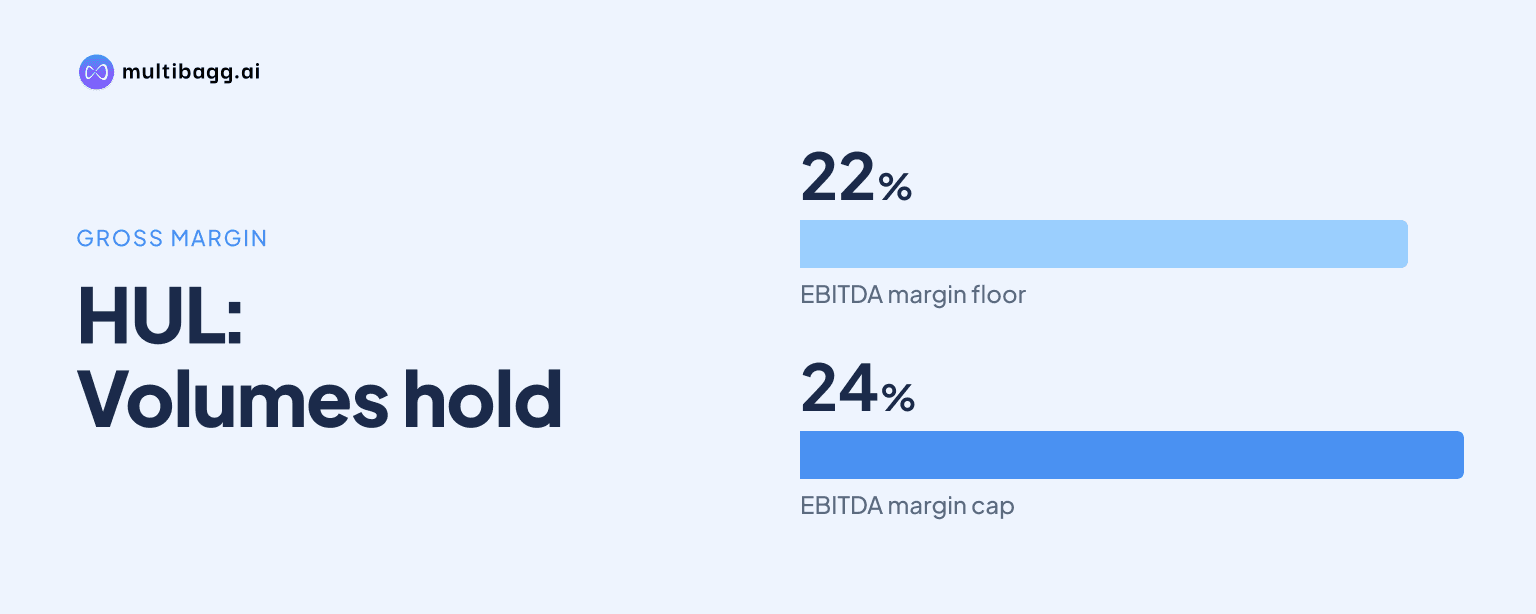
- HUL maintained medium-term EBITDA-margin guidance of 22% to 24%.
- HUL added 30,000 general-trade stores and expects 10% A&P productivity savings.
powered by IRIS
Hindustan Unilever Limited (HUL) prioritised volume growth in the September Quarter 2026, reporting 7% underlying volume growth alongside 8% price growth while gross margin declined about 400 basis points year-on-year. Management said HUL recovered absolute input-cost increases through pricing and used savings in other costs to support absolute profit growth.
Know Hindustan Unilever inside out
Results, valuation, peers and who's buying, in one view.
How is HUL pricing through inflation?
HUL is taking price increases intended to recover the absolute increase in input costs rather than preserve gross margin as a percentage of sales. Chief Financial Officer Niranjan Gupta said this was the approach through the inflation-heavy June and September quarters, with price actions tailored to the cost conditions in each category. In tea, where inflation emerged more recently, management said the necessary pricing had been taken.
This approach can leave percentage gross margin under pressure even when higher costs are recovered in absolute terms. Gupta said HUL is using other profit-and-loss lines to create leverage, citing advertising and promotion productivity and overhead leverage in the September Quarter 2026. Management said these actions helped retain volume growth while also delivering absolute profit growth.
HUL reported 8% price growth and 7% underlying volume growth, or UVG, in the quarter. Priya Nair said volume momentum improved sequentially despite meaningful price increases. She added that HUL operates in everyday categories including laundry, dishwash, tea and soaps, which management considers less price-elastic than discretionary, higher-value purchases.
What happened to HUL's margins in September Quarter 2026?
HUL's gross margin fell about 400 basis points year-on-year in the September Quarter 2026, while earnings before interest, tax, depreciation and amortisation, or EBITDA, margin declined 140 basis points. Gupta said the 260-basis-point difference reflected expense leverage that offset some of the gross-margin pressure. He said the offset did not result from cutting advertising and promotion, or A&P, spending.
Sequentially, HUL's EBITDA margin declined 40 basis points from the June quarter to the September quarter. Nair said input costs typically rise before price changes can be implemented with consumers, so quarterly margin movements should be assessed in the context of that timing difference. Gupta said the June and September quarters had borne the brunt of the inflation increase.
Management retained its medium-term EBITDA-margin guidance of 22% to 24%, while saying commodity inflation was expected to remain elevated. HUL did not provide a quarterly gross-margin target or say that gross margin had bottomed in the September Quarter 2026. Gupta described short-term margin movement as cyclical and said the portfolio was structurally positioned for gross-margin improvement over a three- to five-year horizon.
Got a follow-up? Ask IRIS
Why is HUL putting volume ahead of near-term margins?
HUL is putting volume-led revenue and profit growth ahead of protecting near-term gross-margin percentage because management sees volume momentum as the key measure of demand. Nair said rural growth rose sequentially in the September Quarter 2026, while both urban and rural markets were growing. She described the growth as broad-based across categories, channels and geographies.
HUL's portfolio spans mass and premium offerings, which management said gives it coverage across the consumer price pyramid during changing economic conditions. The extent and timing of pricing differ by category, particularly where inflation varies, as in tea. Management did not forecast a specific future UVG rate, but said its focus would remain competitive volume-led growth.
The quarter's segment results showed variation across the portfolio. Personal Care recorded 9% underlying sales growth, with Skin Cleansing delivering double-digit growth and Pears and Dove bars producing double-digit volume-led growth. Foods also reported 9% underlying sales growth but low-single-digit UVG, while coffee grew at a high-single-digit rate driven by volumes and tea faced softer mass-tea performance amid inflation.
What could shape HUL's pricing and margins next?
HUL said it will continue calibrated price increases in measured steps if inflation requires them, but management did not forecast commodity costs. Gupta said inflation on the scale experienced in the June and September quarters was unlikely to recur, while cautioning that future inflation is difficult to predict. Management will track inflation and monsoon conditions when assessing demand.
A&P productivity is a disclosed part of HUL's margin plan. Gupta said HUL expects 10% savings from non-working media, artificial-intelligence tools and buying efficiency. He said A&P competitiveness should be judged by whether major brand investments are fully funded, rather than by A&P spending as a percentage of sales.
HUL is also pursuing distribution and portfolio actions that management presented as supporting demand and profitability over time. It added 30,000 general-trade stores and grew its assortment, measured as channel-to-stock-keeping-unit mix, in double digits. Premium-format launches included TRESemme Hydra Matrix, Red Label Instant Tea and Horlicks Protein Powder, although HUL did not disclose individual sales or margin contributions for those products.
Conclusion
HUL's September Quarter 2026 performance shows the trade-off in its inflation response: it accepted a gross-margin decline of about 400 basis points year-on-year while producing 7% UVG alongside 8% price growth. The narrower 140-basis-point EBITDA-margin decline indicates that overhead leverage and A&P productivity offset part of the input-cost pressure, while management maintained its 22% to 24% medium-term EBITDA-margin range.
The next issue is whether commodity inflation remains below the intensity seen in the June and September quarters, allowing measured price actions to catch up without a material price-volume rebalancing. HUL's disclosed 10% A&P productivity-savings plan, 30,000-store general-trade expansion and three- to five-year objective of structural gross-margin improvement are the operational markers management has set out for future periods.