








Gold Prices in India Fall to 14-Month Low on Rate Fears
MAX Plan at ₹4,999/yr

Find your next multibaggerBe a Pro Investor
Research stocks and track your picks on the go. Download the app.
Key highlights
- MCX gold touched a 14-month low of ₹1,21,949 per 10 grams in November.
- 24-karat gold fell nearly 13%, or ₹18,530 per 10 grams, in one month.
- Analysts see MCX support at ₹1,21,700 to ₹1,21,000 per 10 grams.
- A break below $3,500 an ounce could take global gold towards $3,300 to $3,350.
powered by IRIS
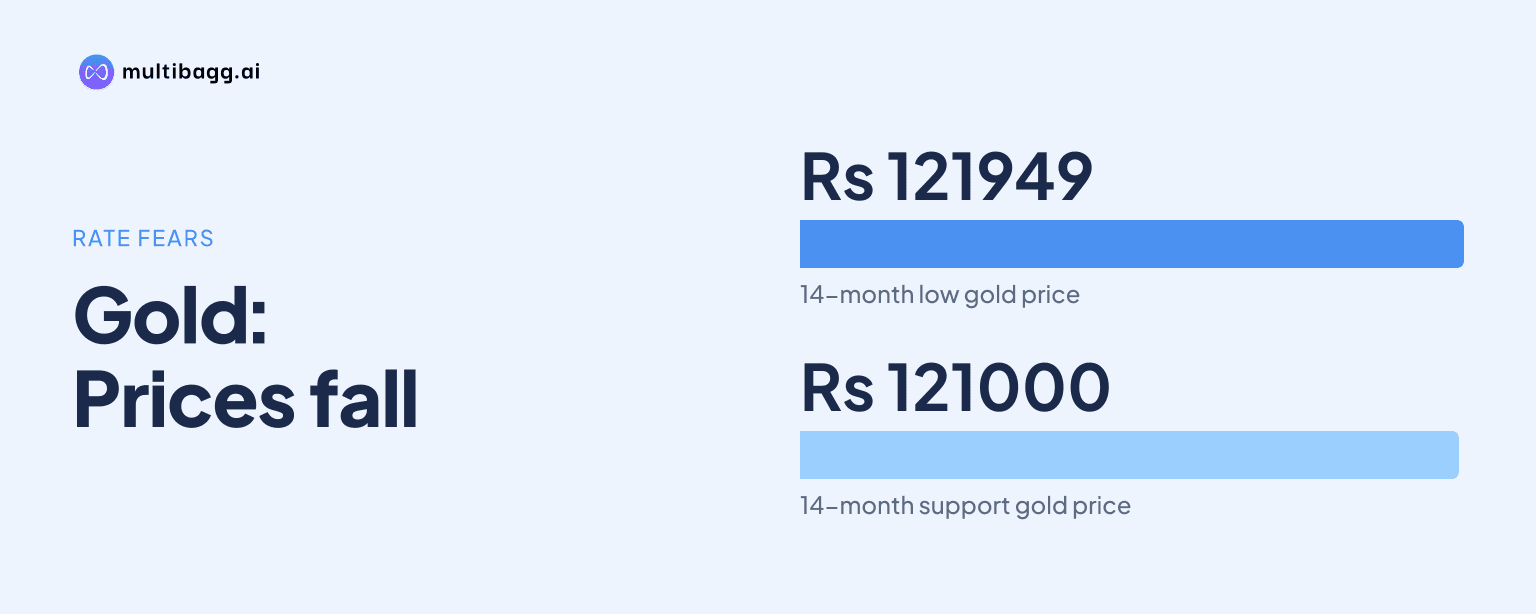
Gold prices in India fell to a 14-month MCX low of ₹1,21,949 per 10 grams in November, as a stronger US dollar, elevated bond yields and expectations of further US Federal Reserve rate hikes weighed on bullion. The decline came after a sharp retreat from January 2026 record highs.
Why have gold prices in India fallen sharply?
Gold prices have weakened because markets are pricing in tighter US monetary policy, which has lifted the US dollar and Treasury bond yields. Higher interest rates can reduce the appeal of non-yielding assets such as gold, while a stronger dollar makes dollar-priced bullion relatively more expensive for buyers using other currencies.
The decline has also been reinforced by profit booking in international and domestic bullion markets. Social-media discussions and market commentary have focused on the prospect of a December Federal Reserve rate hike, with investors assessing incoming US inflation and economic data. Gold prices fell below $3,500 an ounce on November 25, a level analysts identified as an important technical support area.
How far have gold prices in India dropped from recent levels?
Gold prices have fallen nearly 13% in a month, with 24-karat prices declining by ₹18,530 to around ₹1,26,900 per 10 grams on November 23 from ₹1,45,430 on October 23. The scale of the correction has prompted investors to reassess the near-term outlook, while some wedding buyers have increased purchases at lower prices.
The broader fall from the January 2026 peak has been larger. Market commentary placed the January record high at ₹1,80,779 per 10 grams, while another reported comparison put the 14-month MCX low at nearly ₹58,830 below that high. Price moves differ across physical-market, association-reported and MCX quotations, but all indicators point to a substantial correction.
What price levels are analysts watching for gold prices?
Gold prices face immediate MCX support between ₹1,21,700 and ₹1,21,000 per 10 grams, according to the market levels cited by analysts. A sustained break below this band could expose the metal to ₹1,18,500 and then ₹1,17,500 per 10 grams.
On the upside, analysts see resistance around ₹1,26,300 to ₹1,27,000, followed by ₹1,30,000 per 10 grams. A recovery above those points could signal improving buying interest. Internationally, a sustained move below $3,500 an ounce has been linked to possible downside towards $3,300 to $3,350, though analysts also say gold has entered oversold territory and could see a technical rebound.
Got a follow-up? Ask IRIS
What is driving the difference between global and Indian gold prices?
Gold prices in India reflect international bullion prices, the rupee-dollar exchange rate and import-related costs, so domestic moves do not always exactly match global declines. In the current correction, commentary cited rupee appreciation as a factor that deepened weakness in domestic bullion alongside lower global prices.
Currency movements can also work in the other direction. A weaker rupee may soften or offset a fall in international gold prices, keeping retail rates relatively elevated even when global bullion declines. This means the outlook for gold prices depends not only on the Federal Reserve and US data, but also on the direction of the rupee.
Should buyers expect further weakness or a rebound?
Gold prices could remain volatile in the near term while expectations of tight US policy persist. Analysts have described the outlook as subdued and fragile, warning that fresh economic indicators may lead investors to reassess the rate path and extend the correction.
At the same time, several market experts retain a positive longer-term view and expect a bottom to form between now and January 2027. They have cautioned that identifying the exact bottom is difficult. Selective consumer purchases are continuing, but demand is expected to depend on price stability, global cues and domestic consumer sentiment.
Conclusion
Gold prices have declined sharply in India after the January 2026 record high, with the move driven mainly by dollar strength, higher bond yields and expectations that US interest rates may remain high or rise further. The fall has brought important domestic support levels into focus and made physical purchases more selective.
The next signals for gold prices will come from US inflation and jobs data, Federal Reserve communication and the rupee-dollar exchange rate. Investors and buyers will also watch whether MCX gold holds the ₹1,21,700 to ₹1,21,000 support zone or recovers above the ₹1,26,300 to ₹1,27,000 resistance area.

