








SEBI MTF Funding Requires 50% Cash Collateral From July 2026
MAX Plan at ₹4,999/yr

Find your next multibaggerBe a Pro Investor
Research stocks and track your picks on the go. Download the app.
Key highlights
- MTF funding must have at least 50% cash or cash-equivalent collateral from 1 July 2026.
- Bank credit to brokers must be 100% collateralised under the revised framework.
- Pledged equity shares face a minimum 40% haircut, so 60% of market value is counted.
- Overnight F&O positions require 50% cash or cash-equivalent margin from 1 April 2026.
powered by IRIS
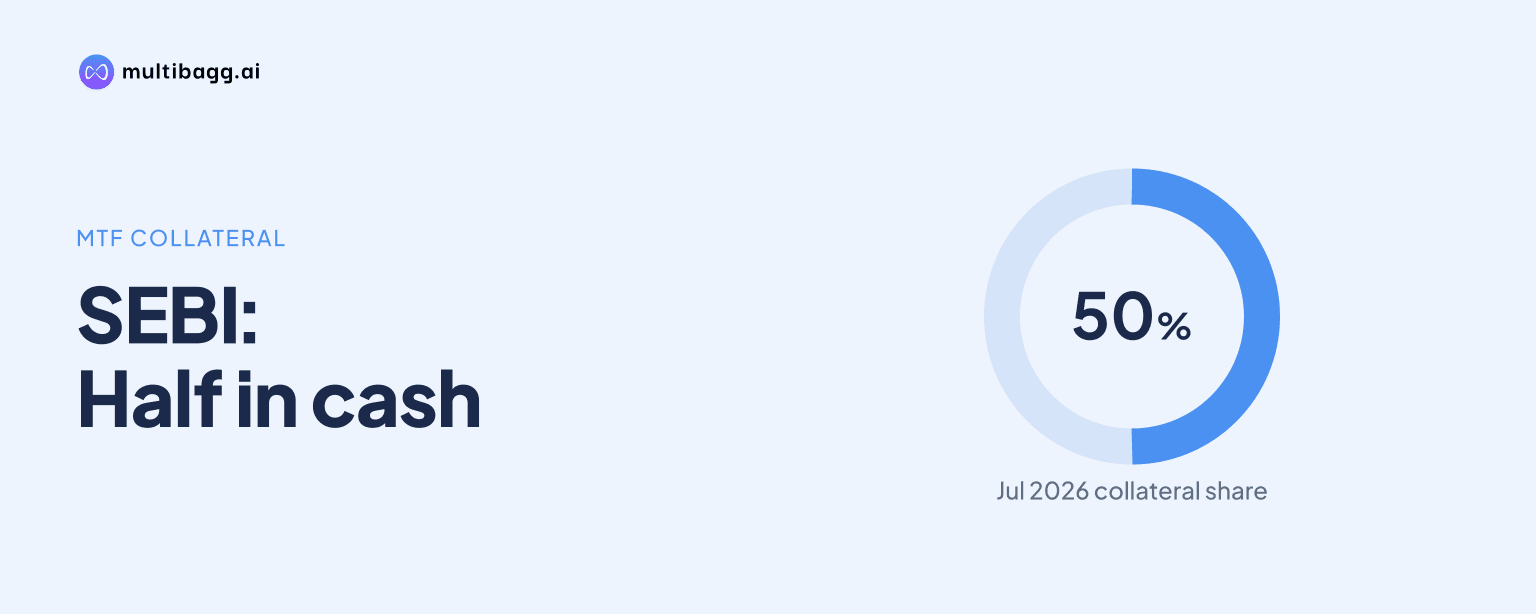
Securities and Exchange Board of India (SEBI) rules and the revised bank-to-broker lending framework require Margin Trading Facility (MTF) funding to carry at least 50% cash or cash-equivalent collateral from 1 July 2026, while bank credit to brokers must be fully collateralised.
What changes for SEBI MTF funding on 1 July 2026?
From 1 July 2026, MTF funding must be backed by collateral in which at least 50% is cash or cash equivalents. The rule is part of the revised framework governing bank credit to brokers for client MTF funding, and the facility must remain fully secured.
The change matters because pledged shares alone cannot meet the entire collateral requirement for such funding. Investors using MTF may need to understand how their broker structures collateral, while brokers will need sufficient cash or cash-equivalent backing for the financing they provide.
How does the 50% cash collateral requirement work?
The 50% requirement means at least half of the collateral supporting MTF funding must be cash or cash-equivalent assets. The balance can be supported by other permitted collateral, subject to the applicable rules and valuation standards.
Pledged equity shares are not counted at their full market value. A minimum 40% haircut applies, meaning equity collateral worth a stated market value is counted at 60% of that value for this purpose. This haircut is important when assessing how much support pledged holdings provide against MTF financing.
Does the 50% cash rule apply separately to every client?
The minimum 50% cash-equivalent collateral requirement is not necessarily applied at the individual client level under the collateral valuation provisions cited in the framework. A clearing member is required to maintain at least 50% of total collateral in cash or cash equivalents.
The framework states that an individual client can have an allocation of cash equivalents lower than the value of non-cash collateral provided by that client. This distinction means the relevant cash composition test can be maintained at the clearing-member level rather than requiring a matching cash-to-securities ratio in every individual account.
Got a follow-up? Ask IRIS
How is the MTF rule different from the F&O cash margin rule?
The MTF funding condition is separate from the 50:50 cash-margin requirement for overnight futures and options positions. Under the revised F&O margin framework effective 1 April 2026, at least 50% of total margin for overnight derivative positions must be in cash or cash equivalents.
For F&O positions, non-cash collateral such as pledged equity shares or equity mutual fund units can cover only the remaining portion of the requirement. Where non-cash collateral exceeds the permitted share, delayed payment charges may apply. The MTF rule instead addresses the collateral supporting broker-provided funding to clients.
Which securities can be used for SEBI MTF margins?
SEBI permits Group I equity shares and units of Group I equity exchange-traded funds to be eligible for MTF, subject to the prescribed conditions. The client's initial margin can be provided through cash, cash equivalents, eligible Group I equity shares, or eligible Group I equity ETF units, with appropriate haircuts.
The applicable initial margin differs by stock category. Group I stocks available in the F&O segment carry a margin of Value at Risk plus three times the applicable Extreme Loss Margin, while other Group I stocks and Group I equity ETFs carry Value at Risk plus five times the applicable Extreme Loss Margin. These requirements sit alongside the collateral-composition and valuation rules.
What do the bank-to-broker lending rules add?
The bank-to-broker lending framework requires credit facilities to brokers and other market intermediaries to be provided on a fully secured basis. For MTF financing, the collateral may include cash, cash equivalents and government securities, but a minimum 50% must be cash.
The framework also restricts direct bank credit for proprietary trading. Separately, bank guarantees issued to exchanges or clearing corporations require at least 50% collateral, of which 25% must be cash. These provisions cover different forms of broker financing and guarantees, so they should not be treated as a single client-level margin calculation.
Conclusion
The 50% cash collateral condition raises the importance of cash-backed funding in MTF arrangements from 1 July 2026. Pledged equity remains relevant, but the 40% minimum haircut reduces the value that can be counted, while full collateralisation remains necessary for bank credit to brokers.
Investors should watch how their broker communicates collateral treatment, eligible securities and funding terms before the effective date. The key unresolved practical point is how each broker allocates cash-equivalent collateral across clients while meeting the clearing-member and bank-financing requirements.

