








National Stock Exchange of India Ltd valuation faces risks
MAX Plan at ₹4,999/yr

Find your next multibaggerBe a Pro Investor
Research stocks and track your picks on the go. Download the app.
Key highlights
- National Stock Exchange of India Ltd reached a ₹5.11 lakh crore market capitalisation at an intraday high of ₹2,074.
- A cited FY26 valuation calculation put NSE at about 49.64 times earnings.
- According to Nuvama, index options contribute approximately 46% of NSE revenue.
- Cash-market volumes rose 24% in the quarter, while equity-options volumes grew 3%.
powered by IRIS
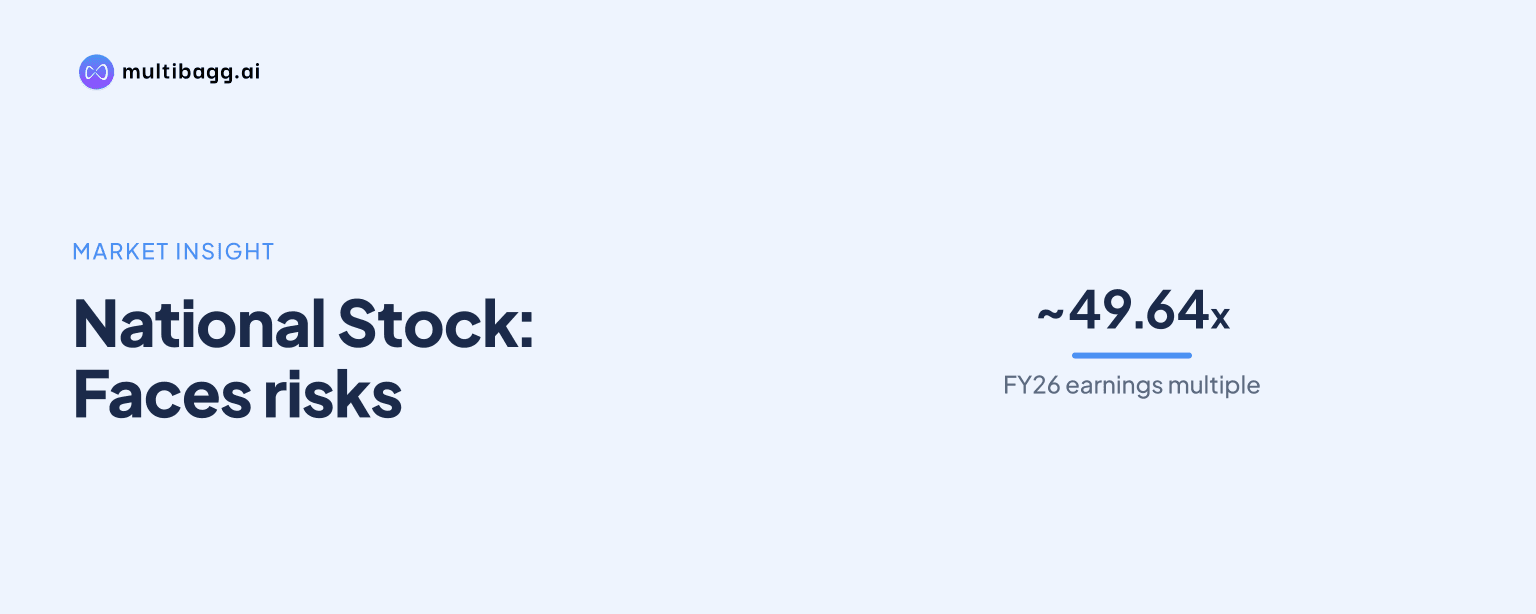
National Stock Exchange of India Ltd reached a market capitalisation of ₹5.11 lakh crore at an intraday high of ₹2,074, but its valuation faces risks from derivatives regulation, potentially slower turnover growth and future share supply. At that level, one assessment put its FY26 price-to-earnings ratio at about 49.64 times.
Why are investors questioning NSE's valuation?
NSE's valuation is under scrutiny because the share price appears to factor in sustained growth, stable margins and a strong competitive position. At the cited intraday high, the exchange's market value was ₹5,11,409.25 crore, or about ₹5.11 lakh crore. Using the annual profit cited in the discussion, that translated to a price-to-earnings multiple of around 49.64 times.
Other assessments in the supplied discussion place NSE near 43 to 45 times earnings and nearly 12 times book value. The differing multiples reflect different reference points, but the common issue is clear: investors are paying a substantial amount for each rupee of profit. One view questions whether growth of about 11% a year supports a multiple above 43 times, even though NSE's returns on equity and near-zero debt have been cited as reasons for a premium.
How dependent is NSE on derivatives activity?
NSE is materially dependent on derivatives activity because index options contribute approximately 46% of its revenue, according to Nuvama. That concentration means changes in options volumes, participation or product rules can affect transaction-linked income more sharply than a diversified revenue mix might suggest.
The recent trend cited by investors illustrates this sensitivity. Cash-market volumes rose 24% in the quarter, while equity-options volumes rose only 3%. Since derivatives are described as the exchange's main earnings engine, slower options activity can matter more for profits than robust cash-market growth. A 23% rise in September-quarter profit was noted, but profit also fell from the June quarter, keeping attention on the pace and quality of growth.
What regulatory and operating risks does NSE face?
NSE faces regulatory risk because derivatives rules, transaction taxes and participation requirements can quickly alter trading volumes. Regulatory scrutiny has tightened around speculative derivatives trading, and this business is central to the exchange's profitability. Any measure that reduces retail options activity could slow transaction income even if the exchange remains profitable.
Other risks cited in the discussion include competition, market-share losses, technology disruptions and execution in newer businesses. Exchange reliability is essential to market confidence, while recent cybersecurity incidents involving digital certificates and critical software vulnerabilities have increased broader concern around operational resilience. There are also questions about 24x7 market operations, with cybersecurity flagged as a concern if markets were to operate continuously.
Got a follow-up? Ask IRIS
Could share supply and market conditions affect NSE shares?
NSE shares could face additional supply around March 2027, based on the cited interpretation that most pre-issue shares have a six-month lock-in. When a large block of shares becomes tradable, selling pressure can build, particularly if investors reassess the valuation or if trading activity weakens.
The wider market backdrop adds another layer of risk. The discussion points to global AI uncertainty, geopolitical tensions, possible increases in US interest rates, crude oil prices and domestic inflation. US 10-year yields were described as being near 5%, while the Nifty 50 was cited at about 21 times trailing earnings. In this setting, a thinner valuation cushion and investor caution in stretched small-cap valuations could make stock-specific disappointments more consequential.
How does NSE compare with exchange valuation benchmarks?
NSE is described as trading close to the industry price-to-earnings average, rather than at a clear earnings discount to the sector. Supporters of the valuation point to its returns on equity, near-zero debt and strong market position. Four brokerages were cited as having targets ranging from ₹1,975 to ₹2,315, showing that views on the stock remain varied rather than uniformly negative.
However, the comparison with global exchanges remains a central concern. One account valued NSE at about 42.9 times earnings for the year ended March, compared with roughly 24 to 25 times for some of the world's largest listed exchange operators. Institutional demand was reported to be stronger than retail interest, while subdued retail demand and grey-market indications of a 2% to 3% gain suggested caution about near-term returns.
Conclusion
NSE's investment case combines a strong market position, profitable operations and cited balance-sheet strengths with a valuation that requires consistent execution. Its exposure to index options is the most important sensitivity: the supplied discussion estimates this activity contributes about 46% of revenue, making regulation and turnover trends critical to earnings expectations.
Investors should watch derivatives-volume growth, regulatory actions affecting futures and options, quarterly profit trends and any competitive shifts. The other disclosed event to monitor is the expected expiry of pre-issue share lock-ins around March 2027, when additional tradable supply could influence the balance between demand and selling pressure.

