








NIFTY 50 rises about 10% in November as smallcaps lag
MAX Plan at ₹4,999/yr

Find your next multibaggerBe a Pro Investor
Research stocks and track your picks on the go. Download the app.
Key highlights
- NIFTY 50 has risen about 10% in November, according to the market discussion.
- NIFTY Smallcap 100 fell 0.62% on November 25 while benchmark indices surged more than 2%.
- NIFTY Midcap 100 closed 0.1% higher at 61,490 on November 25.
- ACE Equity data showed 769 stocks declined between October 8 and November 8.
powered by IRIS
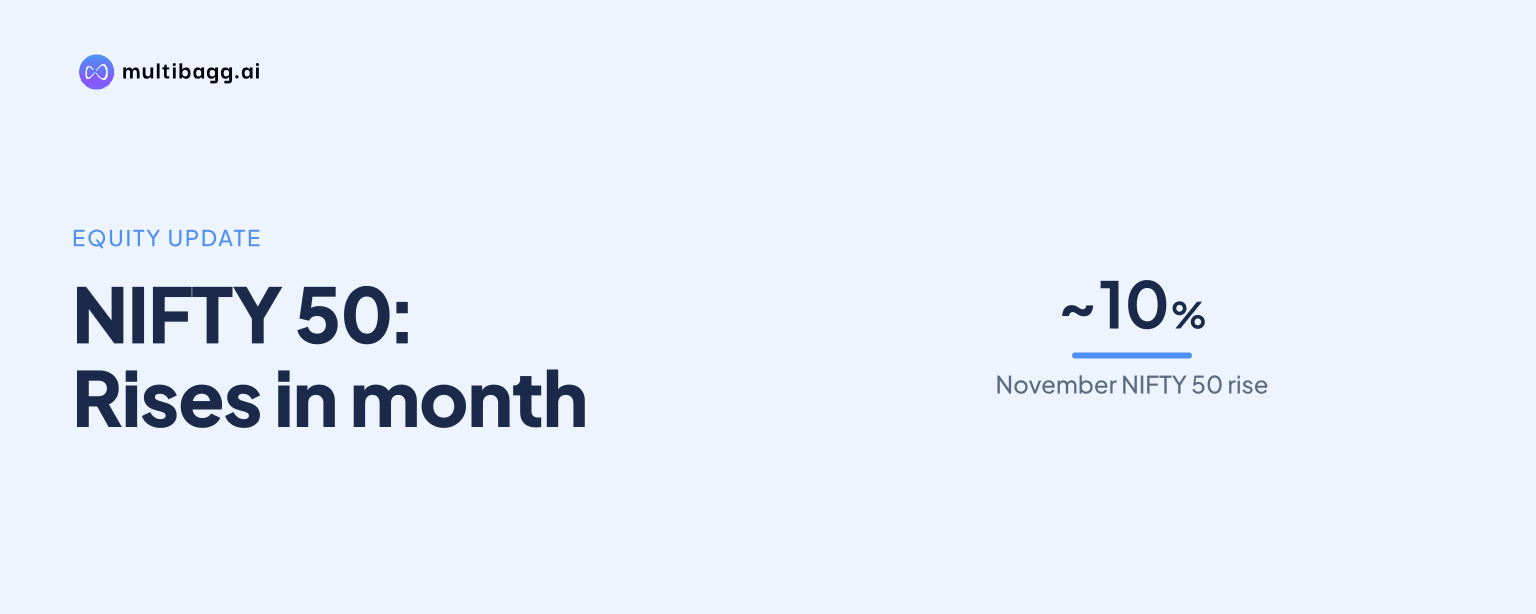
The NIFTY 50 index has risen about 10% in November, while the NIFTY Smallcap 100 fell 0.62% on November 25 and 769 stocks declined between October 8 and November 8, showing that the market recovery has been concentrated in large-cap shares rather than broadly shared across smaller companies.
Why is NIFTY 50 rising while smaller stocks lag?
NIFTY 50 is rising because the latest rebound has been led by large-cap sectors including FMCG, pharma, banking and IT. On November 25, the benchmark rose by more than 422 points and traded above 25,700, while the Sensex gained 1,700 points as it recovered most of Monday's losses.
The move was not broad-based. Market commentary described the rally as concentrated in blue-chip stocks, with investors favouring comparatively safer large-cap names during volatility. Banks were among the main contributors during the week, while the broader phase that many investors are waiting for did not emerge.
How did midcap and smallcap indices perform on November 25?
The NIFTY Midcap 100 was flat to negative for much of November 25 and ended only 0.1% higher at 61,490, while the NIFTY Smallcap 100 declined 0.62%. Those moves contrasted sharply with the more than 2% surge reported in the benchmark indices during the session.
Broader-market breadth also favoured declines despite the benchmark rally. That distinction matters because index gains can mask weakness in a large number of individual shares. Social-media discussion around the session focused on this gap: some mid and small-cap shares showed upward momentum, but the indices did not deliver a comparable breakout.
How narrow has the November market recovery been?
The recovery has been narrow enough that 769 stocks declined between October 8 and November 8 even as NIFTY 50 rallied nearly 13% over a month in another reported comparison. Several well-known companies reportedly lost more than 20%, underlining that a rising headline index did not necessarily translate into gains across smaller shares.
The difference between the 10% and nearly 13% figures reflects separate reported one-month measurement periods in the market discussion. The common conclusion is clearer than the timing difference: hundreds of smaller stocks were bypassed while the benchmark advanced. For retail investors, this means portfolio returns may differ substantially from NIFTY 50 performance when holdings are tilted toward small-cap shares.
Got a follow-up? Ask IRIS
What does relative weakness in midcaps and smallcaps indicate?
Relative weakness indicates that midcap and smallcap groups have lagged the wider market rather than confirming the benchmark rally. Relative-strength commentary showed the NIFTY Midcap 150 versus NIFTY 500 and NIFTY Smallcap 250 versus NIFTY 500 below their respective D-Smart lines after a downtrend.
The same commentary said midcap, smallcap and microcap indices remained in a column of O, describing an overall weak technical setup. This does not mean every smaller company moved lower, as some stocks and segments saw recoveries. It does mean that the available index-level evidence did not show sustained, market-wide leadership from the broader universe.
What could investors watch after NIFTY 50's November rally?
Investors can watch whether broader indices begin to participate consistently rather than merely post isolated positive sessions. A durable widening of the rally would be reflected in stronger midcap and smallcap index performance, improved market breadth and fewer smaller stocks declining while NIFTY 50 advances.
Valuation is another issue raised in the discussion. Midcap and smallcap shares were described as trading at rich valuations, while higher US Treasury yields were identified as a potential challenge to the rally. The immediate backdrop also includes foreign investor interest in lenders, falling crude prices and rotation away from AI-linked trades, all of which were cited as drivers of the benchmark's strength.
Conclusion
NIFTY 50's November advance has been a large-cap-led move, not a uniform rise across Indian equities. The contrast between an approximately 10% monthly gain in the benchmark, a 0.62% decline in the NIFTY Smallcap 100 on November 25, and 769 declining stocks in the earlier measured period shows why broader-market investors may not have experienced the headline rally.
The next point to watch is whether midcap and smallcap indices can move out of their relative underperformance and participate alongside the benchmark. Investors will also be tracking the stated risks around rich valuations and higher US Treasury yields, as well as whether foreign interest in banks continues to support the large-cap-led trend.

