








Reserve Bank of India requires 50% cash for MTF funding
MAX Plan at ₹4,999/yr

Find your next multibaggerBe a Pro Investor
Research stocks and track your picks on the go. Download the app.
Key highlights
- MTF funding must have at least 50% cash or cash-equivalent collateral from 1 July 2026.
- Bank and Type 1 NBFC credit to brokers must be 100% collateralised under the framework.
- Pledged equity shares face a minimum 40% haircut, so only 60% of market value is counted.
- India’s MTF book rose from around ₹25,000 crore in FY23 to ₹1.4 lakh crore in June 2026.
powered by IRIS
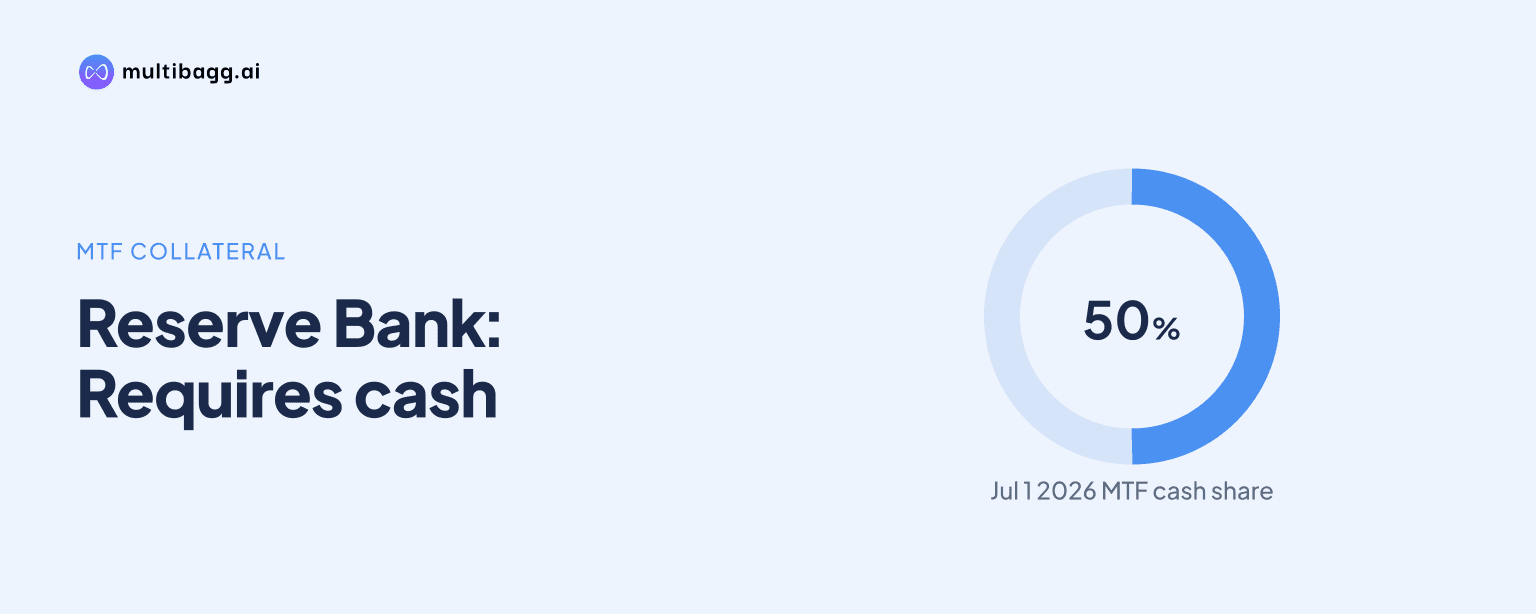
Reserve Bank of India requires bank-funded Margin Trading Facility books to have at least 50% cash or cash-equivalent collateral from 1 July 2026, alongside 100% collateralisation of bank credit to brokers and a minimum 40% haircut on pledged equity shares. India’s MTF book had reached ₹1.4 lakh crore in June 2026.
What does the RBI’s 50% cash rule for MTF funding require?
The RBI’s rule requires at least half of the collateral supporting MTF funding to be cash or cash equivalents from 1 July 2026. The requirement applies to the funding structure between banks and brokers providing MTF, rather than setting a universal cash-payment rule for every retail share purchase.
The revised framework also says bank and Type 1 NBFC credit to brokers must be fully collateralised. Pledged equity shares can remain part of the collateral pool, but lenders must apply a minimum 40% haircut when calculating their value. That means only 60% of a pledged share’s market value counts after the mandated haircut.
Why is the MTF funding change being discussed now?
The MTF funding change is drawing attention because the MTF book expanded from around ₹25,000 crore in FY23 to ₹1.4 lakh crore in June 2026. That growth has increased the relevance of the collateral rules governing how brokers obtain financing for client margin-trading books.
Under MTF, a broker finances part of a customer’s eligible stock purchase while the customer contributes the required margin. The RBI framework tightens the bank-to-broker financing arrangement behind that facility. It should not automatically be read as a new rule that every retail MTF user must personally bring 50% cash for every transaction, since SEBI maintains its own framework for the margin clients provide when using MTF.
How does the 40% haircut affect pledged shares?
The 40% haircut means ₹100 of market value in pledged equity shares is counted as ₹60 for collateral calculations. This reduces the value a lender can recognise from equity collateral and makes the required cash or cash-equivalent portion more significant in a broker’s funding mix.
The framework combines this haircut with the 50% cash-collateral condition and the requirement that bank credit to brokers be fully collateralised. JM Financial said these requirements may reduce access to bank funding and raise trading costs for brokers. The context does not provide a quantified estimate of the impact on individual brokers or retail MTF charges.
Got a follow-up? Ask IRIS
Is this the same as SEBI’s 50:50 F&O margin rule?
No, the RBI’s MTF funding requirement and SEBI’s 50:50 F&O margin rule concern different parts of the market structure. The RBI change addresses banks’ financing and collateral arrangements with brokers, while the SEBI requirement concerns the margin maintained against overnight derivatives positions.
Under the SEBI framework described in the discussion, at least 50% of the total margin for an F&O position must be in cash or cash equivalents, with the rest potentially met through approved non-cash collateral. Free cash balances, liquid mutual fund units and certain overnight money-market allocations are cited as cash equivalents, while pledged listed equity shares and equity-oriented mutual fund units are examples of non-cash collateral. The F&O rule should therefore not be conflated with the July 2026 MTF funding change.
What could change for brokers and traders after July 2026?
Brokers may need to hold or arrange a larger share of cash or cash-equivalent collateral for the bank funding used in their MTF books. The mandatory haircut also limits the funding value of pledged shares, which may affect the mix of collateral brokers use to support credit.
The broader RBI overhaul also places conditions on bank guarantees. Bank guarantees issued to exchanges or clearing corporations require at least 50% collateral, with at least 25% in cash. For proprietary trading, direct bank credit is not permitted under the listed framework, while proprietary-trading guarantees must generally be fully secured by eligible collateral. These provisions concern intermediaries and proprietary trading structures, not a general mandate for ordinary delivery investors to pay half of every purchase in cash.
Conclusion
The July 2026 framework changes the collateral mix behind bank-funded MTF by requiring at least 50% cash or cash equivalents, full collateralisation of bank credit to brokers and a 40% minimum haircut on pledged equity shares. The measures arrive after a sharp expansion in India’s MTF book, from around ₹25,000 crore in FY23 to ₹1.4 lakh crore in June 2026.
The key point to watch is how brokers adapt their funding structures after the 1 July 2026 effective date and whether they change the terms or costs of MTF for clients. Investors should also separate this bank-to-broker rule from SEBI’s distinct 50:50 cash-margin requirement for overnight F&O positions.

