








India VIX Rise Highlights Heavy Risks for Option Sellers
MAX Plan at ₹4,999/yr

Find your next multibaggerBe a Pro Investor
Research stocks and track your picks on the go. Download the app.
Key highlights
- India VIX rose 0.54 points, or 3.12%, to close at 17.89 on November 23, 2026.
- SEBI found that 87.7% of individual equity derivatives traders incurred net losses in FY26.
- Options accounted for about 92% of individual traders' losses in the FY26 study.
- Loss-making traders spent an additional 28% of net trading losses on transaction costs.
powered by IRIS
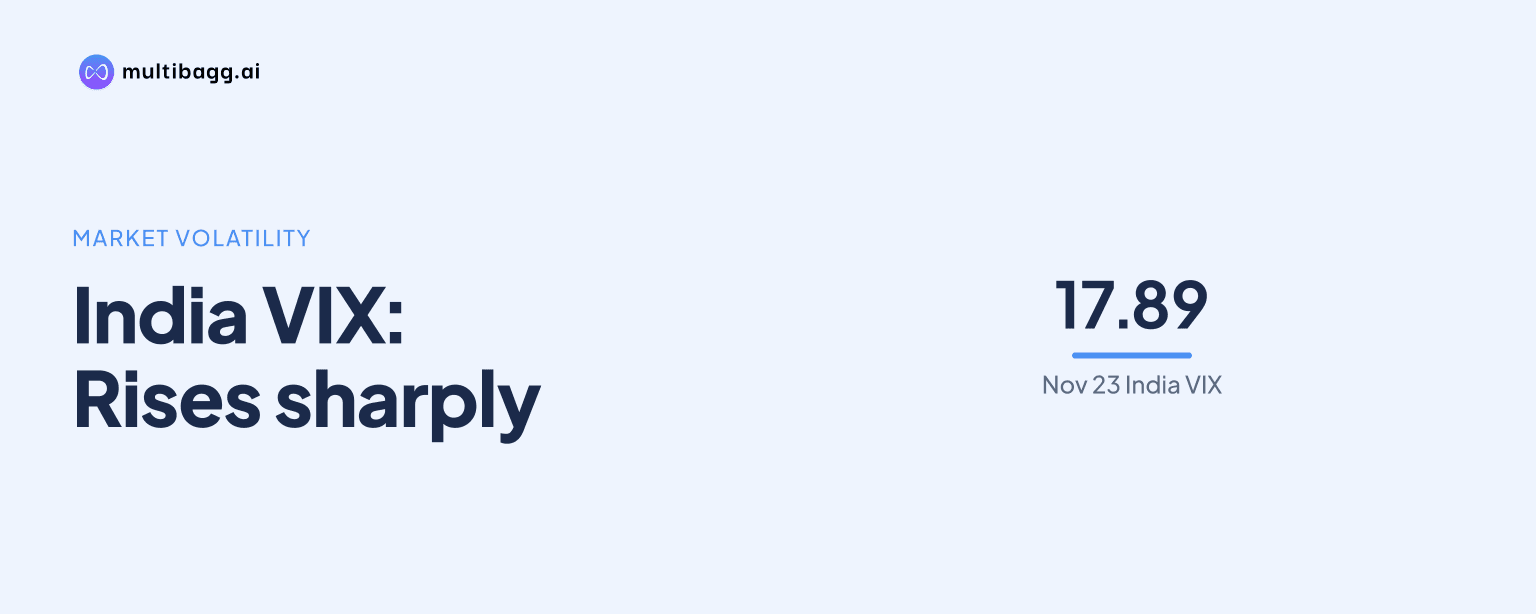
India VIX, the National Stock Exchange's volatility index, rose 3.12% to 17.89 on November 23, 2026, highlighting the risk facing option sellers when equity reversals and derivatives positioning cause sharp swings. SEBI's FY26 study separately found that 87.7% of individual equity derivatives traders incurred net losses.
What does India VIX at 17.89 indicate?
India VIX at 17.89 indicates that option-market pricing reflected higher expected near-term movement in the Nifty market than at the previous close. The index rose by 0.54 points from 17.32, a 3.12% increase, after a sharp reversal in Indian equities, banking-sector losses and derivatives positioning added to market volatility.
India VIX is derived from Nifty option premiums rather than actual past price movements. It therefore offers a forward-looking view of expected market turbulence. A rise in the index does not determine whether the market will move up or down, but it shows that traders are assigning greater value to protection and potential swings.
Why can option selling create large losses?
Option selling can create large losses because the premium received may be small compared with the loss from a sudden move in the underlying index or stock. Higher implied volatility can lift option premiums, but it can also signal wider expected price movement, which increases the risk that a sold strike will move sharply against the seller.
The risk is particularly acute in uncovered positions. Option buyers can lose the premium paid, while unhedged call or put sellers can face substantial losses and must meet margin requirements. Rapid moves in short-dated contracts can force sellers to close positions at a loss before expiry, even where the original view was based on a range-bound market.
Got a follow-up? Ask IRIS
What do FY26 retail derivatives figures show?
FY26 data show that losses were widespread among individual traders in equity derivatives. SEBI's August 2026 study found that 87.7% of individual traders in the equity derivatives segment made net losses during FY26, underscoring the difficult outcomes for retail participation in futures and options.
Options accounted for about 92% of individual traders' losses, according to the study cited in the discussion. Loss-making traders also spent an additional 28% of their net trading losses on transaction costs. The figures matter because a strategy can appear to generate frequent small gains while a limited number of adverse sessions and costs erode the overall result.
Social-media discussion also highlighted claims that small traders bore a large share of futures and options losses while proprietary desks and foreign investors generated profits. The available context does not provide a like-for-like breakdown of each group's positions or methods, but it reinforces the gap between retail expectations and the risks of derivatives trading.
Why has low volatility also hurt option sellers?
Low volatility has hurt option sellers because quieter markets tend to reduce option premiums and narrow the income available from standard volatility-selling strategies. When implied volatility is low, sellers collect less premium for taking on the risk that a later market move could still be large.
The Economic Times reported that India's calm market conditions had prompted a rethink among derivatives participants. It cited market participants saying that lower returns for conventional volatility-selling strategies, along with a reduction in weekly options contracts after regulatory action, had made strategies based on selling and rolling short-term options less rewarding.
This creates a difficult trade-off. High volatility can offer higher premiums but raises the risk of sharp losses, while low volatility can make premiums too small to compensate for the remaining exposure. India VIX and contract-specific implied volatility are useful indicators of pricing conditions, but neither removes the need to consider capital, margin and potential loss.
Conclusion
India VIX's move to 17.89 illustrates how quickly conditions can change for option sellers when equity markets reverse and demand for protection rises. The FY26 retail-loss data show that derivatives outcomes cannot be assessed only through premium income or win rates, particularly when options represented about 92% of individual traders' losses.
Investors will watch whether India VIX remains elevated after the November 23 reversal, how derivatives positioning changes, and whether market calm returns. They will also need to track the continuing effect of SEBI's measures, including the reduction in weekly options contracts, on retail activity and option-selling strategies.

