










Indo Rama says trade shifts make polyester profits durable
Key highlights
- Indo Rama said the latest reported period marked its eighth consecutive profitable quarter.
- Management said it passed through a 40% to 45% raw-material increase in the latest six months.
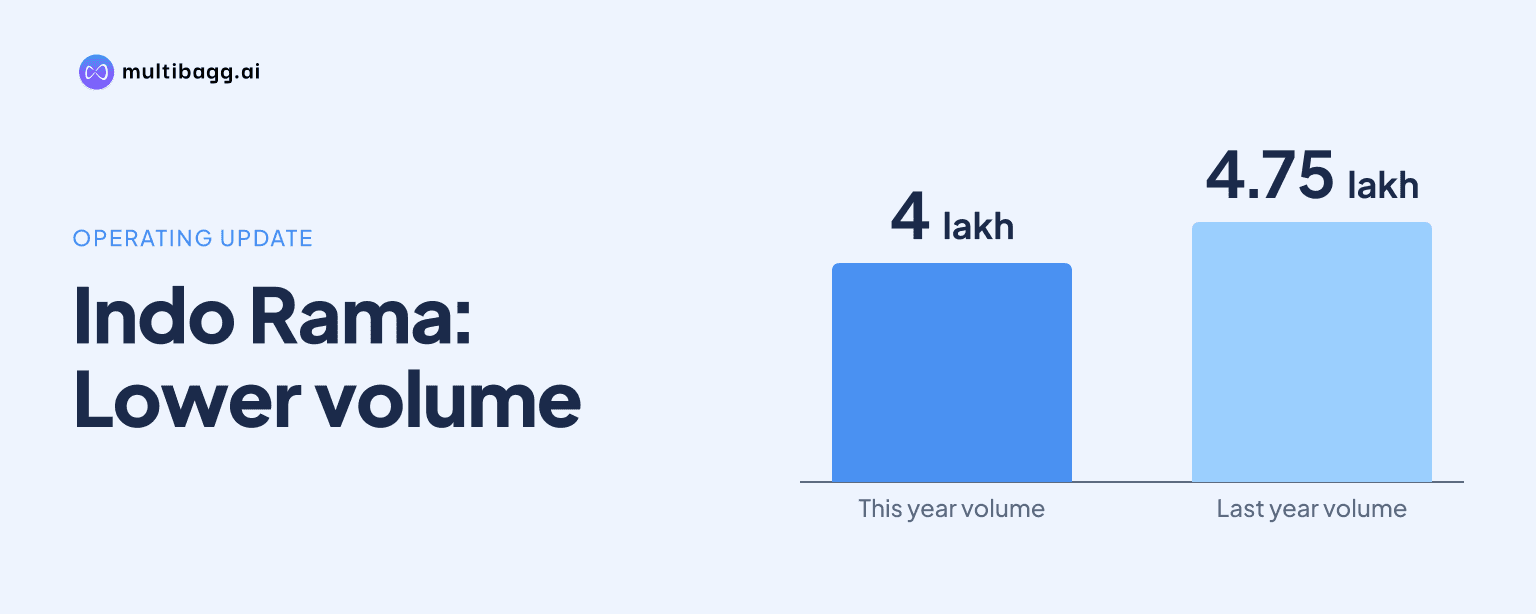
- Indo Rama expects about 4 lakh tonnes of volume this year versus about 4.75 lakh tonnes last year.
- PET-chip utilisation is 60%, while filament and fibre are operating normally at 100%, management said.
powered by IRIS
In the latest reported period, Indo Rama Synthetics said polyester profitability had become more durable after an eighth consecutive profitable quarter, supported by passing through a 40% to 45% raw-material increase. Management linked the outlook to lower barriers on key inputs, prospective trade arrangements and additional domestic purified terephthalic acid supply.
Know Indo Rama Synthetics (India) inside out
Results, valuation, peers and who's buying, in one view.
Why does Indo Rama say polyester profitability is more durable?
Indo Rama says the current position reflects operating investments and a changed input-policy environment rather than only a favourable pricing period. Managing director Om Prakash Lohia said the company was profitable in 2022, invested Rs 628 crore during 2023 and 2024 to ramp up operations and debottleneck plants, and then reached its eighth consecutive profitable quarter. He said cost optimisation and improved plant performance also supported a further Rs 200 crore investment.
Management contrasted this position with the prior decade, when it said anti-dumping duties on purified terephthalic acid, or PTA, and monoethylene glycol, or MEG, raised costs and restricted imports. Lohia said the Government withdrew the PTA anti-dumping duty in the 2021 Budget to promote textiles. He also cited the subsequent removal of anti-dumping duties and Quality Control Orders, or QCOs, as changes that could improve raw-material access.
The company produces filament yarn, fibre and polyethylene terephthalate, or PET, chips. Lohia described Indo Rama as the only integrated polyester player after Reliance, giving it exposure to all three product areas. Management’s view is that this portfolio, together with better input availability, can support industry growth, but it did not give an earnings forecast for a future downturn.
How did Indo Rama pass through higher raw-material costs?
Indo Rama said it passed through a 40% to 45% raw-material increase in the latest six months and recorded some margin improvement. In another response, Lohia said market conditions enabled the company to pass on a 50% input-cost increase, which he said would not normally have been possible. The company uses variable, market-based customer pricing instead of long-term fixed-price contracts.
The pricing mechanism operates with a reported lag of about seven to 10 days. Management said inventory is typically held for 15 days to one-and-a-half months, with about 30 days plus or minus described as normal. For the six months discussed on the call, Lohia cited a 9.9% margin and said lower domestic raw-material costs could help maintain or improve margins if prices decline.
Management did not present pass-through as a permanent result. It tied the outcome to the prevailing market environment and the ability to recover higher costs from customers. Virgin PET-chip prices had risen by Rs 30 to Rs 40 over the preceding six to eight months, making recycled chips cheaper at the time; Lohia said lower raw-material prices could reduce virgin-chip prices and support PET-chip demand.
What trade and PTA changes could increase polyester demand?
Indo Rama expects trade arrangements and new PTA supply to improve the competitiveness of Indian textile exports, although management did not quantify a sales benefit. Lohia said Indian garments faced duties of 10% to 15% in the European Union and referred to an agreement involving the United States. He also said the least-developed-country advantage held by Bangladesh and Vietnam for about 20 years was expected to end in November, as discussed on the call.
On the supply side, management said India had operated with about 6.5 million tonnes of PTA capacity for years, while producers including GAIL, Indian Oil Corporation and Reliance had planned 5.4 million tonnes of additional capacity. Lohia viewed those projects as evidence that suppliers expect demand to grow. He nevertheless said the impact of trade arrangements would be clearer only in the next year.
Exports show why PTA availability matters to the company’s argument. Indo Rama previously exported 20% to 25% of output, but management said the share had fallen to 6% in the preceding six months because domestic demand was more remunerative and Chinese raw-material imports made export production uncompetitive. With domestic PTA supply and lower duties, management said Indo Rama may target a return to a 20% to 25% export share.
Got a follow-up? Ask IRIS
Can Indo Rama raise volumes and use more PET-chip capacity?
Indo Rama’s immediate unused capacity is in PET chips, where management said the plant is operating at 60%, while filament and fibre are operating normally at 100%. The company produced about 4.75 lakh tonnes last year and expects around 4 lakh tonnes this year after the first and second quarters were affected. Lohia said next year’s volume should recover to more than 4.75 lakh tonnes at a minimum.
Management identified higher PET-chip production as a route to additional volume, but did not commit to a wider polyester expansion. It said the Rs 200 crore project would retain the existing business portfolio while broadening specialty yarn and fibre supply for the market. Management expects the project’s estimated Rs 100 crore of annual EBITDA contribution in FY28-29, rather than in the current year.
The specialty plan includes converting 115 to 120 tonnes per day of semi-dull filament output into specialty products, adding another specialty-filament line of about 70 tonnes per day, and restarting a closed fibre line. Management said specialty products account for 10% to 15% of output and can generate margins of about 15%, while most other products have similar margins within a range of 1% to 2%.
How could new PTA plants change Indo Rama’s sourcing costs?
Management said planned PTA capacity in Odisha and Mangalore could reduce Indo Rama’s logistical disadvantage versus producers in Gujarat. Lohia said the company’s Nagpur location could become closer to new eastern supply, while Gujarat could become self-sufficient after Reliance’s planned capacity comes online. He said even a 2% cost saving would make a material difference, but gave no confirmed saving estimate.
This advantage remains conditional on commissioning, pricing and freight outcomes. Management said domestic PTA availability could allow Indo Rama to source at prices closer to China, improving its export competitiveness. It also said it would wait for new PTA capacity, more stable Middle East conditions and corrected oil prices before offering a clearer view on any further polyester expansion.
Conclusion
Indo Rama’s case for more durable polyester profitability combines eight consecutive profitable quarters, Rs 628 crore of earlier ramp-up and debottlenecking investment, variable customer pricing and policy changes that management says improved access to PTA and MEG. The 40% to 45% raw-material pass-through supports that argument, although management acknowledged that the ability to recover costs reflected current market conditions.
The next test is whether planned domestic PTA additions lower supply and logistics costs and whether trade arrangements produce higher textile demand. Management expects volume to rise from around 4 lakh tonnes this year to more than 4.75 lakh tonnes next year, while PET-chip utilisation could increase from 60%. It also expects the Rs 200 crore specialty project to contribute in FY28-29 and plans to reassess further expansion after PTA capacity, oil prices and Middle East conditions become clearer.