










Indo Rama expects FY27 volume near 4 lakh tonnes before rebound
Key highlights
- Indo Rama expects FY27 volume of about 4 lakh tonnes, compared with around 4.75 lakh tonnes in FY26.
- Management expects volume to rise above 4.75 lakh tonnes next year.
- Indo Rama's PET-chip plant operates at 60% utilisation, while filament and fibre facilities operate normally at 100%.
- H1 FY27 EBITDA rose 24.9% to Rs 225.7 crore despite a 9.7% decline in total income.
powered by IRIS
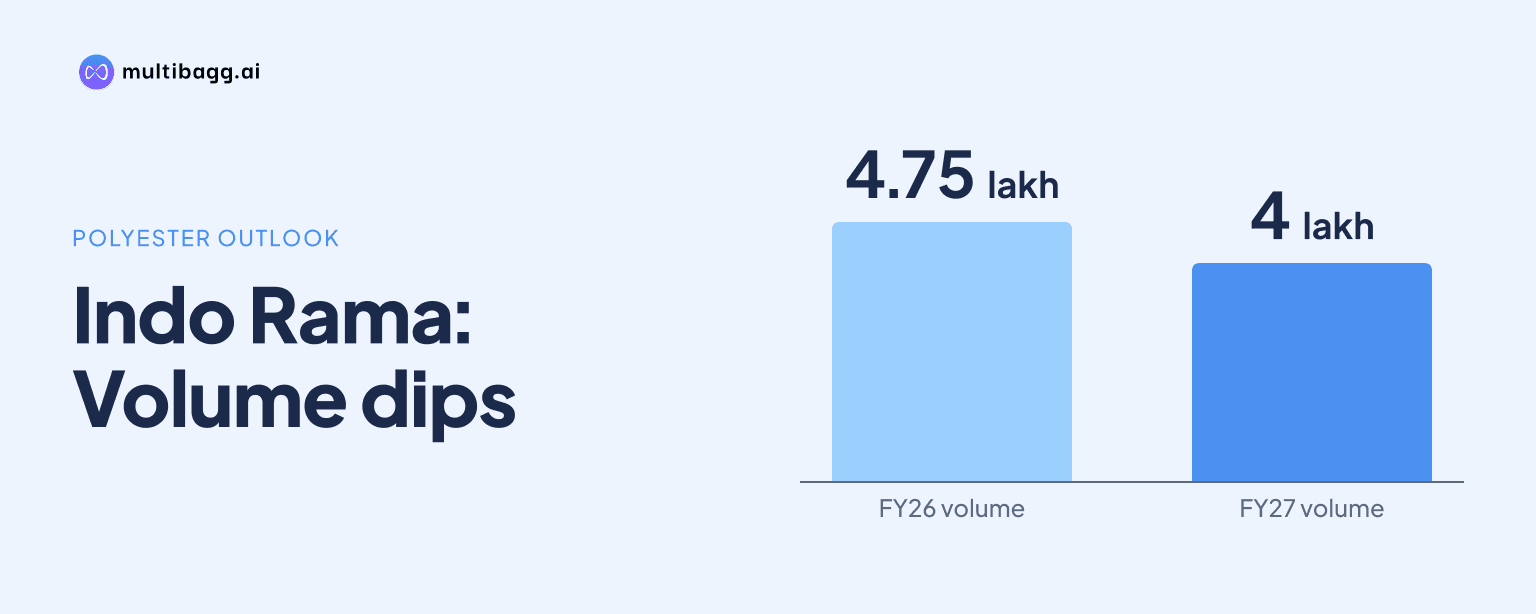
Indo Rama Synthetics expects FY27 volume of about 4 lakh tonnes, down from around 4.75 lakh tonnes in FY26, after supply-chain disruption affected the first two quarters. Management expects volume to rise above 4.75 lakh tonnes next year, supported by improved raw-material availability and higher production at its PET-chip plant, which is operating at 60% utilisation.
Know Indo Rama Synthetics (India) inside out
Results, valuation, peers and who's buying, in one view.
Why does Indo Rama expect FY27 volume to decline?
Indo Rama expects FY27 volume of about 4 lakh tonnes because the first and second quarters were affected by supply-chain disruption. Management gave the estimate after reporting H1 FY27 total income of Rs 2,284 crore, down 9.7% from Rs 2,531 crore in H1 FY26, with supply-chain issues identified as the main reason for the decline.
The FY27 estimate is about 0.75 lakh tonnes below the approximately 4.75 lakh tonnes recorded in FY26. Management did not provide quarterly production volumes, but it directly linked the expected full-year reduction to the disruption in the first two quarters rather than to lower operating capacity across all product lines.
Management described the above-4.75-lakh-tonne expectation for next year as a minimum level rather than a ceiling. It did not provide a specific upper volume target, saying the outcome would depend on growth conditions, raw-material availability and prices.
What could restore Indo Rama's volume next year?
Indo Rama expects better domestic raw-material availability and more competitive prices to help lift volume next year. Management said additional purified terephthalic acid, or PTA, capacity is expected in 2027 and 2028; India currently imports around 25 lakh tonnes of PTA, while the cited upcoming plants together represent 55 lakh tonnes of capacity.
Management said exports had historically accounted for 15% to 20% of output but had declined recently. It expects domestic PTA availability to improve cost competitiveness and could support more exports, while demand may also benefit from the agreements discussed during the call. However, management did not quantify how much either exports or domestic demand would add to volume.
The company said the supply-chain situation was fine at the time of the call and it did not see a current impact from conditions in the Middle East. Even so, management said it was difficult to state how far total volume could increase because product and raw-material prices remained uncertain.
How much PET-chip capacity can Indo Rama use?
Indo Rama is operating its PET-chip plant at 60% utilisation, while its filament and fibre facilities are operating normally at 100%. Management said this gap is the principal internal opportunity to increase output above the 4.75-lakh-tonne FY26 level, because filament and fibre operations have no comparable spare capacity.
Management said it is seeking to increase PET-chip production and gradually raise that plant towards 100% utilisation. The ramp-up depends in part on the relative pricing of virgin and recycled PET chips, as lower raw-material costs could make virgin-chip pricing more competitive.
At the beginning of the year, recycled PET chips were selling at Rs 8 to Rs 10 per kg above virgin PET chips, according to management. Virgin-chip prices then increased by Rs 30 to Rs 40 per kg during the following six to eight months as raw-material prices rose, making recycled chips cheaper at the time of the call.
Management said a future decline in raw-material prices would lower virgin PET-chip prices and could help increase PET-chip production next year. It did not provide a target date for full utilisation or a forecast for the price difference between virgin and recycled chips.
Got a follow-up? Ask IRIS
How did Indo Rama improve H1 FY27 earnings despite lower income?
Indo Rama increased H1 FY27 earnings despite lower income, reporting earnings before interest, tax, depreciation and amortisation, or EBITDA, of Rs 225.7 crore, up 24.9% from Rs 180.7 crore in H1 FY26. EBITDA margin rose 280 basis points to 9.9% from 7.1%, while total income fell 9.7% to Rs 2,284 crore.
Profit after tax rose 78.3% to Rs 137.8 crore in H1 FY27 from Rs 77.3 crore a year earlier. Net cash from operating activities reached Rs 328.5 crore, compared with about Rs 92 crore in H1 FY26, and net debt declined 23.5% to about Rs 852 crore on September 30 from Rs 1,113 crore at the end of FY26.
The second quarter showed a different revenue trend from the first half. Q2 FY27 total income increased 10% year on year to Rs 1,344 crore, EBITDA rose 46.4% to Rs 117.7 crore, and profit after tax increased 201.8% to Rs 74.1 crore.
Management said it hoped to maintain the 9.9% EBITDA margin recorded in the last six months through the next two quarters. That was an expectation rather than formal guidance, and management tied it to its ability to sustain product contribution, operating efficiency and the pass-through of raw-material cost changes.
What conditions could affect Indo Rama's volume recovery?
Indo Rama's recovery depends on raising PET-chip utilisation, securing more domestic PTA and managing raw-material pricing, management said. It noted that it had passed through a 40% to 45% increase in raw-material prices during the last half year, with customer contracts based on variable market prices rather than fixed long-term prices.
Management said the typical lag in passing on raw-material price changes is about seven to 10 days. It generally holds raw-material inventory for around 15 days to one and a half months, limiting the period in which input-cost changes are carried without corresponding revisions to selling prices.
Management also said it would have a clearer view on any further expansion after new PTA capacity starts arriving next year and after oil prices and the Middle East situation stabilise. Its current specialty expansion is a separate Rs 200 crore investment in specialty filament and specialty fibre production at Butibori, with commercial operations expected in calendar 2027.
The Butibori project is expected by management to increase top line by about 15% and EBITDA by about 20%, with payback of less than two years, subject to execution, ramp-up and market conditions. Management said the new specialty output will be supplied to the market rather than used captively.
Conclusion
Indo Rama's FY27 volume outlook indicates a temporary reduction to about 4 lakh tonnes from approximately 4.75 lakh tonnes in FY26, following disruption in the first half and limited PET-chip utilisation. The expected recovery above 4.75 lakh tonnes rests primarily on raising PET-chip output from 60%, improving domestic PTA access and potentially restoring exports.
The next disclosed milestones are the expected arrival of new PTA capacity in 2027 and 2028, progress in PET-chip production, and commercial operations at the Rs 200 crore Butibori specialty project in calendar 2027. Management has also said that oil prices and the Middle East situation must stabilise before it can provide a clearer view on further capacity expansion.