










RIR Plans Subsidised Debt-Only Funding for SiC Packaging
Key highlights
- RIR plans to use debt only, rather than further equity, for phase 1B SiC packaging.
- The proposed phase 1B loan would receive a 5% government interest subsidy, according to management.
- RIR said SiC packaging could be completed nine to 12 months after financing is finalised.
- RIR estimated Rs 12 crore to Rs 15 crore of epitaxy revenue over the remaining four to six months of the financial year.
powered by IRIS
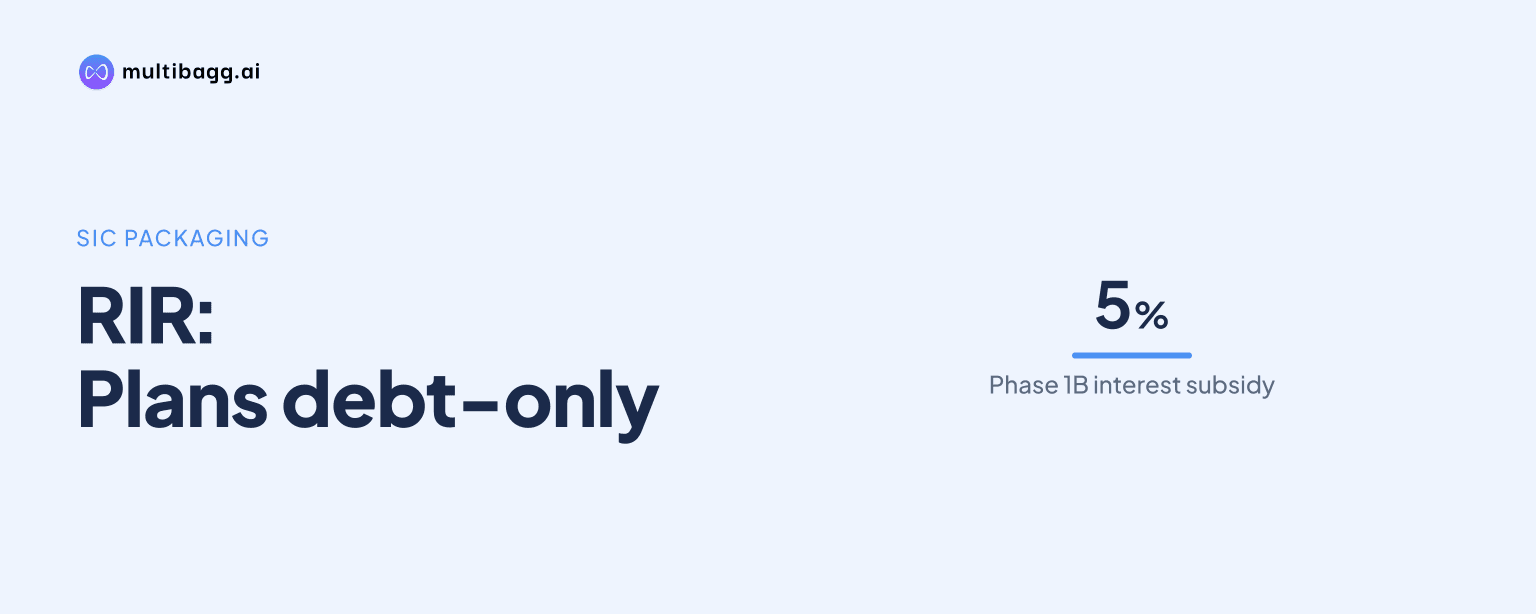
On October 27, 2026, RIR said it plans to fund phase 1B silicon carbide (SiC) packaging entirely through a bank loan supported by a 5% government interest subsidy, without further equity, and expects the facility to be completed nine to 12 months after financing is finalised.
Know RIR Power Electronics inside out
Results, valuation, peers and who's buying, in one view.
How will RIR fund phase 1B SiC packaging?
RIR plans to use debt alone for phase 1B packaging, while phase 1A was funded through equity without debt. Ankit Shah said no additional equity participation was planned for phase 1B, which covers packaging, whereas the earlier phase 1A equity contribution had already been completed. The financing split changes the funding method within phase 1 rather than applying one structure across the Odisha project.
Management said a 5% government interest subsidy was a key reason for considering debt for phase 1B. Shah said the subsidy would reduce the borrowing cost and that debt would form part of the funding source after RIR had raised equity for phase 1A. RIR did not disclose the loan amount, interest rate before the subsidy, repayment terms, lender name or debt-to-equity ratio on the call.
What will secure RIR’s proposed packaging loan?
RIR said the proposed loan would be backed by promoters’ immovable properties and fixed deposits, or FDs, as collateral and security. Shah said the pledged assets belong to the promoters, rather than identifying project assets as the sole security. RIR did not disclose the properties’ value, the value of the FDs, whether company assets would also be pledged, or the amount of financing sought.
The bank had completed internal approvals but had not issued its formal sanction letter as of the October 27, 2026 call, according to Shah. Chairman Harshad Mehta said management had been hearing for about two months that approvals were complete and the matter was in paperwork. The sanction letter remains the immediate condition before RIR can start phase 1B implementation.
When could RIR complete the SiC packaging facility?
RIR said phase 1B packaging could be completed in nine to 12 months after the term loan receives final approval. Ramesh Kumar said the location was already available and that equipment and supplier preparations were in place. The stated construction timetable begins after financing is finalised, rather than from the October 27 call date.
The Odisha building leased to RIR is intended to house both the epitaxial-reactor and packaging activities. Kumar said packaging would not need a special approval once the building approval was obtained, although an expansion approval would be required in Delhi. That differs from epitaxy, where RIR said Odisha building and fire clearances were still being processed before commercial production could begin.
Management said it had also prepared draft agreements and worked on technology partners and product mix for packaging. Mehta said RIR wanted to begin investment only when implementation could start promptly, referring to a US$2 million investment made in Andhra Pradesh in 2021 that the company now plans to monetise. He said management did not expect further issues after earlier bank-and-state arrangements, but formal loan approval was still pending.
Got a follow-up? Ask IRIS
How does packaging fit into RIR’s SiC revenue plan?
RIR described SiC revenue as a three-stage rollout: epitaxy first, packaging second and fabrication later. Mehta said epitaxy could begin generating revenue within a maximum of three months, while packaging would be the next revenue source after roughly eight or nine months. Kumar’s nine-to-12-month estimate for packaging was separately tied to loan finalisation, making the bank sanction central to the second stage.
For the remaining four to six months of the financial year, RIR estimated Rs 12 crore to Rs 15 crore of revenue from epitaxy. Shah said an average per-wafer realisation could not be provided because pricing varies by wafer specifications and thickness. Mehta said letters of intent covered about 90% of expected capacity, while noting that actual sales depend on RIR supplying a competitive product.
RIR’s established operations provide a separate base while the SiC project moves through approvals and financing. Standalone revenue from operations rose 31.1% year on year to Rs 61.14 crore in H1 FY27 from Rs 46.66 crore in H1 FY26, while adjusted operational earnings before interest, tax, depreciation and amortisation rose to Rs 10.36 crore from Rs 7.25 crore. Management also reported an order backlog of about Rs 39 crore at the end of Q2 FY27, but gave no revenue or earnings guidance for FY27-28.
What could delay RIR’s next SiC milestones?
The formal bank sanction is the main disclosed unresolved item for phase 1B, because RIR said work would begin after the financing approval. For epitaxy, the outstanding building and fire clearances in Odisha remain the stated constraint on commercial production despite reactor installation. RIR did not provide a date for either the loan sanction or the required Odisha clearances.
RIR said phase 2 fabrication would be a greenfield project, allowing building design and layout issues to be addressed from the beginning. Kumar contrasted this with the leased-building setup used for epitaxy and packaging, where approvals created delays. Management’s stated plan is to address fabrication approvals in the initial project design, although it gave no fabrication funding timetable or construction date.
Conclusion
RIR’s financing plan separates its SiC expansion into an equity-funded phase 1A and a debt-funded phase 1B. Promoter-backed collateral and the 5% government interest subsidy are intended to allow packaging to proceed without another equity raise, while epitaxy is positioned as the first source of SiC revenue.
The next item to watch is the bank’s formal sanction letter, which remained outstanding on October 27, 2026 despite management’s statement that internal approvals had been obtained. After sanction, RIR’s stated phase 1B completion target is nine to 12 months, while epitaxy still requires building and fire clearances before commercial production.