










RIR Power targets December SiC output pending approvals
Key highlights
- RIR Power expects Odisha SiC epitaxy production by December 2026 if building and fire clearances arrive.
- Management estimates Rs 12 crore to Rs 15 crore of SiC epitaxy revenue in the remaining four to six months of FY27.
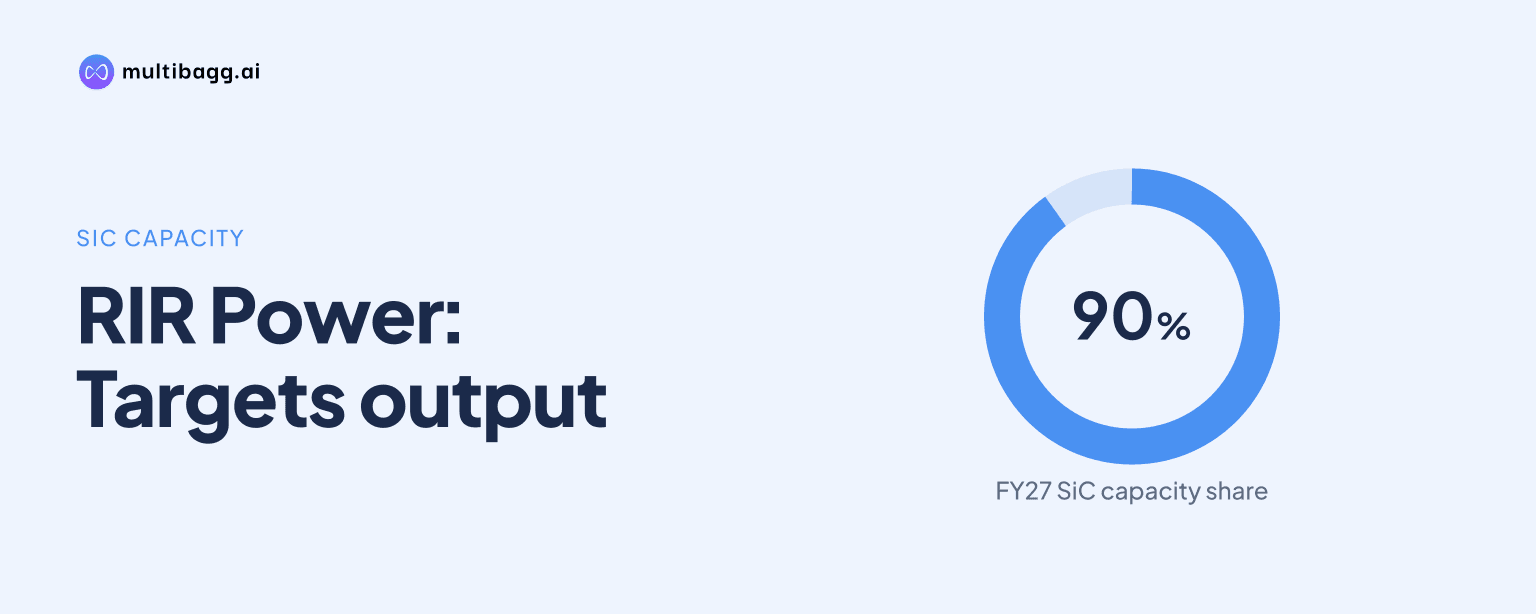
- About 90% of RIR Power’s SiC epitaxy capacity has letters of intent, according to management.
- RIR Power reported Q2 FY27 revenue of Rs 33.98 crore and profit after tax of Rs 4.45 crore.
powered by IRIS
RIR Power Electronics Limited expects its Odisha silicon carbide, or SiC, epitaxy facility to begin commercial production by December 2026 if building and fire clearances arrive, with management estimating Rs 12 crore to Rs 15 crore in epitaxy revenue during the remaining four to six months of FY27.
Know RIR Power Electronics inside out
Results, valuation, peers and who's buying, in one view.
When will RIR Power’s Odisha SiC plant begin production?
RIR Power said commercial production can begin once Odisha government building and fire clearances are received, and management said on the Q2 FY27 call that it was hoping to start in November 2026 or, if not, “definitely in December.” The company said it had completed reactor installation and was conducting internal testing, but did not offer a firm start date because the approvals remain outside its control.
The facility is the first phase of RIR Power’s Odisha project, which combines epitaxy and packaging before a later fabrication phase. Management said the clean room and infrastructure for power supply through a 33 kilovolt line had been completed in Q1 FY27, while the SiC epitaxial wafer manufacturing reactors were erected and installed during Q2 FY27. Senior Odisha state-government officials visited the facility in September 2026, according to the company.
The clearance issue is the immediate commissioning constraint rather than reactor installation. Management said the company was pursuing the matter with state officials regularly. It described the pending building and fire approvals as the remaining statutory and regulatory formalities needed before the installed equipment and supporting infrastructure can be used for commercial output.
How much SiC epitaxy revenue does RIR Power expect in FY27?
RIR Power estimates Rs 12 crore to Rs 15 crore of epitaxy revenue over the remaining four to six months of FY27 after commercial production starts. Chief Financial Officer Ankit Shah gave that range in response to a question on output capacity and wafer pricing, while cautioning that a single per-wafer realisation could not be specified because price depends on wafer specifications and epitaxial-layer thickness.
Management did not provide a wafer-volume forecast because productivity changes with the coating requirement. RIR Power explained that a 30-micron coating, for example, would yield a different number of wafers per month than another thickness, and that thickness is determined by the voltage requirement. The Rs 12 crore to Rs 15 crore projection is therefore a revenue estimate across a mix of specifications rather than a disclosed capacity-utilisation target.
Demand indications are ahead of the plant’s commercial launch, but they are not final sales. Chairman Harshad Mehta said about 90% of capacity had letters of intent from customers, including international customers, and that RIR Power had received specifications from prospective buyers. He said letters of intent depend on timing and that customer orders require a competitive product, so the stated coverage does not establish booked revenue.
What has changed in RIR Power’s Odisha project?
RIR Power has moved from construction and infrastructure completion to installed-reactor testing, while statutory approvals are still needed for commercial production. In Q1 FY27, the company said the clean room and 33 kilovolt power-supply infrastructure had been completed; by Q2 FY27, it said the SiC reactors had been erected and installed and internal testing was under way.
This transition has occurred while RIR Power’s existing operations continued to grow and the new epitaxy activity had not yet begun commercial revenue. Standalone revenue was Rs 33.98 crore in Q2 FY27, up from Rs 27.16 crore in Q1 FY27 and Rs 25.64 crore in Q2 FY26. Profit after tax was Rs 4.45 crore in Q2 FY27, compared with Rs 3.15 crore a year earlier.
For the first half of FY27, revenue from operations reached Rs 61.14 crore, against Rs 46.66 crore in H1 FY26. Adjusted operational earnings before interest, tax, depreciation and amortisation, or EBITDA, rose to Rs 10.36 crore from Rs 7.25 crore, while profit after tax increased to Rs 7.59 crore from Rs 4.89 crore. These figures relate to the operating business and do not indicate that Odisha epitaxy sales have begun.
Got a follow-up? Ask IRIS
What is RIR Power’s plan for packaging and fabrication?
RIR Power plans to add packaging after epitaxy, subject to final bank approval for a term loan, and management expects that work to take about nine to 12 months once it begins. The company said space was ready, equipment and suppliers had been identified, and the project was at the closing stage for finance. Management said packaging should not need the same special approval as epitaxy because it would be treated as an expansion.
The proposed funding structure for phase 1B packaging differs from phase 1A epitaxy. Management said phase 1A had been funded with the company’s equity contribution and no debt, while phase 1B was expected to use debt with no additional equity participation. Shah said the proposed loan would be supported by certain promoter-owned immovable properties and fixed deposits, and would carry a 5% government interest subsidy, according to management.
Fabrication remains a later, greenfield project. RIR Power said a new fabrication facility would be planned from the initial building-layout stage, which management believes should avoid the approval issues encountered in the leased building used for epitaxy and packaging. Mehta said the company expects three potential revenue stages: epitaxy first, packaging after that, and fabrication later, while it intends to generate revenue from its intellectual property through contract manufacturing in parallel.
What supports RIR Power’s ability to absorb new output?
RIR Power reported a Rs 39 crore order backlog at the end of Q2 FY27 for its existing operations, while management said some high-power-device bottleneck processes had reached about 90% utilisation. The company said those bottlenecks could be doubled by adding machines, whereas low-power devices and equipment primarily require additional assembly benches and people rather than a comparable production-capacity expansion.
The company also reported repeat railway orders, with management expecting railway-business quantity and value to rise 70% to 80% over the prior year. It said its defence prototype testing had been completed but first orders were still awaited, and that approximately 70% of an initial export order had been executed. These existing segments are separate from the planned SiC epitaxy business but form the operating context for the Odisha commissioning effort.
Conclusion
RIR Power’s near-term semiconductor milestone is completion of building and fire approvals rather than further reactor installation. The reactors are installed, internal testing is under way, and management has attached a Rs 12 crore to Rs 15 crore FY27 revenue estimate to epitaxy once output begins. About 90% of capacity has letters of intent, although customer commitments still depend on competitive product delivery.
The next point to watch is whether the statutory clearances allow commercial output in November or December 2026, as management expects. After commissioning, the other disclosed milestones are formal bank sanction for packaging finance, the subsequent nine-to-12-month packaging implementation period, and conversion of customer letters of intent into orders.