










RIR Power targets 70-80% railway growth amid bottlenecks
Key highlights
- RIR Power's Q2 FY27 standalone revenue rose 32.5% year on year to Rs 33.98 crore.
- RIR Power's Q2 FY27 profit after tax increased 41.2% year on year to Rs 4.45 crore.
- RIR Power said certain high-power manufacturing bottlenecks have reached about 90% utilisation.
- RIR Power expects railway-business growth of 70-80% in FY27, driven by repeat orders.
powered by IRIS
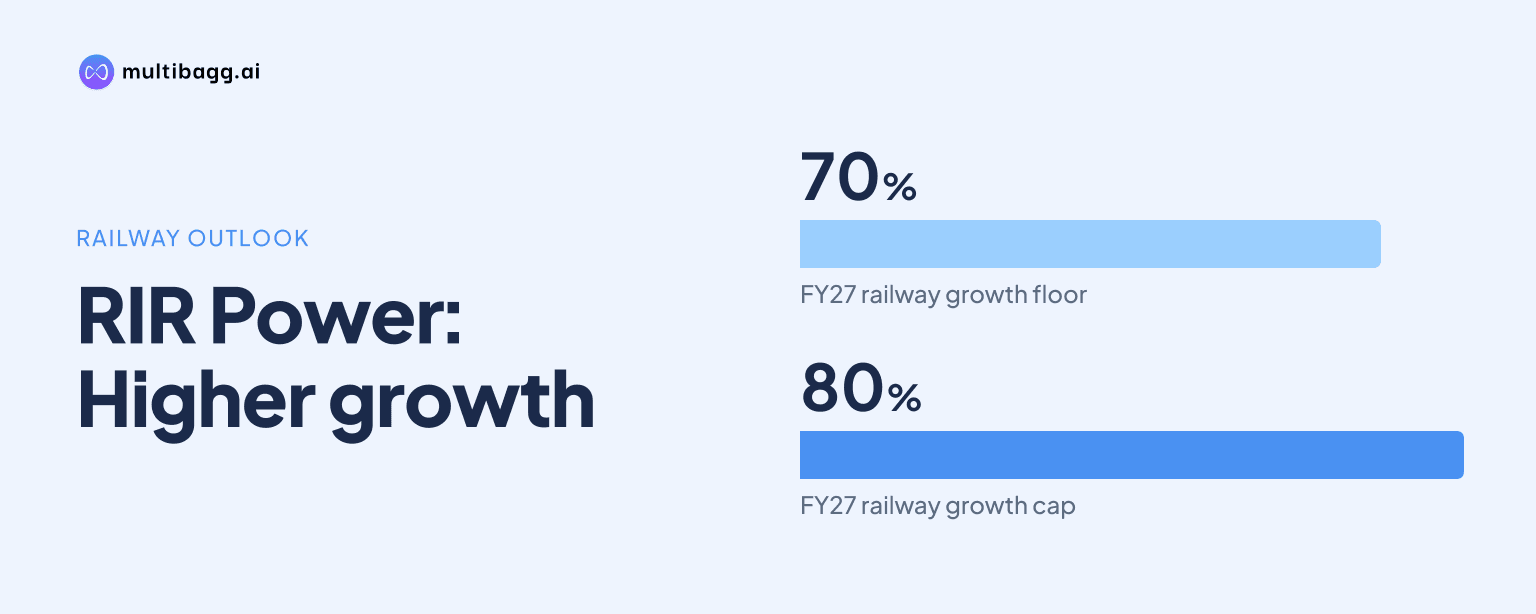
RIR Power Electronics Limited expects its railway business to grow 70-80% in financial year 2026-27 (FY27), as repeat orders rise, after second-quarter (Q2) revenue grew 32.5% year on year to Rs 33.98 crore and some high-power manufacturing bottlenecks reached about 90% capacity.
Know RIR Power Electronics inside out
Results, valuation, peers and who's buying, in one view.
How did RIR Power perform in Q2 FY27?
RIR Power reported higher revenue and profit in Q2 FY27, with standalone revenue reaching Rs 33.98 crore, up 25.1% from Rs 27.16 crore in Q1 FY27 and 32.5% from Rs 25.64 crore in Q2 FY26. Profit after tax rose 41.2% year on year to Rs 4.45 crore from Rs 3.15 crore, while the profit-after-tax margin increased to 12.5% from 11.97%.
Adjusted operational EBITDA, or earnings before interest, tax, depreciation and amortisation, was Rs 5.66 crore in Q2 FY27, compared with Rs 4.36 crore a year earlier. Its margin declined to 16.6% from 17.0%, which management attributed to a 2.8% increase in raw-material costs linked to geopolitical issues and spending on events including SEMICON India and Transrail.
For H1 FY27, RIR Power recorded revenue of Rs 61.14 crore, 31.1% above Rs 46.66 crore in H1 FY26. Adjusted operational EBITDA increased 42.8% to Rs 10.36 crore and its margin expanded by 140 basis points to 16.9%, while profit after tax rose 55.2% to Rs 7.59 crore from Rs 4.89 crore.
Why does RIR Power say manufacturing is the constraint?
RIR Power says demand is no longer the principal issue because its order backlog was about Rs 39 crore at the end of Q2 FY27 and the focus has shifted to factory productivity and on-time delivery. Management said neither Q1 nor Q2 revenue contained one-time items, describing quarterly revenue as routine operating revenue rather than an exceptional contribution.
The specific capacity constraint is in high-power devices, where some bottleneck operations have reached about 90% utilisation. Management said those operations could be doubled by adding machines and that it is investing in the identified bottlenecks. This differs from low-power devices and equipment, where management said capacity can be expanded largely through additional assembly benches and personnel.
RIR Power operates three existing product verticals: low-power devices, high-power devices and equipment. In high-power devices, the process runs from wafer handling and diffusion through fabrication and finished products, making constrained process steps more consequential. The plant programme is intended to raise productivity while preserving product quality as the order backlog increases.
Got a follow-up? Ask IRIS
What is driving RIR Power's railway growth target?
RIR Power's 70-80% FY27 railway-growth expectation is based chiefly on repeat orders for existing products, rather than only on newly developed products. Management said railway customers are already placing repeat orders, whereas defence remains at the prototype and testing stage and has not yet begun commercial supply.
The railway business also has product-development work tied to changing Railway Design and Standards Organisation specifications, according to management. RIR Power said passenger trains are moving towards Vande Bharat trainsets, while locomotives should continue to be required for freight, creating demand across existing railway applications as well as revised specifications.
This railway outlook contrasts with the export programme, where the first order is about 70% executed and the customer is expected to test the products in the United States after completion. Management said future export repeat orders would depend on that testing. For defence, it said prototypes and testing are complete, but it is awaiting initial orders.
When could RIR Power's silicon carbide revenue begin?
RIR Power could begin commercial silicon carbide epitaxial-wafer production after Odisha government building and fire clearances are received, with management expressing hope during the October 27, 2026 call that production would begin in November or December 2026. The company said reactor installation, clean-room construction and 33-kilovolt power-supply infrastructure had been completed, but it did not provide a firm commissioning date.
For the remaining FY27 period, management estimated Rs 12 crore to Rs 15 crore of revenue from the epitaxy process over four to six months after operations begin. It did not provide an average revenue per wafer because pricing depends on required specifications and coating thickness, which varies with voltage requirements.
Management said letters of intent cover about 90% of the capacity of the two installed reactors, subject to RIR Power delivering competitive products. The next phase, packaging, awaits final bank approval for a term loan; management said equipment suppliers and the site are ready, with execution expected to take nine to 12 months after financing closes. The proposed loan would be secured by promoters' immovable properties and fixed deposits, with a stated 5% government interest subsidy.
Conclusion
RIR Power's Q2 FY27 results show revenue growing 32.5% and profit after tax growing 41.2%, while management frames the immediate operational issue as throughput rather than demand. The Rs 39 crore order backlog, repeat railway orders and the stated 70-80% railway-business growth expectation make bottleneck removal central to delivery during FY27.
The next items to watch are the Odisha statutory clearances required for epitaxy production, the timing of the formal bank sanction for the packaging loan, and whether RIR Power delivers its estimated Rs 12 crore to Rs 15 crore of epitaxy revenue over four to six months after commissioning. Management also plans to add machinery at high-power-device bottlenecks that have reached about 90% utilisation.