










I&PCL invests in machining to ship finished precision parts
Key highlights
- I&PCL spent Rs 23.23 crore on capital expenditure in FY 2025–26 and Rs 5.27 crore in H1 FY 2026–27.
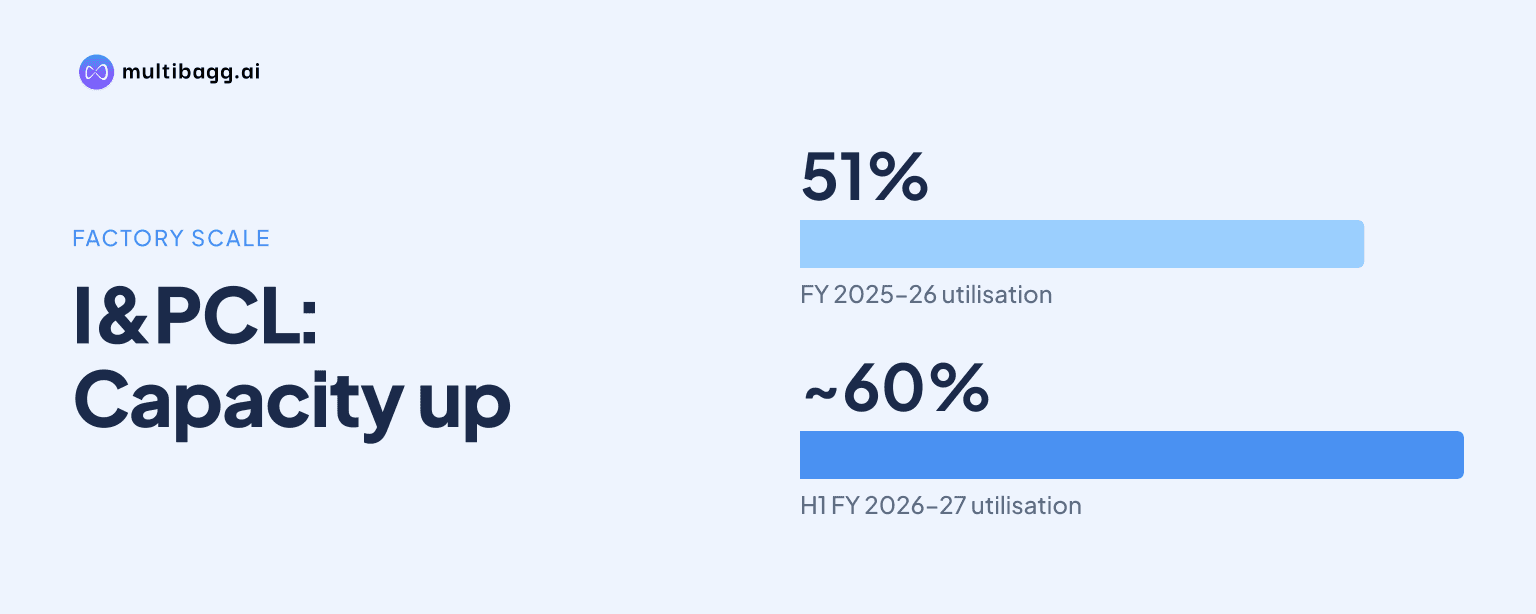
- I&PCL reported about 60% capacity utilisation in H1 FY 2026–27, up from 51% in FY 2025–26.
- Aerospace and defence represented 11% of H1 FY 2026–27 revenue, compared with 6% in FY 2025–26.
- I&PCL’s listed precision-component range runs from 8 grams to 330 kilograms.
powered by IRIS
Investment & Precision Castings Ltd is expanding CNC machining and demand-linked special processes so more castings can be supplied as finished, inspected parts; capital expenditure was Rs 23.23 crore in FY 2025–26, followed by Rs 5.27 crore in H1 FY 2026–27.
Know Investment & Precision Castings inside out
Results, valuation, peers and who's buying, in one view.
How is I&PCL moving beyond castings alone?
I&PCL is positioning itself to supply components either as-cast or fully finished through an integrated route from pattern making to inspection. Its listed product range spans intricate, near-net-shape parts weighing from 8 grams to 330 kilograms, including turbine wheels and blisks, turbocharger housings, pump impellers, copper conductors machined ready for assembly and orthopaedic implants polished to a mirror finish.
The immediate investment mechanism is added computer numerical control, or CNC, machining capacity, which I&PCL says will enable more finished parts to ship from the same castings. The company also identifies more castings leaving machined and inspected as one of four ways to fill available plant capacity, alongside new nominations, qualified parts ramping up and new processes.
I&PCL describes its offer as one source from pattern to finished part under one quality system and one point of accountability. More than 80 engineers support design for manufacture from the request for quotation, or RFQ, through series supply, while the company says it handles more than 500 specifications across superalloys, aluminium, copper and steel.
What is I&PCL spending on machining and processes?
I&PCL spent Rs 5.27 crore on capital expenditure in H1 FY 2026–27, after Rs 23.23 crore in FY 2025–26, and says the programme is funded through internal accruals and debt. The disclosed programme covers a lost-foam precision-casting line in installation and trials, CNC and machining capacity, and heat treatment, vacuum casting and inspection where confirmed demand requires them.
Capital expenditure increased from Rs 3.84 crore in FY 2024–25 to Rs 23.23 crore in FY 2025–26. H1 FY 2026–27 covers the six months to 30 September 2026 and is therefore not comparable with a full year, but its Rs 5.27 crore outlay shows continued investment after FY 2025–26.
Overall gearing rose by 0.03 times from 0.68 times at 31 March 2026 to 0.71 times in H1 FY 2026–27. Interest coverage increased to 5.12 times in H1 FY 2026–27 from 3.40 times in FY 2025–26, while the presentation identifies CARE BBB; Stable as I&PCL’s rating.
Which products and markets can use I&PCL’s finished-part capability?
I&PCL can apply finishing, inspection and machining across aerospace, defence, space, energy, medical, automotive, turbochargers, pumps and valves, agriculture and industrial applications. Listed examples include aerospace gimbals and structural housings, gas-turbine nozzle rings, automotive transmission parts, pump impellers and diffusers, and orthopaedic implants.
Aerospace and defence represented 11% of revenue in H1 FY 2026–27, compared with 6% in FY 2025–26. Automotive accounted for 62% in H1 FY 2026–27 against 64% in FY 2025–26, while industrial, energy and general engineering accounted for 27% against 30%; I&PCL says industrial sales did not fall, but aerospace and defence grew faster.
The largest listed casting is a pump impeller weighing up to 330 kilograms, while the lower end of I&PCL’s range is 8 grams. I&PCL says its products are built to customer drawings and specifications, meaning the machining, inspection and finishing route can vary by programme, material and customer requirement.
Got a follow-up? Ask IRIS
What approvals support I&PCL’s end-to-end supply plan?
I&PCL says it holds aerospace, automotive, defence and medical approvals, including airworthiness approval on flight hardware. Its management-system certifications include EN 9100:2018, ISO 9001:2015, IATF 16949:2016 and ISO 13485:2016, covering aerospace, quality, automotive and medical-management requirements respectively.
For special processing, I&PCL lists Nadcap approvals for fluorescent penetrant inspection, magnetic particle inspection and heat treatment. It also has a National Accreditation Board for Testing and Calibration Laboratories, or NABL, accredited laboratory to ISO/IEC 17025 for chemical, mechanical and metallographic testing.
I&PCL’s qualification stage can take from six months to four to five years. The process starts with RFQ feasibility and design-for-manufacture review, then moves through customer nomination, tooling, samples and production part approval process, or PPAP, before rolling monthly call-offs begin.
How does finished-part supply fit I&PCL’s capacity and results?
I&PCL reported about 60% capacity utilisation in H1 FY 2026–27, up from 51% in FY 2025–26. Management says volume can fill plants on the current product mix, while value can come from vacuum-melted and non-ferrous work, more finished parts and new processes.
Revenue from operations reached Rs 111.4 crore in H1 FY 2026–27, up 26.3% from Rs 88.2 crore in H1 FY 2025–26. Earnings before interest, tax, depreciation and amortisation, or EBITDA, including other income, rose 67.5% to Rs 24.1 crore, while profit after tax increased 107.2% to Rs 10.8 crore and EBITDA margin reached 21.6% from 16.2%.
In Q2 FY 2026–27, revenue was Rs 58 crore, up 8.67% from Rs 53.37 crore in Q1 FY 2026–27 and 31.55% from Rs 44.09 crore in Q2 FY 2025–26. Q2 EBITDA margin was 22.17%, versus 20.94% in Q1 FY 2026–27 and 17.45% a year earlier, although the presentation does not attribute the improvement solely to machining or special processes.
Conclusion
I&PCL’s disclosed strategy is to capture more manufacturing steps on precision components by combining casting with CNC machining, inspection and selected special processes. The approach is backed by Rs 23.23 crore of FY 2025–26 capital expenditure, an 8-gram-to-330-kilogram product range, and approvals spanning aerospace, automotive, defence and medical applications.
What to watch next is the installation and trials of the lost-foam line, the share of castings that leave machined and inspected, and whether confirmed demand prompts further heat-treatment, vacuum-casting or inspection investment. Management also identifies about 60% H1 FY 2026–27 utilisation, new nominations and qualified parts ramping up as routes to use capacity, while qualification can take six months to four to five years.