










I&PCL utilisation rises to about 60% from 51% in H1 FY 27
Key highlights
- I&PCL reported about 60% capacity utilisation in H1 FY 27, compared with 51% in FY 2025–26.
- I&PCL says part qualification can take from 6 months to 4–5 years before programme volumes ramp.
- I&PCL supports more than 500 specifications across component weights from 8 grams to 330 kilograms.
- I&PCL's 4 MW solar capacity and two 1.25 MW wind turbines supply about 40% of its energy.
powered by IRIS
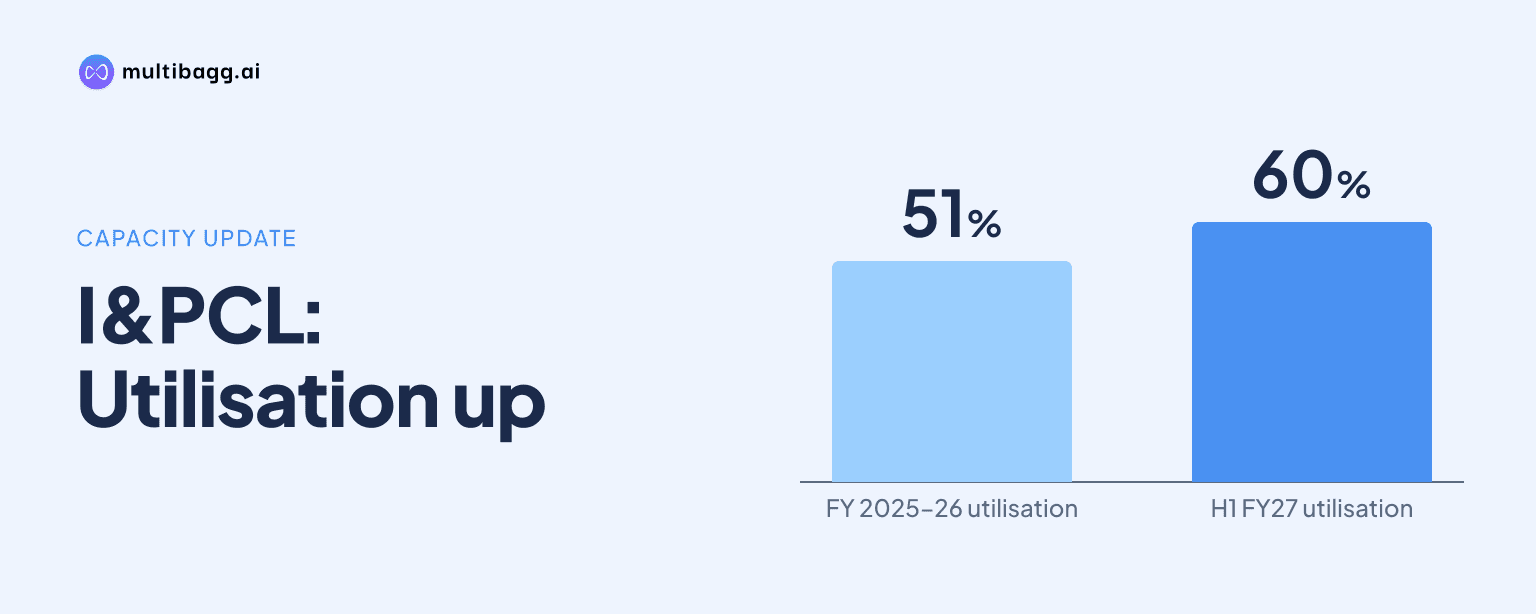
Investment & Precision Castings Limited (I&PCL) reported capacity utilisation of about 60% in H1 FY 27, compared with 51% in FY 2025–26, and says qualified-part ramps, new nominations, more finished parts and a shift toward vacuum-melted and non-ferrous work can use the remaining plant headroom.
Know Investment & Precision Castings inside out
Results, valuation, peers and who's buying, in one view.
Why did I&PCL utilisation reach about 60%?
I&PCL reached about 60% capacity utilisation in H1 FY 27, versus 51% in FY 2025–26. The comparison represents an increase of about 9 percentage points and indicates that installed capacity remains available for additional production.
I&PCL says the headroom exists because it built capacity ahead of customer nominations. A nomination awards a part to I&PCL for a customer programme, but qualification, tooling and sample approval can take from six months to four to five years before recurring monthly schedules begin.
The company separates its capacity plan into volume and value. Volume means filling plants using the present product mix, while value means changing the mix toward vacuum-melted and non-ferrous work. I&PCL does not describe the H1 FY 27 utilisation increase as the result of a new plant-expansion programme.
How can qualified parts increase I&PCL utilisation?
I&PCL says parts that have already completed qualification can raise utilisation as customer programmes ramp, because they need no new approval before volumes increase. Customer call-offs are made through rolling monthly schedules once the approved process is established.
New nominations are another stated source of volume because each can add a part supplied monthly for the life of a programme. The process starts with a request for quotation, drawing review and design-for-manufacture work, then proceeds through nomination, qualification and recurring supply.
The six-month to four-to-five-year qualification period explains why capacity can be built before output arrives. I&PCL also says a wide base of qualified repeat parts helps cushion the lag while newer programmes move through approval stages.
Working capital is a stated requirement for the volume route. I&PCL says most inventory is work in progress within a long production process rather than idle stock, while customer call-offs can change within weeks because schedules follow customers' production plans.
How can machining and alloy mix increase value per part?
I&PCL says more castings can leave its facilities as machined and inspected finished parts. This route adds processing to its pattern-to-inspected-part offering, which the company says operates under one quality system.
The other value route is a shift toward vacuum-melted and non-ferrous work. I&PCL lists existing capability in superalloys, aluminium, copper and steel, covering more than 500 specifications and component weights from 8 grams to 330 kilograms.
I&PCL also identifies lost-foam as a process now available, with further capabilities planned in the future. The presentation does not quantify the revenue, margin, capacity utilisation or investment associated with lost-foam, machining, vacuum-melted work or non-ferrous work.
More than 80 engineers support customers from the request-for-quotation stage through series supply, according to I&PCL. The company links this engineering support with complex-shape production and its ability to supply critical parts from pattern making through inspection.
Got a follow-up? Ask IRIS
Which markets and approvals support I&PCL's capacity plan?
I&PCL serves ten end markets: aerospace, defence, space, energy and gas turbines, medical, automotive, turbochargers, pumps and valves, agriculture, and industrial. It says no single end market must carry the business because additional markets can use existing plant capacity and approvals.
Its aerospace and defence applications include aircraft systems, aero engines, afterburners, small-arms systems, land systems and naval systems. Space products include launch vehicles and cryogenic engines, while energy applications include industrial gas turbines and steam turbines.
I&PCL says it has approvals across aerospace, automotive, defence and medical, including airworthiness approval on flight hardware. Its listed systems include EN 9100:2018, ISO 9001:2015, IATF 16949:2016 and ISO 13485:2016, alongside Nadcap approvals for penetrant inspection, magnetic-particle inspection and heat treatment.
The presentation places these markets in an external demand setting that includes Indian defence production of Rs 1.51 lakh crore in FY 2024–25, against a national target of Rs 3 lakh crore by 2029. These figures are industry context rather than an I&PCL order forecast or revenue target.
What could limit I&PCL's move beyond 60% utilisation?
I&PCL identifies customer and segment concentration as a risk because its top five customers account for about half of revenue. Automotive remains its largest segment, although the company says its share is falling as industrial and aerospace and defence work grow.
Schedule variability can affect utilisation because customer call-offs can change within weeks. I&PCL says its exposure is spread over ten end markets, but it does not disclose utilisation by customer, programme or individual end market.
Input cost and currency exposure are managed through pass-through contract terms and own renewable generation, according to I&PCL. The company has 4 megawatts of tracker-mounted solar capacity and two 1.25-megawatt wind turbines, which together supply about 40% of its energy.
The disclosed utilisation figure is therefore an overall H1 FY 27 measure rather than a segment-level measure. Qualification timing, customer schedules and working-capital availability remain the mechanisms identified by I&PCL that can affect how quickly unused plant capacity converts into output.
Conclusion
I&PCL's move to about 60% capacity utilisation in H1 FY 27 from 51% in FY 2025–26 shows higher use of existing plants while retaining capacity headroom. Its stated routes to further loading combine qualified-part ramps and new nominations with more machining, inspection, vacuum-melted work and non-ferrous work.
The next point to watch is whether approved programmes translate into larger monthly schedules and whether new nominations advance through the disclosed six-month to four-to-five-year qualification cycle. I&PCL also says further capabilities are planned, while its operating framework distinguishes volume growth, which needs working capital, from value growth, which needs capability.