








A J Packaging Limited: AJ Cans is 23.28% of purchases in FY2024

Find your next multibaggerBe a Pro Investor
Research stocks and track your picks on the go. Download the app.
Key highlights
- AJ Cans accounted for 23.28% of A J Packaging’s total purchases in the year ended 31 March 2024.
- A J Packaging’s sales to AJ Cans ranged from 11.90% to 12.86% of total sales across four disclosed periods.
- A J Packaging reported Rs 3.13 crore of trade receivables from AJ Cans at 30 June 2026.
- A J Packaging held a Rs 20.25 lakh non-current investment in AJ Cans at each disclosed balance-sheet date.
powered by IRIS
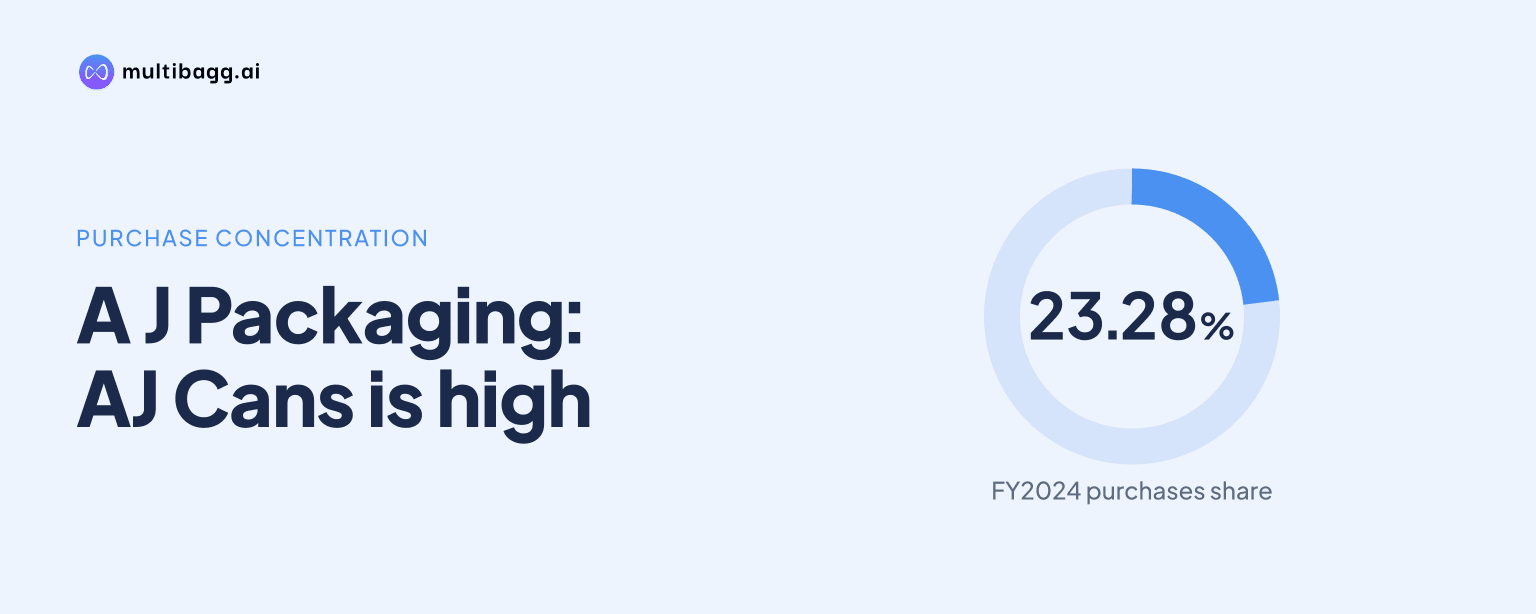
A J Packaging Limited reported purchases from AJ Cans Private Limited equal to 23.28% of total purchases in the year ended 31 March 2024, while sales to AJ Cans represented 11.90% to 12.86% of total sales across four disclosed periods. The relationship also included a Rs 20.25 lakh investment, loan movements and Rs 3.13 crore of trade receivables at 30 June 2026.
How material were A J Packaging’s AJ Cans sales and purchases?
A J Packaging’s sales to AJ Cans were consistently about one-eighth of total sales, while purchases from AJ Cans ranged from 17.79% to 23.28% of total purchases in the disclosed periods. A J Packaging classifies AJ Cans as an entity in which key management personnel, or KMP, or relatives of KMP exercise significant influence, making the dealings related-party transactions.
Sales to AJ Cans were Rs 26.75 crore in the year ended 31 March 2024, Rs 24.89 crore in the year ended 31 March 2025, Rs 26.55 crore in the period ended 31 March 2026 and Rs 9.59 crore in the period ended 30 June 2026. Purchases from AJ Cans exceeded sales in three of the four columns, including Rs 35.88 crore in the year ended 31 March 2024 and Rs 29 crore in the year ended 31 March 2025.
A J Packaging states that these sales percentages are calculated against total sales for each respective period, while purchase percentages are calculated against total purchases. The figures are net of goods and services tax, or GST, and the note does not disclose product categories, contract duration, pricing methods, credit terms or alternative counterparties.
How did A J Packaging’s AJ Cans purchase concentration change?
A J Packaging’s AJ Cans purchase concentration fell from 23.28% in the year ended 31 March 2024 to 17.79% in the period ended 31 March 2026, before increasing to 21.74% in the period ended 30 June 2026. Sales concentration moved within a narrower range, from 12.73% in the year ended 31 March 2024 to 12.86%, 11.90% and 12.17% in the following three disclosed columns.
The movements are not fully like-for-like because the year ended 31 March 2024 and year ended 31 March 2025 figures are consolidated, whereas the 31 March 2026 and 30 June 2026 figures are standalone. The 30 June 2026 column also covers a shorter period, but AJ Cans accounted for more than 11% of sales and more than 17% of purchases in every reported column.
A J Packaging also received machinery rent from AJ Cans of Rs 18 lakh in the years ended 31 March 2024 and 31 March 2025, Rs 19.50 lakh in the period ended 31 March 2026, and Rs 6 lakh in the period ended 30 June 2026. These amounts represented 72.28%, 68.18%, 69.89% and 77.32%, respectively, of total machinery rent received in those periods.
The disclosed sales and purchase shares depend on AJ Cans continuing to buy goods from and supply goods to A J Packaging. The note establishes recurring transaction scale but does not specify committed volumes, minimum purchases, price benchmarks, payment schedules or a plan to reduce the commercial relationship.
Got a follow-up? Ask IRIS
What funding, investment and balance-sheet ties exist with AJ Cans?
A J Packaging held a Rs 20.25 lakh non-current investment in AJ Cans at cost at 31 March 2024, 31 March 2025, 31 March 2026 and 30 June 2026. The unchanged carrying amount means the reported investment balance did not change across the four disclosed dates.
AJ Cans also appeared in A J Packaging’s loan disclosures. The loan received or repaid-back line records Rs 7 crore received in the year ended 31 March 2024, followed by Rs 5 crore repaid in the year ended 31 March 2025 and Rs 2 crore repaid in the period ended 31 March 2026; no amount was reported for the period ended 30 June 2026.
Long-term borrowings from AJ Cans were Rs 7 crore at 31 March 2024 and Rs 2 crore at 31 March 2025, with no AJ Cans balance shown in the 31 March 2026 or 30 June 2026 columns. A J Packaging’s debt-equity ratio declined from 2.63 times at 31 March 2024 to 1.47 times at 30 June 2026, although the note attributes the reduction at 31 March 2025 to a significant increase in net worth from share-capital issuance rather than solely to related-party loan repayments.
A J Packaging reported trade receivables from AJ Cans of Rs 1.74 crore at 31 March 2026 and Rs 3.13 crore at 30 June 2026. The Rs 1.39 crore increase accompanied Rs 9.59 crore of sales to AJ Cans in the period ended 30 June 2026, but the supplied note does not provide receivable ageing, payment terms or subsequent collections.
Which disclosures define A J Packaging’s AJ Cans related-party exposure?
A J Packaging identifies AJ Cans as an entity influenced by KMP or relatives of KMP, rather than identifying AJ Cans as a subsidiary or associate in the related-party note. The same list names Ajay Agarwal as chairman and whole-time director, Nitin Agarwal as managing director, and Ranjani Agarwal and Ridhi Bansal as relatives of KMP.
A J Packaging separately reported rent paid to Asian Colour Cartons of Rs 36 lakh in the years ended 31 March 2024 and 31 March 2025 and the period ended 31 March 2026. AJ Cans is the only named related party in the supplied disclosure that appears in goods sales, goods purchases, machinery rent received, loan movements, non-current investment and trade receivables.
The scope of the AJ Cans relationship therefore spans operating revenue, procurement, rental income, financing and balance-sheet items. At 30 June 2026, the Rs 3.13 crore receivable and Rs 9.56 crore of purchases in the period show that the commercial connection continued after the long-term borrowing balance was no longer reported.
Conclusion
A J Packaging’s disclosures show that AJ Cans was a material counterparty across commercial and financial links rather than solely a customer or supplier. Purchases reached 23.28% of total purchases in the year ended 31 March 2024, sales remained near 12% of total sales across four periods, and the relationship included machinery rent, a Rs 20.25 lakh investment, prior borrowing and Rs 3.13 crore of receivables at 30 June 2026.
What to watch next is whether A J Packaging reports changes in AJ Cans transaction shares, the Rs 3.13 crore receivable or financing balances in later financial statements. The supplied note discloses no target, transition plan, contract expiry date or commitment governing these related-party flows, so subsequent disclosures will determine whether the standalone pattern at 30 June 2026 persists.

