








A J Packaging IPO RHP Analysis: Revenue Rs 223.04 Crore

Find your next multibaggerBe a Pro Investor
Research stocks and track your picks on the go. Download the app.
Key highlights
- A J Packaging reported FY2026 revenue from operations of Rs 223.04 crore and PAT of Rs 7.91 crore.
- The IPO comprises 27.50 lakh fresh shares and 2.50 lakh offer-for-sale shares.
- Top 10 customers contributed Rs 147.48 crore, or 66.12%, of FY2026 revenue.
- Total fund-based debt was Rs 70.69 crore at June 30, 2026.
powered by IRIS
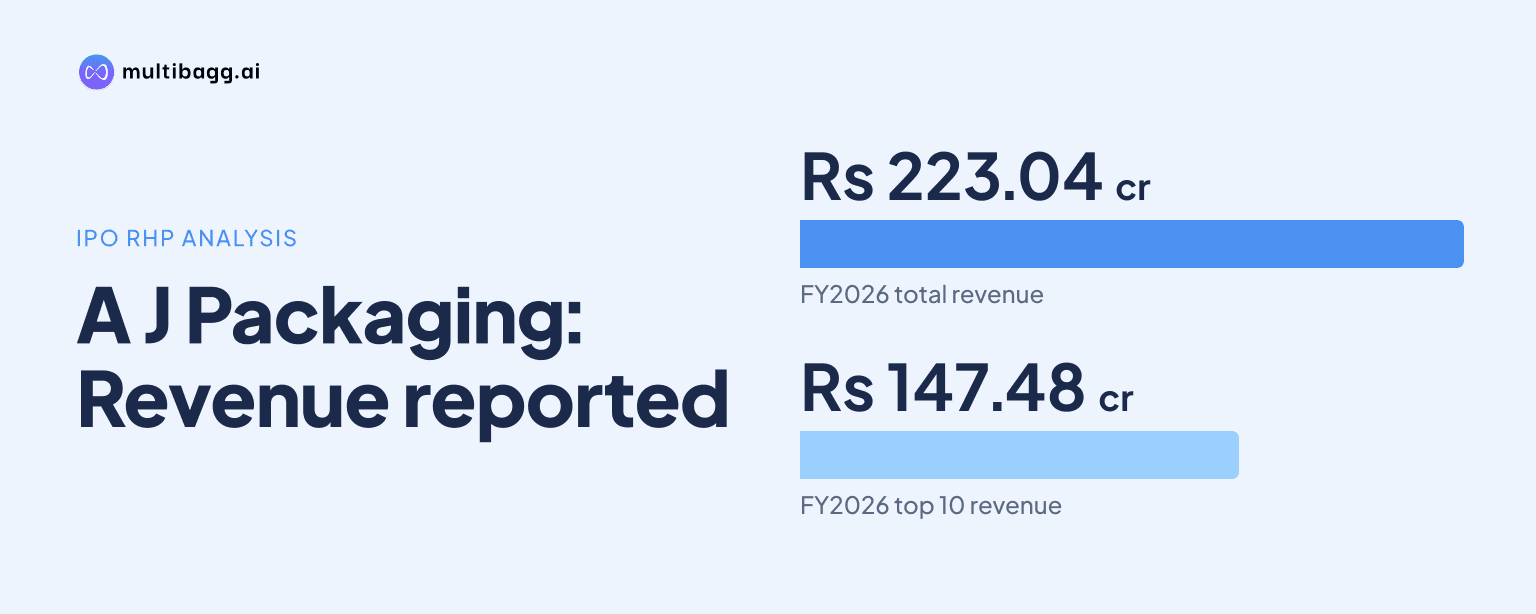
A J Packaging Limited is seeking to list its metal-can manufacturing business on NSE Emerge through a 30.00 lakh-share IPO, and its most important disclosed financial fact is FY2026 revenue from operations of Rs 223.04 crore. The RHP shows improving reported margins and a Rs 36.30 crore proposed allocation to debt repayment and working capital, but leaves the price band undisclosed.
What are the offer details of A J Packaging?
A J Packaging is offering up to 30.00 lakh equity shares, comprising a fresh issue of 27.50 lakh shares and an offer for sale of 2.50 lakh shares. The offer is a 100% book-building issue proposed for listing on NSE Emerge. Offer terms below use the Capital Structure and Issue Structure disclosures, which provide the detailed and internally consistent share count.
The issue includes a market-maker reservation of 1.50 lakh shares and a net offer to the public of 28.50 lakh shares. R.K. Stockholding Private Limited is the market maker and has agreed to provide market making for three years from listing. The indicative timetable sets December 4, 2026 for finalisation of the basis of allotment, December 7 for credit of shares, and December 8 for commencement of trading.
What does A J Packaging sell, who buys it, and what are its dependencies and concentration?
A J Packaging manufactures metal tin cans in oval, rectangular and round formats for business-to-business customers in food, beverages, coffee, fast-moving consumer goods and paints. Its products include printed, lacquered, embossed, shaped and customisable cans ranging from 50 grams to 500 grams and 50 millilitres to 5,000 millilitres.
The RHP names CCL Products (India) Limited, Indus Coffee Private Limited, Mrs. Bectors Food Specialities Limited, Haldiram Foods International Private Limited, Asian Paints Limited, SLN Coffee Private Limited and Marino Foods Private Limited among customers. Manufacturing facilities are located in Hyderabad and Ghaziabad, with another Telangana factory at Quthbullapur.
Metal containers generated Rs 158.19 crore, or 70.93%, of FY2026 revenue. Printed and lacquered sheets contributed Rs 26.86 crore, trading sales contributed Rs 18.16 crore, and other operational sales, including scrap and job-work revenue, contributed Rs 19.81 crore. Installed capacity was 15,000 metric tonnes in FY2026, production was 8,766 metric tonnes, and capacity utilisation was 58.44%.
Customer concentration is substantial. The top five customers contributed Rs 119.03 crore, or 53.37%, of FY2026 revenue, and the top 10 contributed Rs 147.48 crore, or 66.12%. The RHP states that A J Packaging has no long-term or formal agreements with key customers. Telangana represented 59.47% of FY2026 revenue, Uttar Pradesh 28.93%, and Maharashtra 11.60%.
Tinplate was 84.45% of FY2026 raw-material cost. The top five suppliers accounted for Rs 114.60 crore, or 66.92%, of FY2026 purchases, while the top 10 accounted for Rs 131.30 crore, or 76.67%. A J Packaging has no long-term contracts for raw-material procurement, which includes tinplate, printing and coating inks, lacquering inks, copper foil and aluminium foil.
What is A J Packaging’s multi-year financial track record?
A J Packaging reported FY2026 growth in revenue, EBITDA and profit after tax after revenue declined in FY2025. The table uses standalone financial information for the period ended June 30, 2026 and FY2026, and consolidated financial information for FY2025 and FY2024, as presented in the financial statements.
FY2026 revenue increased from FY2025, although the comparison is between standalone FY2026 and consolidated FY2025 information. The RHP attributes the FY2025 revenue decline from FY2024 to reduced coffee-customer demand following higher coffee prices and uncertainty in confectionery demand linked to evolving United States tariff developments.
EBITDA means earnings before interest, tax, depreciation and amortisation, while PAT means profit after tax. EBITDA margin rose from 8.88% in FY2024 to 11.90% in FY2026, and PAT margin rose from 1.80% to 3.55%. Net worth increased by Rs 17.76 crore between FY2024 and FY2026. June 2026 figures cover three months, and the disclosed June return ratios are annualised.
How do A J Packaging’s margins and returns compare with named listed peers?
A J Packaging reported an FY2026 EBITDA margin of 11.90%, PAT margin of 3.55%, return on equity of 17.79% and return on capital employed of 17.41%. The RHP identifies Shetron Limited, Kaira Can Company Limited and Rajeshwari Cans Limited as listed peers.
The RHP’s peer data reflects the respective companies’ FY2026 figures. Product mix, scale, accounting presentation and capital structure differ among these companies, so the disclosed metrics are comparisons rather than identical operating measures.
What do cash flow and debt show?
A J Packaging generated Rs 15.75 crore of net operating cash flow in FY2026, spent Rs 6.29 crore in investing activities and used Rs 4.83 crore in financing activities. Net operating cash flow was Rs 13.03 crore in FY2025 and Rs 16.17 crore in FY2024. Investing cash outflow was Rs 8.74 crore in FY2025 and Rs 14.11 crore in FY2024.
Capital expenditure was Rs 8.63 crore in FY2026, Rs 11.85 crore in FY2025 and Rs 9.84 crore in FY2024, according to the management discussion and analysis. Over FY2021 to FY2026, the company states it incurred around Rs 57.98 crore of capital expenditure to expand capacity from 9,000 metric tonnes to 15,000 metric tonnes.
Total debt was Rs 70.69 crore at June 30, 2026, comprising Rs 15.23 crore of long-term debt and Rs 55.46 crore of short-term debt. The debt-to-equity ratio was 1.47 times at June 30, 2026, compared with 1.69 times at March 31, 2026 and 1.87 times at March 31, 2025. Unsecured loans repayable on demand were Rs 12.34 crore at June 30, 2026.
Working-capital cash-credit and overdraft limits totalled Rs 48.50 crore. Facilities are secured by charges over current assets and movable fixed assets, specified properties of A J Packaging and Asian Colour Cartons, personal guarantees from Ajay Agarwal and Nitin Agarwal, and corporate guarantees from AJ Cans Private Limited and Asian Colour Cartons.
Material covenants restrict dividends, withdrawals through remuneration or otherwise except out of current-year profits when facilities are regular, and share buybacks without lender consent. A covenant breach, material adverse effect, or default under another borrowing can permit lenders to demand prepayment, cancel facilities or enforce security.
What is A J Packaging’s valuation at the upper price band?
A J Packaging’s price-to-earnings, enterprise-value-to-EBITDA, price-to-book and price-to-sales multiples cannot be computed because the RHP does not disclose the price band or offer price. The implied post-issue market capitalisation and enterprise value also cannot be determined until the price is finalised.
The inputs available from the RHP are FY2026 earnings per share of Rs 10.20, net asset value per share of Rs 57.33, EBITDA of Rs 26.63 crore, revenue from operations of Rs 223.04 crore, post-issue shares of 1,05,05,245, and pre-issue net debt of Rs 68.11 crore. Any P/E, EV/EBITDA, P/B and P/S calculation after pricing would be our own calculation from the document’s figures.
The disclosed peer P/E multiples are 26.13 for Shetron Limited, 69.80 for Kaira Can Company Limited and 6.59 for Rajeshwari Cans Limited. The RHP reports an industry-average P/E of 34.17 using these three peers.
Got a follow-up? Ask IRIS
Who receives the IPO proceeds and what are the offer-for-sale and lock-in terms?
A J Packaging will receive the proceeds of the fresh issue, while Mrs. Ranjani Agarwal will receive the proceeds of the offer for sale. Mrs. Ranjani Agarwal is the promoter selling shareholder offering up to 2.50 lakh equity shares, with a weighted average acquisition cost of Rs 10.08 per share.
The company allotted 5.00 lakh shares through a preferential allotment at Rs 115 per share on January 20, 2025, raising Rs 5.75 crore in cash. It also made a bonus issue of 24.18 lakh shares in a 1:2 ratio on December 30, 2024. The RHP states that no shares were locked in as of its date, but all pre-IPO equity shares will be locked in before listing. The duration of promoter lock-in is Not disclosed in the RHP.
How will A J Packaging use the fresh-issue proceeds?
A J Packaging proposes to deploy fresh-issue net proceeds toward repayment or prepayment of borrowings, working capital, general corporate purposes and issue expenses. Final gross proceeds, net proceeds, issue expenses and the allocation to general corporate purposes depend on the final issue price.
The RHP projects net working capital of Rs 90.83 crore for FY2027 and Rs 103.66 crore for FY2028. It expects Rs 29.30 crore of FY2027 working-capital funding from IPO proceeds, Rs 48.50 crore from bank borrowings, and Rs 13.03 crore from internal accruals, other term liabilities and unsecured loans. General corporate purposes cannot exceed 15% of gross offer proceeds or Rs 10 crore, whichever is lower.
Who are A J Packaging’s promoters and related parties?
A J Packaging’s promoters are Ajay Agarwal, Ranjani Agarwal, Nitin Agarwal and AJ Cans Private Limited, who held 69.40 lakh shares, or 89.49%, before the offer. Promoter-group holdings were 2.50 lakh shares, or 3.23%, taking combined promoter and promoter-group ownership to 92.72% before the offer and 66.07% after it.
Ajay Agarwal has been associated with A J Packaging since incorporation in 1995 and is chairman and whole-time director. Nitin Agarwal has been a director since 2012 and is managing director. They are father and son. AJ Cans Private Limited is described as a supporting and contract manufacturer that converts printed sheets supplied by A J Packaging into metal cans, primarily for Asian Paints Limited requirements.
AJ Cans Private Limited entered a non-compete agreement with A J Packaging on July 10, 2026, which applies in perpetuity from its effective date. The company also terminated a machinery lease agreement with AJ Cans and acquired machinery and related equipment from it in July 2026; the cash consideration is Not disclosed in the RHP.
FY2026 related-party sales to AJ Cans Private Limited were Rs 26.55 crore and purchases were Rs 27.24 crore. Factory rent paid to Asian Colour Cartons was Rs 36 lakh in FY2026, while the disclosed monthly rent for a Hyderabad factory building was Rs 30 lakh plus goods and services tax. Loans from promoters at June 30, 2026 were Rs 1.82 crore, including Rs 1.70 crore from Nitin Agarwal.
What are the top risks in the order listed in the RHP?
A J Packaging’s first listed risk is customer concentration, followed by geographic concentration, supplier concentration, potential promoter-business competition, leased-premises reliance, financial-performance variability, promoter guarantees, litigation, indebtedness and cash-flow dependence.
- The top 10 customers generated Rs 147.48 crore, or 66.12%, of FY2026 revenue, and Rs 60.89 crore, or 77.21%, in the June 2026 period. Key customers do not have long-term or formal agreements with A J Packaging.
- Telangana, Uttar Pradesh and Maharashtra accounted for all revenue in the risk-factor geographic table. Telangana alone contributed Rs 132.63 crore, or 59.47%, in FY2026.
- The top 10 suppliers represented Rs 131.30 crore, or 76.67%, of FY2026 purchases. Tinplate represented 84.45% of FY2026 raw-material cost.
- Promoter AJ Cans Private Limited operates in a similar line of activity. The company states that its July 2026 non-compete agreement addresses this risk, but the machinery-acquisition consideration was not disclosed.
- A substantial portion of manufacturing and warehousing operates from leased or licensed premises, including a related-party facility leased from Asian Colour Cartons.
- Revenue from operations was Rs 223.04 crore in FY2026, Rs 193.46 crore in FY2025 and Rs 210.03 crore in FY2024, showing that reported revenue has varied across periods.
- Existing borrowing arrangements are supported by personal guarantees from promoters and promoter-group members. Guarantee amounts are Not disclosed in the RHP.
- The risk summary states that proceedings against A J Packaging involve Rs 2.13 crore in aggregate, while promoter proceedings involve Rs 80.87 lakh.
- Fund-based indebtedness was Rs 70.69 crore at June 30, 2026, and the company proposes to use Rs 7.00 crore of net proceeds for debt repayment or prepayment.
- Operating cash flow was Rs 15.75 crore in FY2026, while investing cash outflow was Rs 6.29 crore and financing cash outflow was Rs 4.83 crore.
What litigation and contingent claims are outstanding?
A J Packaging has no disclosed criminal proceedings, but the RHP reports tax, statutory and material civil matters against the company, as well as criminal and tax proceedings involving promoters. The counts and aggregate values below follow the litigation summary in the risk factors.
The company has filed a compounding application for non-compliance relating to placing declared dividend amounts in a separate scheduled-bank account within the prescribed period. It remains pending. A disputed goods and services tax demand not acknowledged as debt was Rs 1.10 crore at June 30, 2026.
Claims against A J Packaging not acknowledged as debt included Rs 3.66 crore of outstanding letters of credit and Rs 7.50 lakh of bank guarantees at June 30, 2026. Ajay Agarwal is named in a pending execution proceeding involving a stated decree claim of Rs 3.29 crore plus future interest, where the RHP describes him as liable as guarantor.
Conclusion
A J Packaging’s RHP presents a metal-can manufacturer that reported FY2026 revenue of Rs 223.04 crore, EBITDA of Rs 26.63 crore and PAT of Rs 7.91 crore. The prospectus also shows customer and supplier concentration, debt of Rs 70.69 crore at June 30, 2026, significant related-party dealings, and a proposed use of fresh proceeds for debt reduction and working capital. The missing price band means the issue’s valuation and final market capitalisation remain unresolved.
The next disclosed event is the December 1 to December 3, 2026 bid period, followed by the indicative December 8 NSE Emerge trading date. The final prospectus is expected to establish the price band, lot size, gross and net proceeds, issue expenses, general-corporate-purpose allocation, post-issue capitalisation and the specific borrowings selected for repayment.

