










IRIS CARBON ARR rises 52% in six months on enterprise deal
Key highlights
- IRIS CARBON ARR increased 52% from March 31, 2026, in the first six months of FY27.
- IRIS CARBON had more than 50 clients as of the November 6, 2026 earnings call.
- IRIS reported revenue growth of more than 30% year on year in both Q1 and Q2 FY27.
- IRIS said first-half sales and marketing spending was below $1 per $1 of net ARR gained, excluding the large enterprise deal.
powered by IRIS
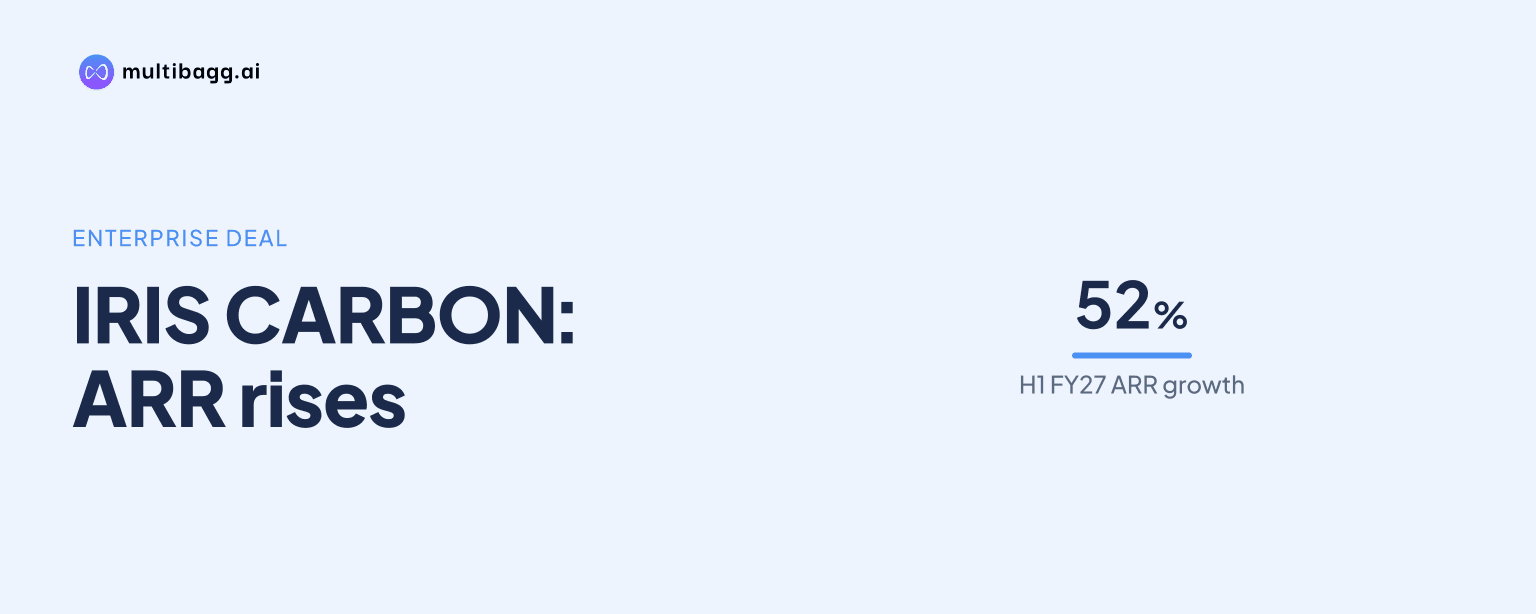
IRIS RegTech Solutions Limited said its IRIS CARBON annual recurring revenue, or ARR, rose 52% from March 31, 2026, during the first six months of FY27, supported by a large enterprise deal and a disclosure-management client base exceeding 50. IRIS is raising sales and marketing activity to expand recurring enterprise software revenue.
Know IRIS Regtech Solutions inside out
Results, valuation, peers and who's buying, in one view.
How fast did IRIS CARBON ARR grow?
IRIS CARBON ARR grew 52% from its March 31, 2026 level in the first six months of FY27. Management said a large enterprise deal contributed to the increase, while more than 50 clients were using the disclosure-management platform. IRIS did not disclose either the opening or closing ARR value, or the ARR contribution from that customer contract.
The increase came as IRIS reported revenue growth of more than 30% year on year in both the first and second quarters of FY27. Management said enterprise software traction, particularly at IRIS CARBON, supported that performance despite increasing global economic uncertainty. The company had previously discussed growing SaaS revenue at about 35% annually in the foreseeable future.
The 52% ARR movement was above that approximately 35% SaaS revenue objective at the FY27 halfway point, but the measures are not identical. ARR tracks recurring revenue on an annual basis, whereas management's 35% reference concerned SaaS revenue growth. IRIS said it had surpassed that target halfway through the year, while also saying more work remained to build the product, brand and partner network.
Why is IRIS increasing SaaS sales spending?
IRIS is increasing sales and marketing expenditure because management's stated focus is to grow enterprise SaaS ARR. In the first six months of FY27, management said it spent slightly less than $1 in sales and marketing for every $1 of net ARR gained, excluding the ARR from the large enterprise deal. It compared that ratio with its view that SaaS companies typically spend more than $1 to generate $1 of net ARR.
Management cautioned that the first-half relationship may not continue. It said the trend might not be easy to sustain and would need to be monitored, particularly as the company plans a higher sales and marketing outlay. IRIS has not disclosed a separate sales and marketing expense figure in the format discussed on the November 6, 2026 call.
The additional outlay is intended to build the IRIS CARBON brand in the U.S., strengthen the product and develop partnership networks. Management also said contracts being signed are generally for longer periods, giving the company revenue and margin benefits over a longer period than the initial customer-acquisition cost. It did not disclose average contract length, renewal rates or customer retention data.
An analyst asked for sales and marketing expenditure to be separately identified because expenses appeared to be rising faster than revenue. IRIS's chief financial officer said the company could consider presenting the expense separately going forward. Management said it would continue to provide an indication of how it was managing sales and marketing activity, without committing to a detailed standalone disclosure.
Got a follow-up? Ask IRIS
How does IRIS CARBON win replacement customers?
IRIS CARBON pursues replacement customers by presenting its product modules, support and structured-reporting capabilities when a prospect reviews its existing disclosure-management contract. Management said prospects commonly evaluate alternatives around contract expiry or renewal, so IRIS engages potential clients ahead of that decision point.
IRIS also cited eXtensible Business Reporting Language, or XBRL, capabilities, faster onboarding and Microsoft Office 365 integration as relevant parts of the offer. Management said many prospective clients already use Microsoft Office applications before the disclosure-management stage, making the Office 365 workflow more seamless. It said faster onboarding matters because changing disclosure-management systems can otherwise take a long time.
The sales process differs by prospect. Management said IRIS can conduct a proof of concept, limited dry run or workshop in which it sets up a customer's own document for evaluation. These activities allow users to test the platform before deciding whether to replace their existing system.
Artificial intelligence functions are included within products such as IRIS CARBON rather than sold separately. Management said it is rolling out those functions to existing enterprise and supervisory customers according to their requirements. The company did not describe AI as a separate business line or disclose revenue from those embedded functions on November 6, 2026.
What are the other growth drivers and risks for IRIS?
IRIS is seeking larger end-to-end automated reporting contracts through IRIS iDEAL, its solution for banking, financial services and insurance, or BFSI, customers. Management said it had recently completed one such implementation in India and was pursuing similar opportunities in India, Mauritius and Qatar. The company views end-to-end automation as both an upsell opportunity and a route to larger new-client deal sizes.
IRIS iDEAL has a longer sales cycle than the immediately reported IRIS CARBON ARR increase. Management said it had a few discussions developing but gave no expected closing dates or deal values. That leaves the timing of revenue from the India, Mauritius and Qatar opportunities unresolved as of the November 6, 2026 call.
In supervisory technology, or SupTech, management said global economic uncertainty, especially in the Middle East, affected anticipated new order intake. IRIS said it remained involved in several requests for proposal, or RFPs, and expected the second half of FY27 to be better. It also said it obtained additional work from existing SupTech customers during the period.
IRIS expanded its SupTech suite with risk-based supervision, licensing and other modules for regulators and government departments with supervisory responsibilities. Management said it seeks to use profits from SupTech and iDEAL partly to balance SaaS customer-acquisition costs and manage earnings before interest, tax, depreciation and amortisation, or EBITDA. It also said its cash position was comfortable while outlining plans for higher SaaS sales and marketing spending.
Conclusion
IRIS is shifting greater emphasis toward recurring enterprise SaaS revenue, with IRIS CARBON ARR up 52% from March 31, 2026 and the platform serving more than 50 clients in the first six months of FY27. The large enterprise deal aided that increase, while revenue grew more than 30% year on year in both Q1 and Q2 FY27.
The next measures to watch are whether higher ARR produces higher revenue as the third quarter unfolds, as management expects, and whether higher U.S. brand-building, product and partnership spending changes customer-acquisition economics. Management also pointed to potential second-half FY27 SupTech RFP conversions and long-cycle IRIS iDEAL discussions in India, Mauritius and Qatar, while Middle East uncertainty remains unresolved.