










IRM Energy Limited Targets 15% H2 EBITDA Margin Despite Q3 Hit
Key highlights
- IRM Energy targets an EBITDA margin of about 15% for H2 FY27, versus a 16.5% H1 FY27 margin cited on the call.
- MoPNG changed HPHT gas allocation methodology on 3 September and introduced phased relaxations on 19 October.
- Management said around 80% of the HPHT allocation issue had been corrected by the Q2 FY27 earnings call.
- IRM Energy expects the transition to affect sourcing costs for around 20 days to one month and weigh on Q3 FY27.
powered by IRIS
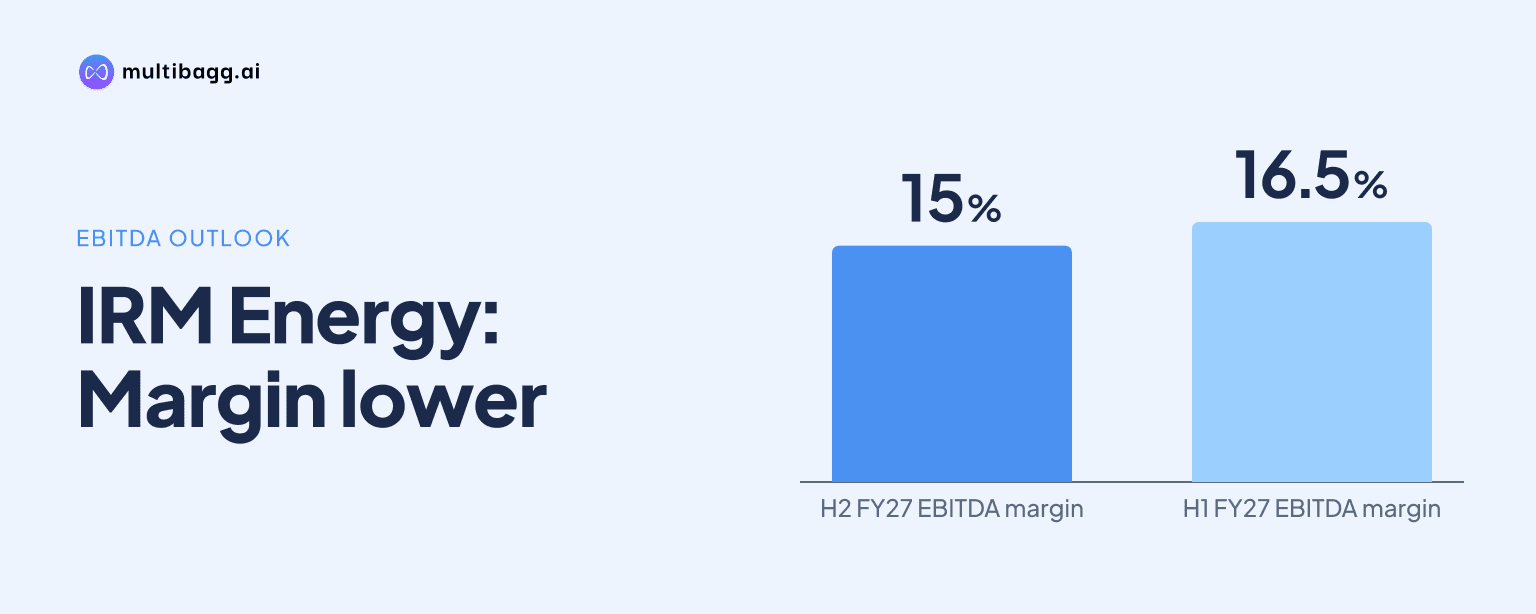
IRM Energy expects a temporary Q3 FY27 margin impact from higher gas sourcing costs after a September HPHT allocation change, but management targets an EBITDA margin of about 15% in H2 FY27. By the Q2 FY27 earnings call, management said the government had corrected around 80% of the issue.
Know IRM Energy inside out
Results, valuation, peers and who's buying, in one view.
Why does IRM Energy expect a Q3 FY27 margin impact?
IRM Energy expects Q3 FY27 to be affected because its gas sourcing cost rose during a transition period of around 20 days to one month. Management said its immediate concern was Q3 FY27, even though the government had substantially amended the domestic HPHT gas allocation framework by the time of the call.
The disruption followed a 3 September notification from the Ministry of Petroleum and Natural Gas, or MoPNG, that revised the allocation methodology for HPHT gas. IRM Energy said its smaller scale relative to certain other market participants meant that the change affected its HPHT allocation, requiring the sourcing team to address a shortfall during the transition.
Management did not give a precise Q3 FY27 EBITDA margin forecast or a rupee-per-SCM estimate of the impact. It said spot gas prices remain volatile, while sourcing costs can also move with Brent prices and the dollar exchange rate, making a specific outlook for Q3 FY27 and subsequent quarters difficult.
An analyst cited IRM Energy's H1 FY27 EBITDA margin at 16.5% during the call. Management's H2 FY27 target of about 15% is therefore below that H1 FY27 level, reflecting temporary cost pressure from the altered HPHT allocation and market-price volatility.
What changed in IRM Energy's HPHT gas allocation?
IRM Energy said the 3 September MoPNG notification changed the methodology used to allocate HPHT gas across companies, reducing its allocation as a relatively smaller player. Management said the earlier approach was more favourable to smaller bidders that bid higher in auctions and received higher allocations at a relatively lower price of around USD 9.
On 19 October, MoPNG introduced relaxations under which the revised allocation process would be applied in phases. Management said this action had corrected around 80% of the issue, although it also said the matter was not fully resolved during the Q2 FY27 earnings call.
IRM Energy's sourcing team has arranged a longer-term supply arrangement to balance the HPHT gas shortfall. Management presented that arrangement as part of its response to the transition, but still expects some Q3 FY27 effect because sourcing costs rose before the phased revised framework took effect.
The call did not quantify the volume of HPHT gas lost, the incremental sourcing cost, or the share of total gas procurement covered by the longer-term arrangement. Management instead described the position as dynamic and said it would manage the sourcing portfolio rather than provide exact quarterly guidance.
Got a follow-up? Ask IRIS
Can IRM Energy maintain about 15% EBITDA margin in H2 FY27?
IRM Energy said it remains confident of maintaining an EBITDA margin of around 15% for H2 FY27 despite the expected Q3 FY27 impact. This is management's stated outlook, and it followed the 19 October phased relaxation in the HPHT allocation methodology.
The target compares with the 16.5% H1 FY27 EBITDA margin cited by an analyst on the call. A margin near 15% is about 1.5 percentage points below that H1 FY27 level, indicating that management expects the Q3 FY27 sourcing disruption to be contained across the full second half rather than permanently alter its cost base.
Management declined to specify whether Q3 FY27 or later quarters would reach a particular margin percentage. It said it would not provide exact guidance in rupee-per-SCM terms because spot gas prices can change with market conditions and the HPHT allocation issue was only around 80% corrected.
The margin plan relies on sourcing portfolio management, cost optimisation, operating-cost efficiency and better use of existing assets. Management also said it expects conditions in the natural-gas sector to improve gradually over the next six months, without providing a quantified earnings forecast for IRM Energy.
How is IRM Energy protecting margins without raising prices too far?
IRM Energy said it has passed on price increases where necessary to protect margins, but it may absorb part of a cost increase for a period if needed to keep compressed natural gas, or CNG, below petrol prices. Management said CNG priced above petrol in a state could affect consumer psychology, new vehicle conversions and market expansion.
Management said consumers had accepted price actions as liquefied petroleum gas prices remained on a higher trend and alternative fuels such as furnace oil were also not favourable. It warned, however, that a war-like situation continuing for another six months could worsen conditions across the city gas distribution sector.
For industrial customers, IRM Energy must also consider competition from coal and other alternatives. Management said National Green Tribunal orders are in place, while consent-to-establish and consent-to-operate approvals for new industries are increasingly linked to natural gas and cleaner fuels; some existing steel rolling plants, however, may consider alternative fuels because of pressure from imported steel.
Asset utilisation is another element of the response. IRM Energy is providing compression services to BPCL in Namakkal and Trichy, where it has LCNG stations, and management said it is open to using spare compression capacity for another company or geographical area where it can earn a margin.
Conclusion
IRM Energy's H2 FY27 outlook rests on management's expectation that a roughly 20-day to one-month sourcing-cost disruption will be temporary. The company expects Q3 FY27 to absorb some impact from the 3 September HPHT allocation revision, while the 19 October relaxation and a longer-term supplier arrangement underpin its target of about 15% EBITDA margin for H2 FY27, compared with the 16.5% H1 FY27 margin cited on the call.
The next issue to watch is whether the remaining portion of the HPHT allocation issue is resolved and whether sourcing costs stabilise in Q3 FY27. Management did not provide a precise quarterly margin forecast, so the Q3 FY27 result will indicate how price pass-through, sourcing changes and compression-asset utilisation offset the transition cost.